Connect with us

Business

When the media missed the message: Benioff clarifies meaning on multiple levels
Published

on


Communications scholar Marshall McLuhan’s prescient 1964 bestseller, Understanding Media, argued that “the media is the message,” in which the technology overtakes the spoken words it transmits. In fact, the core messages can get garbled if the media can’t keep up with the intended meaning. Ironically, the media echo chamber initially misunderstood key messages from Salesforce founder Marc Benioff about the safety context of the San Francisco-based Dreamforce extravaganza, as well as the nature of the technology it was showcasing.  

To many people, the firestorm that quickly engulfed Benioff after a buzzy New York Times interview this month seems deserved—just another Big Tech CEO pusillanimously rebranding their politics to gain the favor of President Trump and seeming to endorse a declaration of martial law. A Bloomberg columnist went even further, calling the comments “more than the general bootlicking.” An AdWeek contributor declared, “Dance with politics and you often lose half the market. Sometimes all of it.” 

But those presumptions are lazy attempts to understand how a prominent figure in the Bay Area community takes responsibility for leading his company. What was a legitimate safety concern became a political drama. Such shortsightedness is not only plain wrong but also another example of how every word is weaponized in the American society of 2025. 

Benioff shows how leaders shape context and meaning

Benioff is a seasoned leader, familiar with navigating through this sort of myopic thinking. Many CEOs could have been overwhelmed by the daunting challenge of simultaneously mastering media misconceptions on multiple fronts. But instead of tripping in frustration, Benioff rose to the threefold leadership challenge of correcting a media misunderstanding, pulling off another tentpole event for his company, and contributing a major economic boost to his beloved San Francisco.

A devoted booster of San Francisco, Benioff has long been an advocate for public safety and a sponsor of increasing police protection and staffing levels. And his controversial interview was ambiguous on its face, and appears to have been parsed in a manner meant to capture headlines instead of providing the intricate truths. The key quote was about the National Guard: “We don’t have enough cops, so if they [the National Guard] can be cops, I’m all for it,” he said. This has to be understood in the context of the Trump administration sending the National Guard into several cities across the country on the pretext of an out-of-control crime wave—one that’s contradicted by most statistics. Benioff advocating for the National Guard to invade San Francisco was  construed to seem as a long-time liberal, benevolent billionaire making a heel turn into the Trump camp, a move that so many Silicon Valley oligarchs have made.

And yet. The very same New York Times journalist who interviewed Benioff has also reported on perceived safety concerns in San Francisco herself over the past nine months. She has covered newly elected Mayor Dan Lurie’s efforts to roll back highly questionable open-drug-use policies, such as “the free distribution of clean foil, pipes, and plastic straws on the streets of San Francisco.” In another article, the same reporter quoted Lurie saying, “widespread drug dealing, public drug use, and constantly seeing people in crisis has robbed us of our sense of decency and security.” 

Benioff clarified his National Guard comments in subsequent days leading up to Dreamforce, without backing off his long-running concerns over public safety. “I do not believe the National Guard is needed to address safety in San Francisco,” he posted on X. “I sincerely apologize for the concern it caused … It’s my firm belief that our city makes the most progress when we all work together in a spirit of partnership.” In fact, President Trump then backed off his threats to send the National Guard after speaking with Benioff, Nvidia CEO Jensen Huang, and Mayor Lurie.

At Dreamforce the next day, he told CNBC’s Jim Cramer that he “just want[ed] the city to be as safe as possible” ahead of the conference. Benioff has numerous reasons to personally ensure the event succeeds, both as a CEO and as a community philanthropist. Unfortunately, like many major cities, San Francisco has a shortage of police officers—500 officers, according to the San Francisco Police Department, or an understaffing of more than 20%.

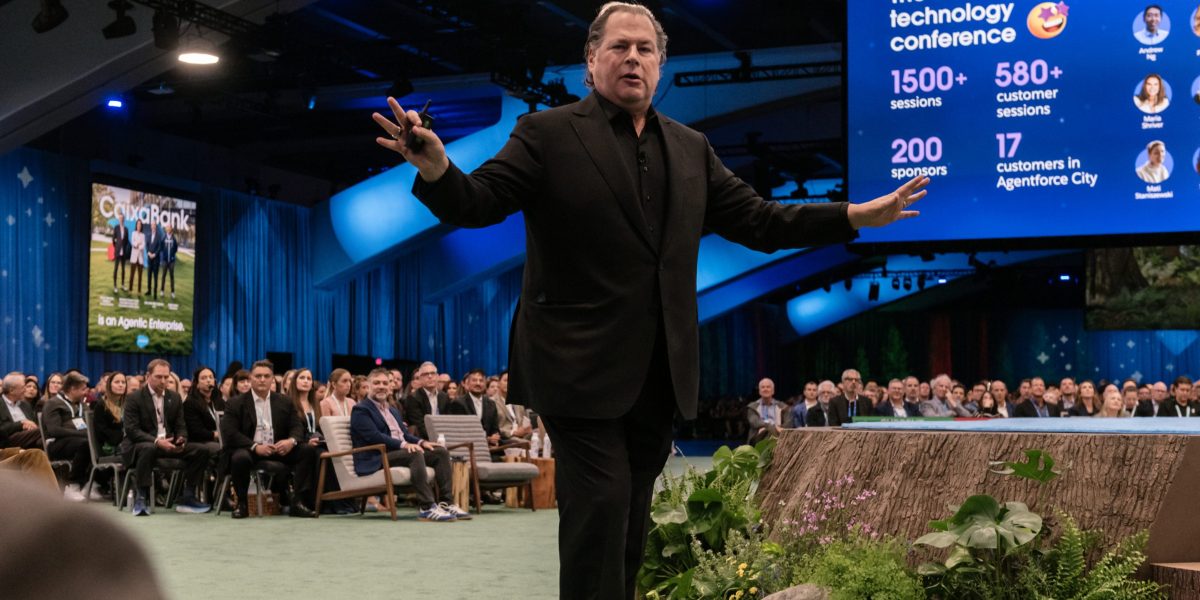
Each year, Dreamforce brings nearly 50,000 people to downtown San Francisco for three days of major keynotes, customer-led discussions, product demos, hands-on learning, and community building. Millions of viewers watch online. Attendees this year included the biggest names in business, such as Dell Technologies’ Michael Dell, Starbucks’ Brian Niccol, and FedEx’s Richard Smith, as well as everyday users of Salesforce products. The economic impact on San Francisco is estimated to generate $130 million in revenue for the city and create 35,000 local jobs.

And then there’s Salesforce’s importance for the wider tech sector, especially in the artificial intelligence (AI) space. Its nascent systems are unlike traditional AI models, which operate within predefined constraints and require human intervention. Salesforce’s agentic AI provides autonomy capable of making its own decisions, planning, executing complex multi-step workflows, and adapting to changing circumstances without being driven by the constant human intervention of generative AI models such as OpenAI, Anthropic, Perplexity, Gemini, and Grok.

The market has not been impressed. Salesforce’s stock is down nearly 25% year-to-date, while competitors such as Microsoft (up 25%), Oracle (up 70%), and SAP (up 10%) have seen solid gains. Markets have continued to focus on quarterly results rather than the extraordinary potential in Salesforce’s burgeoning agentic AI capabilities.

Like the partisan preconceptions surrounding Benioff and his New York Times interview, the faulty assumptions about Salesforce’s future performance are missing the bigger picture. Or as CNBC’s Cramer said, you cannot miss “the forest for the trees” when it comes to Benioff’s long-term vision. The market gave a hint of agreement, as Dreamforce was hailed as a massive success. The market even offered a rare reprieve, sending Salesforce’s stock up by almost 5%. 

The leap into agentic AI

Agentic AI “isn’t vaporware or beta testing,” Benioff explained to Cramer at Dreamforce. The Salesforce CEO used the annual event to deliver an impressive showcase of the revolutionary technology in real-world applications by some of the world’s largest companies. 

FedEx has realized “hundreds of millions of dollars” in new revenue by converting customers to use international services in addition to domestic. These AI-powered insights have allowed the shipping giant to capture market share from competitors.

Williams-Sonoma expects over 60% of chat inquiries to be resolved autonomously through applications such as “Olive,” an automated sous-chef agent that provides personalized menu planning, shopping lists, and product recommendations. 

More than 12,000 other customers, including OpenTable, Reddit, and Under Armour, have already adopted Salesforce’s agentic AI technology, Agentforce, for use as sales agents, supply chain management, and IT service management, among others. The tens of thousands of deployments led to a 119% surge in agent creation during the first half of the year and have resulted in the Data and AI business segment reaching $1.2 billion in the most recent quarter, a year-over-year growth rate of 120%. 

The visionary who bet early

Given all the hype around agentic AI, why has Salesforce seen lackluster performance over the last five years? The answer is simple: Marc Benioff has been thinking long-term, transforming Salesforce for the age of AI. It began as early as 2014, in an all-hands meeting, when Benioff boldly told employees and shareholders that “Salesforce will become an AI-first company.” And the vision became reality as early as 2016, with the introduction and integration of Einstein into the Customer Resource Management (CRM) platform, enabling more predictive and personalized customer experiences. 

Strategic acquisitions—from Tableau to Slack to MetaMind to Airkit—and major R&D initiatives have each contributed to Salesforce’s unique first-mover advantage in agentic AI. The company has invested more than $10 billion in R&D in the technology since fiscal year 2024, shipping four iterations of Agentforce. Salesforce is not just adding basic AI features, like another duplicative LLM. Instead, Benioff is advancing his fundamental transformation of how the business operates into an “era of Agentic Enterprise.” 

The founder and chief executive is so confident in the potential of Agentforce and Salesforce’s other AI technologies that he announced a new long-term revenue target of over $60 billion by fiscal year 2030, suggesting a 10% organic compounded annual growth rate for the next five years. Even Michael Dell appears to buy into the potential as well, telling Dreamforce attendees that Agentforce would “reinvent his whole company.”

Unfortunately, short-term-oriented financial markets do not always reward the interim progress of visionaries. Perhaps with the successes presented at Dreamforce 2025, investors will begin to understand where Benioff is taking Salesforce. While the tech world debated whether agentic AI was hype, Benioff was already building it, deploying it, proving it, and restructuring his entire $40 billion company around it. This is the mark of a visionary—not waiting for consensus, but creating the future while others pontificate about it. 

History will not remember the distortion of a CEO’s vague phrasing about event security in October 2025; it will, however, remember the visionary who declared “AI-first” and delivered the enterprise AI revolution that is now transforming how the world’s top companies operate. True leadership is not about flawless words but about conveying electrifying meaning.  This requires nimble responses, perfect timing, and unwavering execution. 

Recent neurological research by the University of Rochester on multitasking reveals that versatile brains can complete complex cognitive tasks simultaneously. Still, many do not know how Benioff skillfully juggled concurrent leadership tasks, doing more than the “one thing at a time,” a display of unidimensional focus so often preached by coaches. Leaders must not only walk and chew gum at the same time, but multitasking becomes especially critical when they accidentally step on the gum. 

The opinions expressed in Fortune.com commentary pieces are solely the views of their authors and do not necessarily reflect the opinions and beliefs of Fortune.


Source link

Continue Reading

Business

Trump’s postal chief says cuts have gone too far: ‘we cannot cost-cut our way to prosperity’

Published

on


Steiner said the 150-year-old agency needs to expand its revenue base to restore prominence in the nation’s delivery network. It also should capitalize on its long-standing legal obligation to deliver to every address.

One way it can do that, Steiner said during the Postal Board of Governors meeting in Washington, is by working with more customers to provide final or “last mile” delivery to individual home and businesses, the most expensive and labor-intensive part of delivery.

“I’ve taken to saying that we cannot cost-cut our way to prosperity,” Steiner said. “We have to grow.”

Steiner said the postal service, which has faced an uncertain future since President Donald Trump’s election to a second term, is currently negotiating deals with private parcel delivery service UPS and similar companies to expand its last-mile service for the final leg of delivery. He said USPS also wants to open up that program to large and small retailers, offering same-day and next-day delivery.

“We’ve begun discussions with a number of retailers and the desire for fast, reliable and affordable delivery is certainly strong among all retailers,” he said. “Our value resides in going to every address six and often seven days a week while offering a remarkable retail and processing footprint.”

Steiner, who began as postmaster general in July, was previously a board member of the FedEx delivery service.

Postal service faces major financial challenges

While a new financial report released Friday showed operating revenue of $80.5 billion, an increase of $916 million from last fiscal year, the postal service suffered net losses totaling $9 billion. It marks a slight improvement from the previous fiscal year, when the net loss was $9.5 billion.

Amber McReynolds, who was re-elected chair of the Postal Board of Governors on Friday, said “long-standing and unnecessary restrictions” are weighing down USPS’s bottom line and “highlight the urgent need for executive and legislative action” so the postal service can be financially sustainable for the long-term. USPS is an independent and mostly self-supporting federal agency.

She said the postal service is currently required to pay a “disproportionate share” into its retiree system compared to other federal agencies. It’s also only allowed to invest postal retirement funds in treasury securities, losing out on hundreds of billions of dollars that could be invested in a diversified portfolio, she added.

McReynolds also called for congressional updates to USPS’s pricing system, its workers’ compensation program and its borrowing limits, which haven’t been changed since 1991.

“This is urgent and it is time for action,” she said.

Steiner warned Friday there’s also a need to cut costs at the post office, be more efficient and use innovative methods, including bringing artificial intelligence into the USPS logistics network.

“To do all of this, we need capital and the ability to leverage our assets,” he said. “We should be able to borrow like our competitors, who are not limited by statute.”

Sticking with modernization plans

Steiner, who said he has visited more than 20 postal facilities and spoken with thousands of postal workers and stakeholders during his first 100 days on the job, made it clear Friday he plans to mostly stay the course with the $40 billion, 10-year modernization and financial stabilization plan launched by his predecessor, Louis DeJoy.

He said the progress made so far has empowered the USPS to “reach new levels,” noting on-time mail delivery has been steadily improving and most customers can expect delivery of their mail and packages in less than three days on average. However, he said more improvements are still needed.

With the busy holiday season looming, Steiner said the postal service is ready, noting $20 billion has been spent over the past four years on mail processing and logistics modernization. Also, due to a “stabilized workforce,” only a “modest” number of seasonal employees of roughly 14,000 people will need to be hired.

While multiple members of the public on Friday voiced concerns about the postal service possibly being privatized, an idea raised by President Donald Trump and his former adviser, Elon Musk, McReynolds tried to quash the notion.

“There are no proposals or plans to privatize the postal service,” she said. “The new postmaster general has talked at length about that in his public comments and the board certainly has shared that sentiment as well.”


Source link

Continue Reading

Business

The day the crosswalk music died: Iconic Buddy Holly Glasses to be lifted from hometown crosswalk on Trump directive

Published

on


Fans of the Buddy Holly crosswalk in his hometown of Lubbock, Texas, with a painted depiction of the rock and roll legend’s iconic glasses, will soon have to say goodbye to it. That’ll be a day that will possibly make them cry.

Lubbock City Council members said this week they have no choice but to remove it, to comply with a directive from the Trump administration and Republicans to rid the public roadways of any political messages or artwork.

Laredo, in South Texas, removed a mural in October that protested the border wall along the southern border with Mexico. In August, Florida officials removed a rainbow-colored crosswalk outside the Pulse nightclub where 49 people were gunned down.

Lubbock’s crosswalk was first installed in 2020 and is near the Buddy Holly Center, a downtown museum with exhibits honoring Lubbock’s most famous native son.

“It’s such a tasteful cross section and people like it. But what do you do?” said City Council Member Christy Martinez-Garcia, who was among those questioning why it had to go.

Lubbock received a letter from the Texas Department of Transportation with “some harsh wording” that threatened the possible loss of state or federal funding for road projects if such artwork was not removed, David Bragg, Lubbock’s interim division director of public works, told council members on Tuesday.

“This was very broad letter. I don’t think it was intended to go after, say, the Buddy Holly glasses. Unfortunately it did,” Bragg said.

Mayor Mark McBrayer said the city had no choice but to comply.

“Probably everybody here got some communication from people wanting that not to be the case,” McBrayer said. “But I don’t really feel like we have the wherewithal to do anything about that without trying to litigate it and I don’t think there’s any appetite here anyway.” Bragg said the removal will happen during normal maintenance next year.

On Oct. 8, Abbott directed the department to ensure that all Texas cities and counties are in compliance with federal and state guidelines on roadway safety and that symbols, flags and other markings conveying social or political messages are prohibited, as well as any signage and signals that don’t directly support traffic control or safety.

“Texans expect their taxpayer dollars to be used wisely, not advance political agendas on Texas roadways,” Abbott said in a statement.

Abbott’s office did not immediately respond to an email seeking comment on Friday.

Abbott’s directive came after Trump’s Transportation Secretary Sean P. Duffy sent letters to all U.S. governors in July saying that intersections and crosswalks must be kept free from distractions.

“Roads are for safety, not political messages or artwork,” Duffy’s statement said.

Holly was born and raised in Lubbock, located in northwest Texas. He decided to play rock and roll music after seeing Elvis Presley perform in 1955. His best known songs include “That’ll Be the Day,” ’’Rave On” and “ Peggy Sue.”

Holly was only 22 when he died in a Feb. 3, 1959, plane crash near Clear Lake, Iowa, that also killed Ritchie Valens and J.P. “Big Bopper” Richardson. The three rockers’ deaths were immortalized in Don McLean’s 1971 song “American Pie,” and became known as “the day the music died.”


Source link

Continue Reading

Business

Despite AI bubble fears, Warren Buffett’s Berkshire Hathaway buys shares of hyperscaler Alphabet

Published

on


Wall Street has been consumed for months with fears that the artificial intelligence boom is actually a bubble about to pop, but that didn’t stop Berkshire Hathaway from buying shares of a top AI hyperscaler.

Warren Buffett’s conglomerate revealed in a regulatory filing late Friday that it purchased 17.8 million shares of Google parent Alphabet during the third quarter. The stock jumped 4% in after-hours trading yesterday.

It was the biggest stock addition last quarter and was worth about $4.3 billion at the end of September. Berkshire also bought shares of Chubb, Domino’s Pizza, Sirius XM and Lennar.

Meanwhile, Berkshire maintained its position in Amazon, another AI hyperscaler, in the third quarter.

The addition of Alphabet comes amid a massive rally. Even after the most recent AI-fueled stock market selloff, Alphabet shares are still up 46% this year.

To be sure, Alphabet has been on Berkshire’s radar in the past. In 2019, Buffett’s right-hand man at the time, the late Charlie Munger, admitted that he felt “like a horse’s ass for not identifying Google better. I think Warren feels the same way.”

Back then, Google’s dominance in search piqued Berkshire’s interest. But today, the company is among the tech giants leading the charge into AI.

Alphabet, Amazon, Meta Platforms and Microsoft alone are spending hundreds of billions of dollars a year with no signs of a slowdown.

Morgan Stanley has estimated AI hyperscalers plan to spend about $3 trillion on data centers and other infrastructure through 2028.

The relentless capital expenditures, much of which is coming via debt, have made Wall Street nervous about whether AI companies will be able to translate all those outlays into sustainable revenue and profits.

With Buffett due to step down as Berkshire’s CEO by year’s end, it’s not immediately clear whether he, successor Greg Abel, or another top executive made the call to buy Alphabet stock.

And investors may not hear directly from the “Oracle of Omaha” on the matter. In a letter published Monday, Buffett said he’ll be “going quiet,” and will no longer write Berkshire’s annual report, nor talk “endlessly” at the annual meeting.

Leading up to Buffett’s departure, Berkshire has been taking a cautious stance on the stock market as well as company acquisitions, sending its cash pile to record highs.

Buffett’s closely followed stock portfolio continued to shrink overall, as last quarter marked three straight years of net selling. The most recent round of selling included more shares of Apple, which Berkshire has been steadily offloading for more than a year.


Source link

Continue Reading

Trending

Copyright © Miami Select.