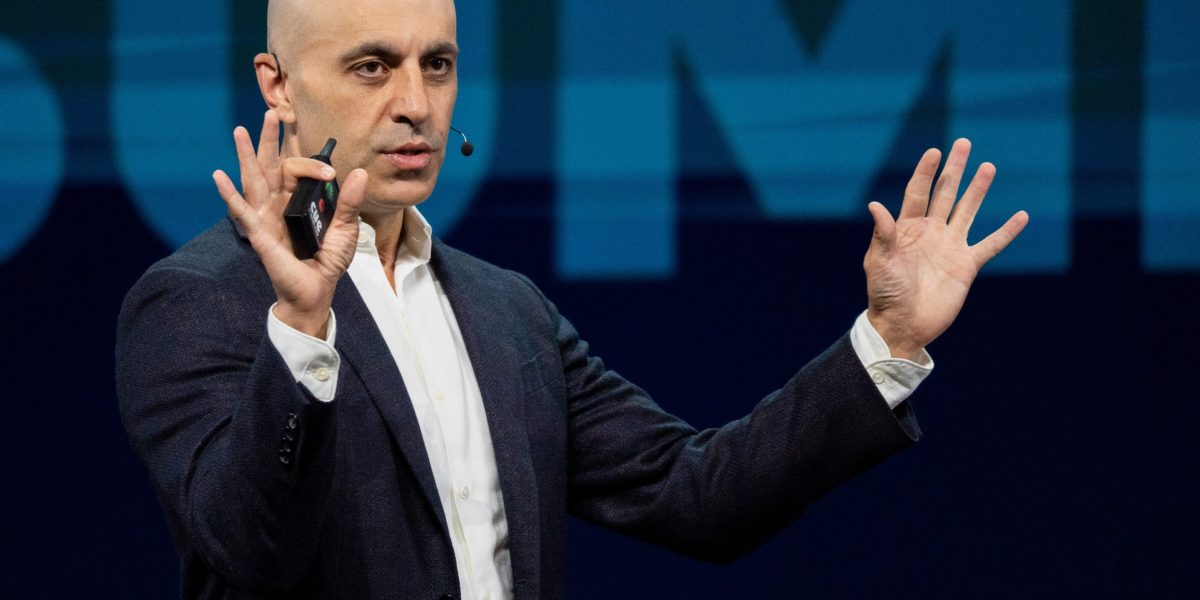
“I try to compress the calendar,” Ghodsi said on a recent episode of the Long Strange Trip podcast. “What I mean by that is I try to put nothing on the calendar. It ends up being packed anyway, but there are many blocks that are free where I can go back to this main thing.”
At 8 a.m. every Monday, Wednesday, and Friday, Ghodsi said he and his team meet to identify that “main thing”—essentially, the biggest bottleneck facing the company and how they can work together to solve it.
“I want to unblock that big thing that I think is the thing that’s going to get us 10x,” he said.
Other than that, Ghodsi said he wants to avoid other meetings being put on his calendar. A day with back-to-back meetings isn’t just exhausting—it can mean losing control of his own schedule.
“I think if I do the 8 a.m. back-to-back-to-back-to-back-to-back-to-5 or 6 p.m., I consider those days I’ve just been a slave to my calendar. I’m just working for my calendar,” he said. Instead of focusing on his own priorities, he’s spending the day working through everyone else’s demands: “Monkeys on my back, right?”
Fortune reached out to Databricks for further comment.
CEOs are pushing back on unnecessary meetings and bad etiquette
In a business environment where companies are constantly being pushed to move faster, it can be tempting to solve every problem with another meeting—and invite a handful of stakeholders.
However, meetings can quickly become distractions themselves, filling up with small talk, veering off topic, or getting bogged down in corporate jargon. In fact, a 2024 survey by software giant Atlassian found that nearly three out of four meetings are ineffective at disseminating information. And for 77% of respondents, meetings simply create more meetings.
And while Ghodsi leads a relatively young company, CEOs at more established businesses have echoed his concerns that calendars packed with meetings can get in the way of actually getting work done.
Southwest Airlines CEO Bob Jordan warned last year that leaders can easily mistake being busy for being effective.
“When you first start, it’s easy to confuse busyness and going to meetings with leadership,” Jordan said on a panel of CEOs at The New York Times DealBook Summit in December 2025. “…Because what we all find, I’m sure, is there’s no time to ‘work,’ and you confuse going to meetings with the work.”
United Airlines CEO Scott Kirby has taken a more concrete approach to protecting that time: He caps his meetings at four hours a day—and sets strict rules for when a meeting is convened.
“My meetings are also quick, and my meetings are almost all conversational,” Kirby said in a recent interview with Semafor. “I want to talk—really, don’t go through decks. If you want to send a deck, send it to me in advance, and then we’re just going to talk about it. But you’re not going to read slides to me.”
Fewer CEOs have been more blunt about their disdain for meetings than JPMorgan Chase CEO Jamie Dimon, who put his philosophy plainly in his 2024 letter to shareholders: “Kill meetings,” he said.
But that doesn’t mean every meeting is useless. Instead, he expects them to be treated with the same focus brought to any other important work.
“When I go to a meeting, I’ve done the pre-reads, and you get 100% of my attention,” Dimon said at Fortune’s 2025 Most Powerful Women summit.
“None of this nodding off, none of this reading my mail,” Dimon added. “If you have an iPad in front of me and it looks like you’re reading your email or getting notifications, I tell you to close the damn thing. It’s disrespectful.”