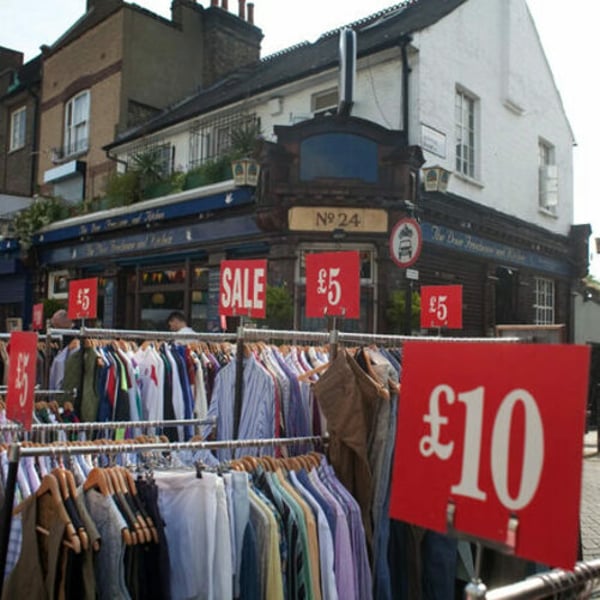
Frugality has been part of the UK’s national mood of late, as cost-of-living pressures take a toll and less wasteful consumer choices become a marker of good taste. Even better-off consumers are increasingly buying second-hand goods and repairing rather than replacing.
Bloomberg
Call them Britain’s thrifty rich. About 40% of families earning more than £83,000 ($112,000) a year shop second-hand, fix items and do their own home improvements more frequently than they did three years ago, according to a Retail Economics survey shared with Bloomberg News. That’s compared with a third of households overall. The main reason high earners gave for the change in their shopping habits was seeking better value for money.
“We see buying less but better, we see extending the life cycle of an item through repair and re-commerce,” said Anita Balchandani, a McKinsey & Co. senior partner who leads the company’s UK consumer and retail practice. She added that habits like resale buying are increasingly a sign of taste for some, whether that’s celebrities like Zendaya or Dua Lipa wearing vintage or luxury London department store Selfridges offering second-hand designer items.
Josephine Kllokoqi, a former luxury fashion buyer who lives in east London, says she felt self-conscious about shopping at charity shops back in the 1990s, when she was growing up. Now, she turns to resellers when something catches her eye in stores and enjoys dressing her toddlers in vintage finds.
“I’m checking Vinted, I’m checking Vestiaire Collective,” she said. “It will be less expensive than retail price and it’s better for the environment.”
Savings intentions among the top 20% of British earners — households with an income of more than £50,000 a year — have almost doubled since Covid, according to a Bloomberg analysis of GfK data. That’s a significantly bigger jump than among consumers overall. Meanwhile, affluent shoppers’ appetite for splashing out on high-value items like cars or jewelry has remained largely unchanged, the data show.
The growing demand for reuse and repairs is showing up in Richmond, a suburb of London that is among the UK’s most affluent neighborhoods.
Operating out of a local church, the Fixery is a council-run community hub where Richmond residents can swap clothes, buy washing-up liquid refills and get their vacuum cleaners repaired. Since opening in March, the Fixery’s volunteers have revamped dozens of electrical items, textile pieces and bicycles.
“It greatly reduces our waste and keeps beloved items in use for longer,” said Elizabeth Gant, a local councilor. While the initiative is part of Richmond’s plan to cut waste and carbon emissions, cost of living is also a factor. “It’s about recognizing value in what we already have,” she said.
Laura Pemberton, a 35-year-old teacher and mother of two, brought her second-hand Yoyo stroller to the Fixery for a free repair job after a wheel broke. Bought new, the brand’s lightweight, foldable strollers can go for hundreds of pounds. “They cost a lot of money, which is why we got it second-hand,” Pemberton said. “We don’t want to replace it because we love it.”
Living standards in the UK have deteriorated slightly since Labour came to power in 2024, adding to the pressure on households still reeling from the post-Covid inflation shock. Back then, about a third of “financially distressed” families planned to buy second-hand products more often, twice as many as among the “comfortable cautious.”
Now, households across the board are facing energy-bill hikes and shrinking pay rises. While wealthier consumers are still the most willing to spend on big-ticket items, costs for higher-income families are rising faster than for lower-income ones for the first time since early 2025, mainly due to petrol costs, as well as restaurant and hotel price increases, according to recent figures from the Office for National Statistics.
“We talk about food, fuel, but the luxury basket has also inflated,” said McKinsey’s Balchandani, adding that “it’s now much more socially, culturally relevant and acceptable” to buy second-hand items or cheaper brands.
Two-thirds of consumers bought second-hand goods last year, according to research by the Centre for Economics and Business Research, while average monthly spending on used items has more than doubled in five years to £124.80.
Amazon.com Inc. has introduced an event offering discounts on second-hand items. UK consumers saved £95 million last year buying pre-owned items rather than new ones, according to the company. This year’s event began on Sept. 1, with discounts on items including “pre-loved” designer bags. High-end names like Prada SpA-owned shoemaker Church’s, luxury luggage company Rimowa and leather-goods brand Mulberry also advertise repair or refurbishment services.
Aggressive price increases by luxury brands after Covid are pushing aspirational shoppers towards the second-hand market, according to Charlotte Staerck, chief executive officer of the Handbag Clinic, which repairs and resells designer bags. Some pieces can cost nearly twice as much new as they did in 2019.
A decade ago, “that level of luxury was attainable, if you worked hard and saved up,” she said. “I’ve really felt that gap shift.” Her business now receives as many as 150 requests to sell bags a day, almost double pre-Covid levels, with more sellers taking immediate cash offers, even at a discount.
Back in Richmond, 78-year old Patsy Harper came to the Fixery to repair her bike, a gift from her late partner. She’s already thinking about her next repair-and-reuse project: turning a pair of blue-and-yellow curtains bought years ago from a charity shop into a duvet cover.
“What people throw away is ridiculous, absolutely ridiculous,” Harper said. “Particularly in good areas, people just get rid of things so quickly, and they could easily be modified.”