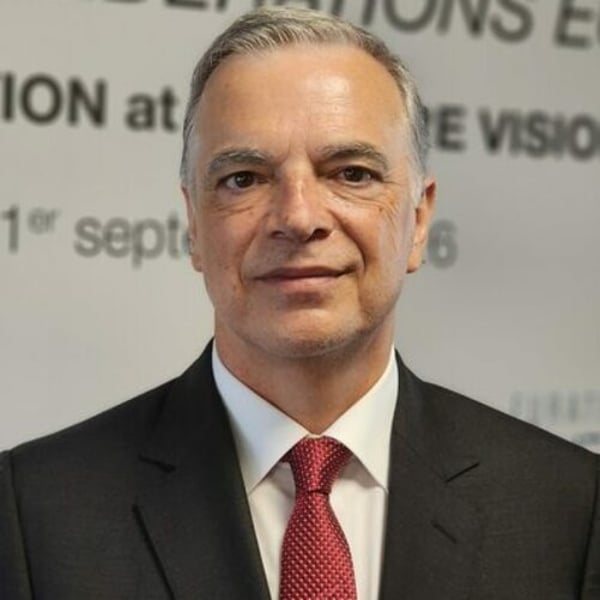
At a meeting of European textile and clothing federations in Paris on Tuesday, the president of the Euratex confederation, Mario Jorge Machado, told FashionNetwork.com about the inadequacy of the tax on small parcels, the continuing damage across the sector, and the strength of European production in the face of Donald Trump’s tariff wars.
Mario Jorge Machado – MG/FNW
FashionNetwork.com: The €3 tax on small parcels will soon be supplemented by handling fees that could range from €2 to €4. Why do you feel these amounts are insufficient?
Mario Jorge Machado: It’s clearly not enough. It’s a small step towards what we’re asking for, namely a level playing field. We cannot continue, in effect, to give European consumers a tax incentive to shop outside Europe, because we are effectively granting a discount on customs duties if they buy from outside Europe. It’s complete nonsense. What’s more, we have no control over the products entering Europe. Consequently, when European consumers shop online and the product enters the EU, they assume it automatically complies with EU requirements. But that is not true. We do not know how that product was manufactured or what chemicals it contains.
Then there is the social dimension, about which we know nothing. There is now EU legislation against forced labour, yet we do not know whether the products arriving in parcels have been manufactured under forced-labour conditions. This is because there is a complete lack of transparency in the exporting countries. We must therefore demand far greater transparency and compliance with the same requirements that, by contrast, we impose on European producers. We are in favour of free trade, but we want it to be fair and transparent.
FNW: Taxation on small parcels is not based on the number of items but on the number of product categories. Why do you consider this to be a missed opportunity?
MJM: Yes, it is a mistake. I fully understand that, technically, applying anything beyond this €3 charge could create far more complications, and that it is better to have something than nothing. Nevertheless, I believe we must rectify this point. And the other point I raised with representatives of the European federations is that we need to check whether these platforms are now starting to import in bulk precisely to avoid paying that €3 fee, by placing goods in European warehouses and then dispatching them from there.
FNW: Such as the one set up in Poland by Shein, for example?
MJM: Yes, like those in Poland. We must therefore be vigilant, because ultra-fast fashion must not be allowed to find further loopholes in European legislation that it would exploit to repeatedly circumvent the rules and avoid this tax, which has already required a great deal of work.
FNW: Aside from the parcel tax, France has introduced a law against ultra-fast fashion. Do you think an equivalent at European level would be desirable?
MJM: Yes, and Europe has been aware of this for some time. It all began a few years ago when the European Commission said, ‘We are fighting fast fashion; we must move towards slow fashion.’ Yet today, the outcome of the legislation put in place is that we haven’t eliminated fast fashion; instead, we’ve created ultra-fast fashion. We’re therefore doing something wrong with the legislation we’re implementing. We need to act, which is why we must create legislation that moves us towards a more sustainable fashion industry. And moving towards a more sustainable fashion industry clearly cannot be achieved through ultra-fast fashion.
MJM: Across Europe, we can see that we continue to lose businesses and jobs. Every month, textile companies are closing down in Europe. When you’re competing with another region of the world that doesn’t have the same requirements (and in Europe we have the highest production standards), when you face the highest energy costs, and when you’re dealing with consumers who aren’t aware that products made in Europe are of high quality, with high standards in terms of the environment, product quality and social responsibility… all of this leads to closures if we do not promote ‘Made in Europe.’ We need to show that these products last longer, and that when you do the maths, it is ultimately cheaper to buy a good-quality European product than a cheaper product that doesn’t last as long. This is something that ‘Made in Europe’ should highlight more strongly, and something that the European Commission should promote more.
FNW: Donald Trump continues to threaten tariffs on imports into the United States. Has this situation had an impact since last year on European textile exports to the US?
MJM: Not so far, because European products aren’t easy to substitute. We have our own design, our expertise, our quality, our service… It’s not easy to find that elsewhere. European brands are still world-leading brands, and ours is one of the few industries where Europe remains a world leader. And if we are world leaders, it is not easy to replace our products.
It’s also a reminder that we mustn’t lose this position, as is happening today in the automotive industry. And that is also why the EU must ensure that European companies and European brands are given the same opportunities as other non-European companies and brands when they come to Europe to sell on our market. We always come back to the same conclusion: we do not need protection; we need a level playing field to ensure fair competition.