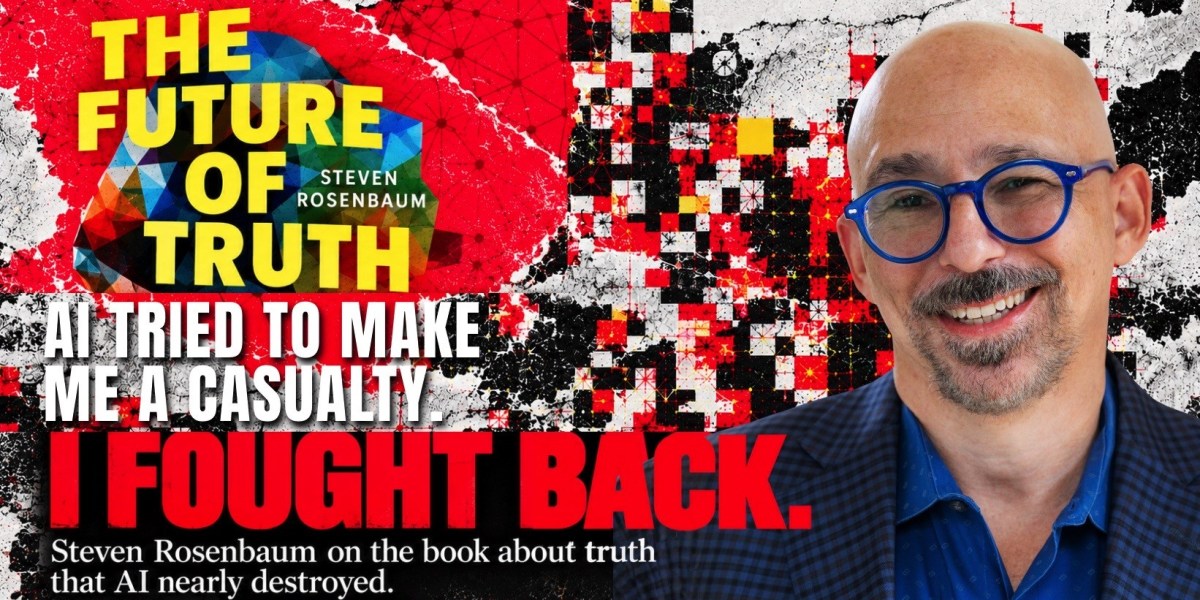
As any author can tell you, the journey from a book idea to the final pub date is a long and bumpy road in the best of times. But AI has changed the author landscape in ways it is hard to imagine. This is my story.
I remember the day vividly, Sunday, May 17, 2026. My book The Future of Truth: How AI Reshapes Reality had been out five days. It was getting good notices and growing but hard-to-quantify buzz. Then my phone rang. “Steve! It’s Ben Mullin. Did you get my last email?” Ben is a media reporter at The New York Times.
His email asked about one quote, attributed to an anonymous DARPA researcher. Did I have a citation? By the end of the afternoon he was convinced he had a smoking gun. Two days later, the Times put it on the front page: “‘The Future of Truth’ Contains Quotes Made Up by A.I.“
The irony was brutal, and the internet loved it. A book warning about AI and truth had been tripped up by AI. Events were canceled. A recorded podcast was spiked. The book became a punchline before I could answer the most urgent question: what happened?
So, nearly five months later, I can tell you what I’ve learned. How did I use AI? Where did it break down? What was I accused of? What am I responsible for? And what did I do to repair what broke and rebuild trust?
First, a brief reminder of what I brought with me to the question of Truth. I’ve spent a career integrating truth, and technologies impact on it. I created MTV News: UnFiltered, a television show that gave viewers control — years before YouTube existed. I wrote Curation Nation, a book that tried to demand human control of the content-overload avanch, and I directed the documentary 7 Days In September, a ground-level experience of New York after 9/11, shot by real people. Plus, my first job — before media, tech, or journalism — was as a magician. So what people believe, and are amazed by, is core to how I view the world. Truth is ever changing, and yet I believed (before I began the book research) that it was irrefutable. Today, that may no longer be true.
The book was a four-year journey. When I began writing it, I was a graduate student at NYU’s Gallatin School. ChatGPT and Claude had yet to be released. The initial research was done the old-fashioned way, with Google, academic papers, and books. Lots of books. Today, the book has more than 400 citations. AI didn’t write the book, I did. I was certain of that, despite the reams of nasty posts and comments to the contrary.
Then there were the interviews that became the spine of the book. Gary Marcus, David Chalmers, Juan Enriquez, Eli Pariser, Douglas Rushkoff, Esther Dyson, Hailey Colborn, Larry Lessig, Steve Fuller, and many more. Did I use AI? I certainly did. My AI use was disclosed in the book’s acknowledgments. I didn’t hide it. I used it to organize research, summarize documents, and refine language.
The book went through five editorial rounds and more than 4,000 tracked changes. Editors and proofreaders pushed back, asked questions, and challenged citations. This is how book editing is supposed to work.
But here’s what changed while the book was being written. AI arrived, and at first a handful of hallucinations seemed more annoying than disastrous. They were sloppy and easy to catch. Searches delivered URLs that didn’t resolve, DOI numbers that were false, or quotes that didn’t have a source. They were bugs, easy to spot and squash.
But here’s what I didn’t count on. This was a book about Truth, and the old standards of proofreading and fact-checking didn’t hold up to AI’s fast-moving ability to replace facts with believable fictions. Are “hallucinations” just the result of early AI evolution that will disappear over time? Or are they part of the business model, included by companies who choose charming answers over truth?
I asked ChatGPT to clarify OpenAI’s position on truth.
“AI companies are building machines whose stated objective is to seek truth while acknowledging that those same machines still manufacture plausible falsehoods.” — ChatGPT, OpenAI
So, in the editing of The Future of Truth, 15 months of human editing slammed headlong into the increasingly charming AI. It felt it knew better, and it “fixed” some quotes that it felt it could improve.
Ben flagged a quote attributed to Kara Swisher. She never said it. In the new edition, I’ve quoted her correctly, and texted with her to confirm it.
That’s how the errors survived. The errors that announced themselves were caught. Some of the errors that read cleanly survived. I should have caught them. That was my responsibility, and I own it.
Then Ben Mullin did the one thing other readers had not: he checked some of the book’s quotes. What ensued was a totally deserved shitstorm. But strangely, the questions weren’t pointed at OpenAI or Anthropic. They were pointed entirely at me, and they were vicious and nasty. That is still painful.
So, I tried to fight back. Fighting fire with gasoline was a bad idea. Then some friends and colleagues suggested I just go to ground and take a year off. But that would have left a book with mistakes out in the market, with my name on it. A book about Truth that had mistakes in it. That couldn’t stand.
My publisher, BenBella Books, did not walk away. Two human fact-checkers went through the manuscript line by line. They discovered 26 quotes that didn’t hold up under scrutiny. Each was traced to a primary source and corrected, rewritten as a paraphrase, or removed. Citations and claims were rechecked. The revised edition opens with an Author’s Note that lays out exactly what happened. I removed every blurb and the foreword.
The Future of Truth: Truth 2.0 Revised publishes October 6.
I think it’s a better book. And it matters more now, because what happened to my book is happening everywhere.
In July, Democracy Now! aired an AI-generated Naomi Klein quote assembled from things she had actually said. “When I first saw it, I thought I had said it,” she told Amy Goodman. When she searched for its origin, Google’s AI pointed her to other AI systems. The fabrication had become its own citation.
Damien Charlotin’s database now documents 2,022 court decisions involving AI-hallucinated material, more than 1,300 in the United States. A Lancet audit of roughly 2.5 million biomedical papers found 4,046 fabricated citations. The State Department projected an AI-made map of Africa, in front of African health ministers, with every country mislabeled.
None of these people were trying to deceive anyone. That is the point. The fabrications are not getting clumsier. They are getting better. More fluent, more specific, more believable, and wrapped in citations that look real.
This is not simply a technical glitch. It is also a consequence of the business model.
AI companies are rewarded for speed, adoption, confidence, and engagement. A system that says “I don’t know” feels less helpful. A system that verifies every claim is slower and costlier. The industry has accepted a level of foreseeable error because charming, confident answers are more engaging, even when they are sometimes wrong. The costs are pushed onto everyone else: authors, lawyers, doctors, patients, readers.
The leaders of the major AI companies say they want rules. But President Trump, in a showy Washington gathering, has rejected legislation. Perhaps after the midterms that will begin to change. Meanwhile, there is still no meaningful system of accountability for AI’s ability to mix fact and fabrication, or for the damage when people rely on the result.
That is the argument of The Future of Truth. In a world flooded with synthetic text, voices, and video, what happens when people cannot tell the real from the counterfeit? Do we throw up our hands and say nothing is true? The worst actors are counting on exactly that. They will flood the zone until verification feels exhausting, and then they will win by default.
I wrote the book to argue we can do better. Then I lived the problem it describes.
The revised edition includes a new chapter, “Hallucinations and Repercussions,” on what fabrication is already doing to law, medicine, and research. It is a stronger book because it was broken and rebuilt in public.
People tell me to quit AI in order to be readmitted to the world of legitimate authorship. My answer is a flat no. There is no pre-AI world to go back to. Use the tools. Keep human judgment in the loop. Disclose. Verify. Correct mistakes publicly. Refuse to let “it sounded right” become the standard for truth.
Two weeks ago I was on stage at the United Nations with the new book in my backpack. Afterwards, a man who works in marketing sought me out.
“I use AI every day,” he confided in me, “and every day it lies to me.”
He took a deep breath. So did I. That is where the conversation starts.
I know I have to earn back your trust. I hope The Future of Truth: Truth 2.0 Revised is the first step back.
The opinions expressed in Fortune.com commentary pieces are solely the views of their authors and do not necessarily reflect the opinions and beliefs of Fortune.