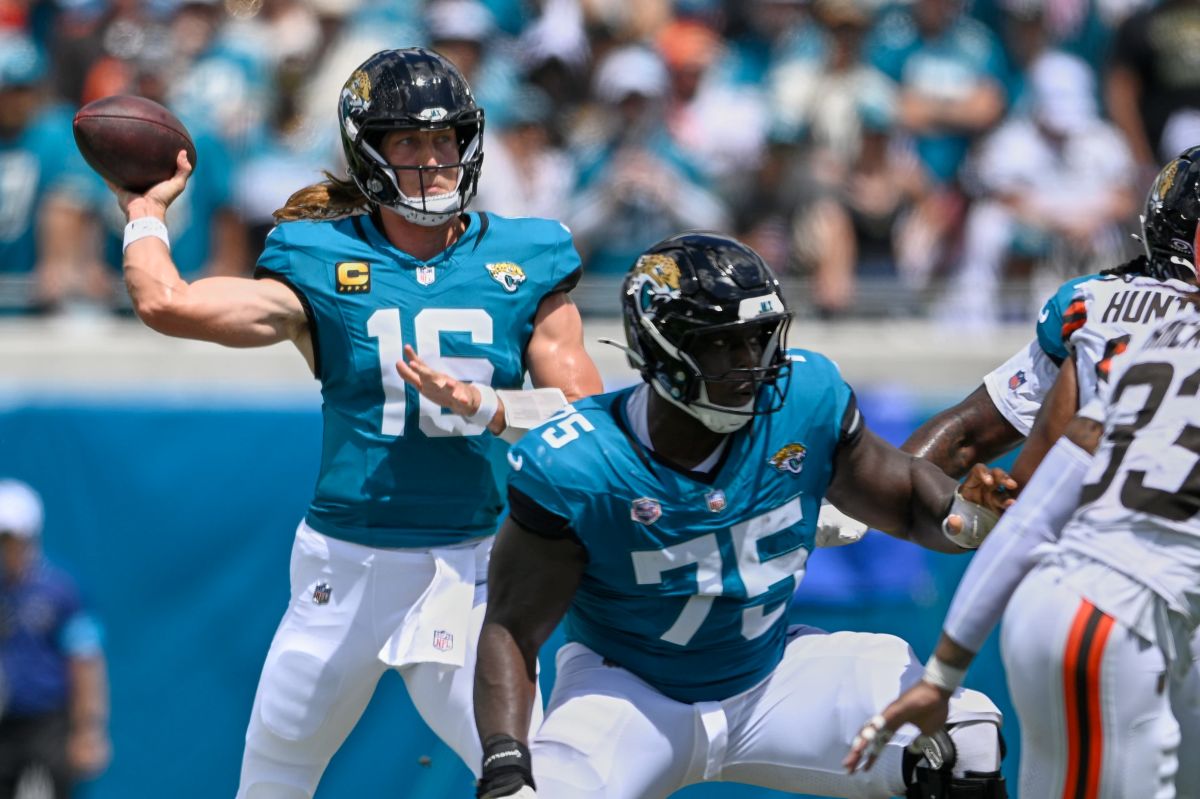
Jacksonville Jaguars quarterback Trevor Lawrence (16) passes in the first half of an NFL football game against the Cleveland Browns, Sunday, Sept. 13, 2026, in Jacksonville. (AP Photo/Phelan M. Ebenhack)
Florida’s NFL teams have started the season with different results. Currently, Jacksonville has won its first three games. Miami has yet to win after losing its home opener. Tampa Bay is also winless, even as some players deliver strong individual performances.
Those differences show why a team’s record tells only part of a player’s story. Recent games have featured players helping their teams score or stop opponents, even when those efforts haven’t secured a victory. A closer look at those contributions reveals which athletes are making an impact and what their performances suggest about the season ahead.
Trevor Lawrence Makes His Completions Count
Trevor Lawrence’s performance against New England showed why passing yardage can undersell a quarterback’s impact. He finished with 182 yards and three touchdown passes in Jacksonville’s victory. Jakobi Meyers caught seven passes, including a touchdown, giving Lawrence a reliable target throughout the game.
Jacksonville converted eight of twelve third downs and scored touchdowns on every red zone possession. Those results give a clearer picture of offensive efficiency than passing yards alone, which matters when assessing teams in upcoming prime-time matchups. Fans comparing those teams may check out NFL Monday night odds and consider how recent offensive efficiency aligns with the market’s assessment. That comparison carries more weight when strong execution continues across several games. Lawrence’s latest outing provides a useful example, but it still needs support from repeat performances.
Bhayshul Tuten Gives Jacksonville Steadier Ground Production
Bhayshul Tuten gave Jacksonville meaningful production on the ground against New England, rushing for 73 yards and a touchdown on fifteen carries. He added seventeen yards on two receptions, contributing beyond handoffs. That brought his season rushing total to 204 yards and two touchdowns on 43 attempts, averaging about 4.7 yards per carry. His latest outing strengthened an early production record while helping Jacksonville deliver its most effective rushing performance of the season.
The distribution of those gains makes his performance more revealing. New England’s analysis credited Tuten with nine successful runs and no stuffs, although only one carry exceeded ten yards. His average reflected gains spread across his workload rather than one long run lifting an otherwise modest total. That pattern suggests he consistently kept Jacksonville moving without needing a breakaway run. It also gives his early production more substance, though maintaining that consistency against different defensive fronts remains the next test.
Emeka Egbuka Produces Through Tampa Bay’s Disruption
Emeka Egbuka led Tampa Bay with five catches for 62 yards against Minnesota. That production came during a game in which Baker Mayfield absorbed six sacks and twelve quarterback hits. Egbuka’s receiving lead therefore deserves context. He produced in an offense that repeatedly struggled to protect its quarterback and move the ball.
Ted Hurst III supplied the Buccaneers’ touchdown with a forty-yard reception, his first NFL score. Egbuka’s production spread across multiple catches, including a 21-yard gain in the fourth quarter. Together, those performances showed different sources of receiving production. Tampa Bay had individual playmakers, but penalties and stalled possessions prevented them from turning those contributions into sustained offensive success
Jacob Rodriguez Creates Value Beyond Tackle Totals
Rookie linebacker Jacob Rodriguez recorded 28 combined tackles through Miami’s first three games, but his performance against Kansas City showed more than a busy defender. He finished with six tackles, including three tackles for loss, and an interception. Tackles behind the line push an offense backward, while an interception ends its possession. His contribution therefore reached beyond stopping plays after opponents had already gained ground.
The timing of his interception made it especially valuable. Miami had just lost a fumble when Rodriguez intercepted Patrick Mahomes on Kansas City’s next possession, keeping the Chiefs from adding points before halftime. His three tackles for loss provided another form of disruption by putting individual plays behind schedule. Miami still lost, so those contributions did not solve the defense’s broader problems. They did, however, show why his impact deserves attention beyond his tackle total, with both the location and timing of his stops strengthening the assessment.
Miami’s Emerging Weapons Face A Larger Test
Miami’s offensive outlook changed when De’Von Achane suffered a torn ACL and entered season-ending injured reserve. Ollie Gordon II took over against Kansas City, finishing with 41 rushing yards and a touchdown. That established his immediate contribution, but it did not demonstrate that Miami had replaced Achane’s broader production. The remaining schedule presents that test.
Rookie receiver Chris Bell delivered another notable performance, catching four passes for 67 yards. His forty-four-yard reception created a promising possession, but that drive ended in a fumble. The sequence captures Miami’s current limitation. An emerging player can generate a big gain without the offense turning it into points, leaving production and scoring as separate measures of progress.
October Gives Early Performances More Meaning
The opening weeks provide a starting point for judging a season. October adds the evidence needed to judge those first impressions more fairly. Emerging players must show their early production can continue.
Established contributors have to remain effective as circumstances change. Strong performances become more convincing when they hold up across different games. Florida’s most influential players will be the ones whose impact remains visible as that evidence grows.