
Politics
Delegation for 9.29.26: Fourth-quarter win — visa screening — data center costs — blue push — red snapper
Fourth quarter score
Legislation that could significantly change the rules for college sports across the country passed the Senate on Monday evening. An amendment at the buzzer appeared to bring one of Florida’s Senators to the winning side of the 77-22 vote.
Sen. Ashley Moody, a Plant City Republican, ultimately supported the Protect College Sports Act (S. 4668), which addresses a variety of collegiate sports-related issues, including athletes’ use of their name, image, and likeness, while reducing the number of allowed transfers.
But the vote took place in the evening after an hours-long pause, followed by a vote on an amendment brought by Moody. She proposed language that would raise the cap on the number of schools in a conference.

“We have a lot of schools that have successful football programs. In fact, 25% of the national football championship teams since 1983 have come from the state of Florida,” Moody said. “They’ve been successful because the universities have had the opportunity to make decisions based on students and the success of their programs. We need more flexibility in the conference caps in this bill, and that’s why I am moving to amend this bill simply by expanding the conference cap by one from 19 to 20. This would go a long way to helping schools like (the University of South Florida), which is in its 30th year.
“The strict conference cap will limit them. It also helps our historic programs at Florida State University that want to continue to build on their storied century-old successes in football.”
The goal of any cap, as reported by NBC News, is to prevent the formation of “superleagues.” The storied Big Ten Conference has already grown to 18 teams. The final number was a big deal for Moody and Scott, according to reporting by Front Office Sports, because it could determine if Florida State University and the University of Miami could leave the Atlantic Coast Conference.
Scott told the sports outlet that the lower cap was among the reasons he could not support the bill.
“It fails to address problems I have heard directly from universities in my state, like disagreements on conference caps, so I couldn’t support it,” the Naples Republican said. He also would not vote for the bill, he said, if it didn’t explicitly restrict transgender participation in women’s sports.
Both Moody and Scott were among 25 Senators who voted against cloture midday. At that point, they were among three Republicans voting against the bill, along with Sen. Rand Paul of Kentucky. Neither Scott nor Paul moved from that position and voted against the bill even with Moody’s amendment.
But changes, including the lifting of the cap, won more votes on final passage than had supported cloture. The effort to continue tweaking the legislation showed the significance the Senate placed on securing broad support, or at least on winning over those states with strong college-sports constituencies. Ultimately, more than three-quarters of the Senate backed the bill, well beyond the 60-vote threshold to break filibusters, or even the two-thirds requirement to override a presidential veto.
That’s not a concern on this bill. President Donald Trump signaled his support for the bill after it passed the Senate. “This is a really big deal,” he posted on Truth Social. “It will not only save college sports, it will save the colleges themselves.”
But it remains uncertain whether the House will accept the bill as written. The House isn’t expected to return to Washington until after the Midterms, when the legislation could be part of a “lame duck” Session.

Sex offender screening
As immigration policy comes under scrutiny, two Florida lawmakers set targets on one group they want kept out of the country: child molesters
Scott, a Naples Republican, just introduced the Strengthened Checks for Reliable Evaluation of Entrants Nationwide (SCREEN) Act, which would give the Homeland Security Department and the State Department limited access to National Center for Missing and Exploited Children data on child sex predators. The goal is to prevent many such migrants from obtaining C-1/D work visas.

The legislation hit the hopper after NBC News reported that Customs and Border Protection deported 27 cruise line employees facing allegations involving child porn.
“The greatest country in the history of the world should have 100% certainty that we aren’t letting child predators come here on work visas. It’s inexcusable that we have let bureaucracy fail our children and put them in danger. It’s time to fix that,” Scott said. “Interagency coordination is vital to both our national security and the safety of American children, and we need more of it.”
In the House, Rep. Carlos Giménez, a Miami-Dade Republican, introduced a companion bill.
“The criminals who exploit innocent children online cannot be allowed to hide behind our borders or take advantage of gaps in our screening systems,” Giménez said. “The SCREEN Act gives the Department of Homeland Security and Department of State access to critical information from the National Center for Missing and Exploited Children to help identify dangerous predators before they can enter or remain in our communities. I am proud to work with Sen. Rick Scott to close this gap, protect our children, and keep dangerous predators out of our communities.”
Data center divides
In the last legislative days before the Midterms, Moody pushed for the Senate to deliver a bipartisan win on data centers. She signed on as a co-sponsor of the Ratepayer Protection Act (S. 5028), which would require states to consider standards to ensure that existing energy consumers aren’t saddled with the costs of increased energy use from the opening of new hyperscale centers.
“I’m cosponsoring the Ratepayer Protection Act to ensure Americans are protected from increased costs associated with new data centers. If billion-dollar tech companies want to build a massive data center, Floridians should not be left to foot the bill,” the Plant City Republican said.

The bill, carried by Ohio Republican Sen. Jon Husted, is notably a companion to one co-introduced in the House by Rep. Kathy Castor, a Tampa Democrat, and passed overwhelmingly in the lower chamber this month.
But it has faced resistance in the Senate, where only Republicans so far have signed on as co-sponsors. Sen. Martin Heinrich, a New Mexico Democrat, blocked it from passing by unanimous consent in the Senate, though it may still pass before the end of the current Congress.
“It is disheartening to see Senate Democrats block the Ratepayer Protection Act from passing,” Moody said. “While Democrats continue to play politics over the issue, I’ll keep fighting to get this common sense legislation passed.”

Feeling blue?
National leaders for House Democrats swung through the Sunshine State this weekend to campaign for three incumbents in battleground Districts and to try to expand blue seats in the state.
Democratic Congressional Campaign Committee (DCCC) Chair Suzan DelBene, a Washington Democrat, and House Democratic Caucus Chair Pete Aguilar, a California Democrat, campaigned alongside Rep. Jared Moskowitz in Miami Beach as the Parkland Democrat seeks re-election in Florida’s 25th Congressional District.
The high-profile event stood Moskowitz alongside some of the region’s most prominent Hispanic leaders as Democrats aim to turn around a rightward swing by Latino voters in the 2024 Presidential Election. Joining Moskowitz, DelBene and Aguilar onstage were former U.S. Rep. Joe Garcia, a Miami Democrat, former Miami Beach Mayor Matti Bower and current Miami Beach Commissioner Alex Fernandez.

DelBene later in the day stopped in Brandon to phone bank for Castor in Florida’s 14th Congressional District, then fundraised with Rep. Darren Soto, a Kissimmee Democrat, as he runs in Florida’s 9th Congressional District.
The DCCC fixture also supported non-incumbents Pia Dandiya, as she tries to keep Florida’s 22nd Congressional District in the blue column, and Bale Dalton, as he tries to flip Florida’s 7th Congressional District from red to blue.
The trip drew the most attention because national Democrats put resources into Florida at all, a state where House seats appeared especially imperiled by a new map enacted by Republican Gov. Ron DeSantis.
National prognosticators have eased concerns about Soto but still see him in trouble. Meanwhile, most now list Castor and Moskowitz in toss-up seats and feel confident about their chances in a strong environment for Democrats.
Welcome gait
Marion County calls itself the Horse Capital of the World, and it isn’t afraid to let the world in to prove it. Rep. Kat Cammack wants to ensure riders don’t have to navigate a regulatory gauntlet just to bring horses to Ocala for competitions.
The Gainesville Republican filed the Temporary International Movement of Equines (TIME) Act (HR 10611), which would streamline rules governing the temporary entry of international competition horses and racehorses.
The TIME Act draws from the World Organization for Animal Health (WOAH) High Health, High Performance (HHP) framework for the temporary international movement of elite competition horses. The United States Animal Health Association has urged that performance-level healthy horses be recognized by the USDA as a distinct subpopulation of horses, and that this should impact the process of entry into the nation.

Cammack introduced the bipartisan bill with Rep. Paul Tonko, a New York Democrat. She said the measure was important to pass before Los Angeles hosts the 2028 Olympic Games, but also for a host of dressage and equestrian competitions in the meantime.
“Marion County is the Horse Capital of the World, and the best horses on the planet should be able to come here and compete without getting tangled up in red tape,” Cammack said. “The TIME Act brings our rules in line with proven international standards and keeps strong protections in place for the horses already here. I’m proud to partner with Congressman Tonko on this bill and to keep working with the American Horse Council to get it across the finish line.”
The American Horse Council, the U.S. Equestrian Federation, the American Association of Equine Practitioners, The Jockey Club, and the Breeders’ Cup all endorsed the bill.

Stretching snapper season
The National Oceanic and Atmospheric Administration (NOAA) Fisheries announced the 2026 red snapper season. A nationwide season will last just three days, but in Florida, Georgia and South Carolina, it will run on the Atlantic Coast from Oct. 9 through 22.
Additionally, data will be collected on fish populations, and NOAA will then decide, with input from the states, if a second season will take place in December.
Rep. John Rutherford, a Jacksonville Republican, has pushed for a re-evaluation of snapper season for years. Last year, anglers could only fish for red snapper for two days.
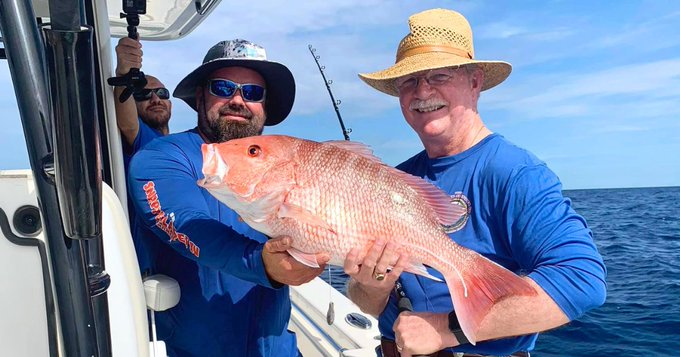
“Finally, the long-awaited South Atlantic red snapper season is here, and I encourage everyone to take advantage of Florida’s beautiful waters and go fishing. While it is fewer days than we hoped for, this season is a great opportunity for us to learn more about the red snapper fishery, collect high-quality data, and lay the groundwork for a longer and more predictable recreational season in 2027 and the years to come,” Rutherford said.
“As a co-chair of the South Atlantic Red Snapper Task Force, I remain committed to advocating for proven methods of collecting reliable data, expanding sustainable harvests, and supporting our coastal economies that depend on this fishery.”
He said he will work with the Trump administration, particularly Commerce Secretary Howard Lutnick, on next steps. He also encouraged collaboration with DeSantis and the Florida Fish and Wildlife Commission, which notably controls the red snapper season in the Gulf and allowed 39 days of fishing, split across May, June, and certain weekends in October.
“Together, we can Make Fishing Great Again,” Rutherford said.
Support for sailors
As the USS Lincoln returned home to San Diego, Rep. Cory Mills was part of a bipartisan group of lawmakers who visited sailors. The New Smyrna Beach Republican shared a video online of his helicopter landing at the carrier.
“Great to be on the USS Abraham Lincoln with our Secretary of the Navy to welcome back our heroes from their deployment to the Arabian Sea,” Mills posted. “Thank you to our brave men and women who serve and protect our great nation.”

“Thank you, Rep. Mills,” responded acting Navy Secretary Hung Cao. “It was great to recognize these warriors for their service and a job well done with fellow warriors like yourself.”
The conditions on the Lincoln have drawn hefty public scrutiny. Cao, in a letter to the Senate, acknowledged that eight sailors attempted suicide across the carrier strike group, PBS reported, during a record-setting 10-month deployment during the ongoing conflict with Iran.

Healthcare roundtable
Rep. Gus Bilirakis will host a roundtable with leaders from Federally Qualified Health Centers around Tampa Bay, and he’s bringing in a powerful colleague to speak on the subject. Rep. Brett Guthrie, a Kentucky Republican and Chair of the House Energy & Commerce Committee, will attend the Wednesday event.
His office said the official event is intended to showcase work done in the region “to deliver high-quality care while keeping services affordable and accessible for the patients and families who need them most.”

The event will also shine a light on the challenges faced by families in Florida trying to access healthcare, in hopes of crafting policy that enables easier, more affordable access to services.
The event will also discuss a partnership between officials and Feeding Tampa Bay that addresses a connection between better nutrition and personal healthcare outcomes. “Through this model, healthcare and community partners are working together to address patients’ dietary needs and combat food insecurity among vulnerable populations,” reads a release from Bilirakis’ office.
The roundtable on healthcare affordability and access will take place at 10 a.m.
Diesel discount?
While gas prices have hurt many families’ pocketbooks, diesel prices have risen even higher. AAA estimates the average price of diesel in Florida at around $6.04 per gallon, compared to $4.30 for regular gasoline, and the national diesel average at about $6.44, increasing the cost of transporting goods across the U.S. via semitrailer.
Rep. Greg Steube just drafted a bill he hopes can address that commodity price.

“Americans are paying far too much for diesel, and that cost gets passed down to families on just about everything they buy,” the Sarasota Republican said.
“My bill gets rid of the federal diesel tax to bring prices down now and makes it easier to build new refineries here at home. We have the energy and the resources, and we should be producing and refining more of it.”
His American Fuel Affordability Act repeals the federal excise tax on diesel fuel, which currently sits at 24.3 cents per gallon. The legislation would keep the Highway Trust Fund and the Leaking Underground Storage Tank Trust Fund intact through general fund transfers, while providing immediate relief from the cost of distillate fuel oil.
The bill also creates a 35% tax credit for investment in the construction of U.S. refineries and a 5-cent-per-gallon production credit for gasoline and diesel from new facilities for the first 10 years of operation. Steube called the proposal a supply-side approach to boosting domestic refining without imposing export restrictions.

Defunding the U.N.
Congressional budget bills passed in the House should send a clear message to the United Nations, according to Rep. Mario Díaz-Balart.
“From Congress to the White House, the Republican agenda has been clear: disrupting the broken status quo,” the Hialeah Republican said in a lengthy statement shortly after Trump addressed the U.N.
“From FY26 appropriations signed into law by President Donald Trump to the FY27 bills advanced out of the full Committee, with multiple passed across the House floor, there have been fundamental shifts in how Washington does business.”

Díaz-Balart serves as Vice Chair of the House Appropriations Committee, and Chair of the National Security, Department of State, and Related Programs (NSRP) Subcommittee that sets international spending. Amid all the talk over the past two years about gridlock in a divided House, he has repeatedly touted that the chamber successfully passed all 12 required appropriations and a full budget this year.
The Senate hasn’t passed a budget, but Díaz-Balart said the House sent a clear message that the U.S. won’t write blank checks to the U.N.
“Weakness and soft rhetoric have been replaced by decisive leadership,” he said. “Progressive mandates and excess have been replaced by America First priorities. Foreign wish lists have been replaced by U.S. interests and security.”
The House budgets contain no funding for the U.N.’s regular budget and withhold program funding absent audits, whistleblower protections, limits on “premium travel” and a removal of anti-Israel bias from operations at the international body.
“We accomplish more while also spending less,” Díaz-Balart said. “My FY27 NSRP bill cuts $2.7 billion in unnecessary spending, building on FY26’s historic 16% reduction while directing resources to the highest-impact priorities that strengthen America.”
Emergency spending
Mount Sinai Medical Center held a ceremony celebrating a new emergency center in Westchester, and Rep. María Elvira Salazar was there to cut the ribbon.
The Coral Gables Republican helped secure $7.65 million for resilience improvements at the medical center, part of nearly $15 million in direct federal investments for healthcare and medical research in South Florida and said the facility would provide a vital service.

“Quality healthcare has to be both accessible and affordable,” Salazar said. “That means having excellent care close to home, enough doctors to see patients, access to the treatments people need, and costs families can actually afford. I am proud to join Mount Sinai for this important expansion and will continue working across the aisle to strengthen healthcare for South Florida.”
The emergency center, which will accept its first patients in October, is the start of a major site expansion by Mount Sinai, officials said.
“When we broke ground here, we made a commitment to the Westchester community that nationally recognized care was coming. Today, it is here,” said Gino Santorio, Mount Sinai President and CEO.
“Families in this community now have emergency care close to home, with advanced imaging on site so patients get answers during their visit rather than a referral and a second trip. And this is only the beginning. We are grateful to Congresswoman Salazar for standing with us today and for her continued support of Mount Sinai and the patients we serve across South Florida.”

On this day
Sept. 29, 2008 — “Dow suffers historic drop” via The Washington Post — Spooked investors fled the market after the House rejected the $700 billion plan to rescue the financial system. The Dow Jones Industrial Average closed down about 778 points, at 10,365. That was nearly a 7% drop. The Nasdaq lost 200 points, about 9%, and the broader Standard & Poor’s 500-stock index fell 106 points, a decline of nearly 9%. The Dow’s point drop set a record, topping the sell-off in the wake of the Sept. 11, 2001, terrorist attacks, when the Dow lost nearly 685 points. The percentage drop was also the second-worst since 1987, when the Dow fell 22% in a single day.
Sept. 29, 1983 — “Congress passes War Powers resolution for Lebanon” via the U.S. Department of State — Fighting had erupted between Maronite Lebanese Forces and pro-Syrian militias led by Walid Jumblatt’s Popular Socialist Party. President Ronald Reagan responded by authorizing the Marines to engage in “aggressive self-defense,” dispatching the battleship New Jersey to Lebanon, and authorizing naval gunfire and airstrikes to prevent hostile forces from seizing Suq al-Gharb, which overlooked the Marine barracks. Congress passed legislation invoking the War Powers Act and authorizing the Marines to remain in Lebanon for 18 months, the first time a time constraint was placed on their presence. Defense Secretary Caspar Weinberger proposed withdrawing U.S. forces offshore.
Happy birthday
Best wishes to Rep. Debbie Wasserman Schultz, who turned 60 on Sunday, Sept. 27.
___
Peter Schorsch publishes Delegation, compiled by Jacob Ogles, edited and assembled by Phil Ammann and Ryan Nicol.
The post Delegation for 9.29.26: Fourth-quarter win — visa screening — data center costs — blue push — red snapper appeared first on Florida Politics – Campaigns & Elections. Lobbying & Government..