
Politics
‘Cruel and unconstitutional’: DCF sued, accused of jailing defendants unfit for trial for months
A lawsuit has arrived one year after Florida Politics detailed how the Department of Children and Families’ (DCF) failure to move mentally ill inmates into treatment centers due to insufficient funding from the Legislature exposed the state to costly legal action.
Disability Rights Florida has filed a federal complaint accusing DCF of leaving people deemed incompetent to stand trial by a court stuck in county jails for months — far beyond the two-week deadline required under state law.
Lawyers from the Southern Poverty Law Center, Florida Justice Institute and the Washington law firm Terris Pravlik & Millian filed the suit, which names DCF interim Secretary Kathryn Williams as the defendant in her official capacity.
At issue: a state law that gives DCF 15 days to move a defendant found incompetent from jail to a state mental health treatment facility once it receives a court’s commitment paperwork, after which the criminal case is frozen until the defendant regains competency.
The lawsuit, filed Wednesday in Miami, said DCF misses that deadline by more than 100 days on average and that the agency’s statewide waitlist has ranged from 650 to 880 people in recent years.
That’s a violation of detainees’ 14th Amendment due process rights, the plaintiffs argue, as the people found incompetent haven’t been convicted and the only lawful reason to hold them is to restore their competency.
Keeping them jailed for months without that treatment, the suit contends, amounts to punishment.
The plaintiffs aren’t asking for monetary damages. They want a Judge to declare DCF’s practices unconstitutional and issue a permanent injunction stopping the agency from continuing to leave incompetent defendants in jail past the point the law allows.
They also asked the court to order DCF to develop a plan ensuring timely admissions, retain jurisdiction until the agency complies and award attorneys fees and costs.
“Denying people with serious mental illness access to court-ordered mental healthcare is both cruel and unconstitutional,” Southern Poverty Law Center Senior Staff Attorney Kelly Knapp said.
“Florida has known about this crisis for nearly 50 years, and yet every time the waitlist grows, the state’s answer remains the same: further delays. These individuals with mental health disabilities have not been convicted and are presumed innocent. Yet, the state is punishing them by leaving them to deteriorate in jail cells instead of providing desperately needed treatment.”
Disability Rights Florida and its lawyers said they interviewed 129 incompetent defendants in 25 counties. For the 108 whose wait could be calculated, the average was at least 124 days.
The longest wait was 246 days. The shortest, 51 days, was still more than triple the legal limit.
The Tallahassee-based nonprofit also identified three people they say died in county jails after DCF’s deadline had passed. Two were in Duval County: a man who died of hyponatremic dehydration four weeks past the cutoff, and a woman who died days after her cellmate severely beat her, roughly a month after a Judge ordered her hospitalized in a mental health treatment facility.
In another example, the plaintiffs said, Sarasota County jail staff allegedly kept a psychotic detainee in a restraint chair for more than a day on three separate occasions, the longest of which was for 35 hours, during which the man had only two bathroom breaks and a single meal. A similar case in Tennessee led to a death last year and a $1.9 million settlement with the county government in February.
The suit said at least 150 people are waiting in jails in the Southern District of Florida, which encompasses nine counties between Indian River and Monroe. Roughly a third are in Miami-Dade County Corrections and Rehabilitation facilities.
Notably, the plaintiffs said, just one of the state’s authorized forensic diversion pilot programs, is fully operating, with a 16-bed site in Miami-Dade. Under those programs, state law allows DCF to use to treat and restore some incompetent defendants in community settings instead of state hospitals.
“Individuals with mental health disabilities, including those who have been arrested and deemed incompetent to proceed, deserve to be treated with dignity and respect,” Disability Rights Florida Litigation Director Caitlyn Clibbon said. “This cannot continue.”
Dante Trevisani, Litigation Director for the Florida Justice Institute, added that Florida “must address this crisis that has persisted for decades.”
In August 2025, Florida Politics reported on how a chronic shortage of forensic treatment beds had left DCF unable to meet the 15-day mandate, putting the state on shaky legal ground.
The conflict was, at the time, playing out in a case in Leon County, where a Judge ordered DCF to explain why it shouldn’t be held in contempt.
DCF General Counsel Andrew McGinley didn’t dispute the missed deadline, saying the agency wasn’t in “willful non-compliance,” but couldn’t meet the 15-day requirement because no beds were available at its six mental health treatment facilities.
At the time, DCF said 772 committed defendants were waiting past the limit, with average waits of 117 days for men and 125 days for women. Forensic commitments had surged 74% since 2020, while the state had about 3,046 beds.
McGinley argued that contempt orders can’t fix what is fundamentally a legislative problem, since courts can’t force DCF to spend money or create beds lawmakers haven’t funded.
An analysis of Florida budgets bore that out. State records showed a long-running gap between what DCF requested and what it received. Ahead of Fiscal Year 2023-24, when delays peaked, for instance, DCF requested $47.3 million for bed capacity and lawmakers approved $35 million.
The next year, DCF sought $77.8 million in nonrecurring funds and got $9 million. And in Fiscal Year 2026, DCF requested $95.4 million and got $78.6 million, though only $19.6 million was cleared for immediate release.
Disability Rights Florida says lawmakers later freed that reserve after DCF delivered required metrics.
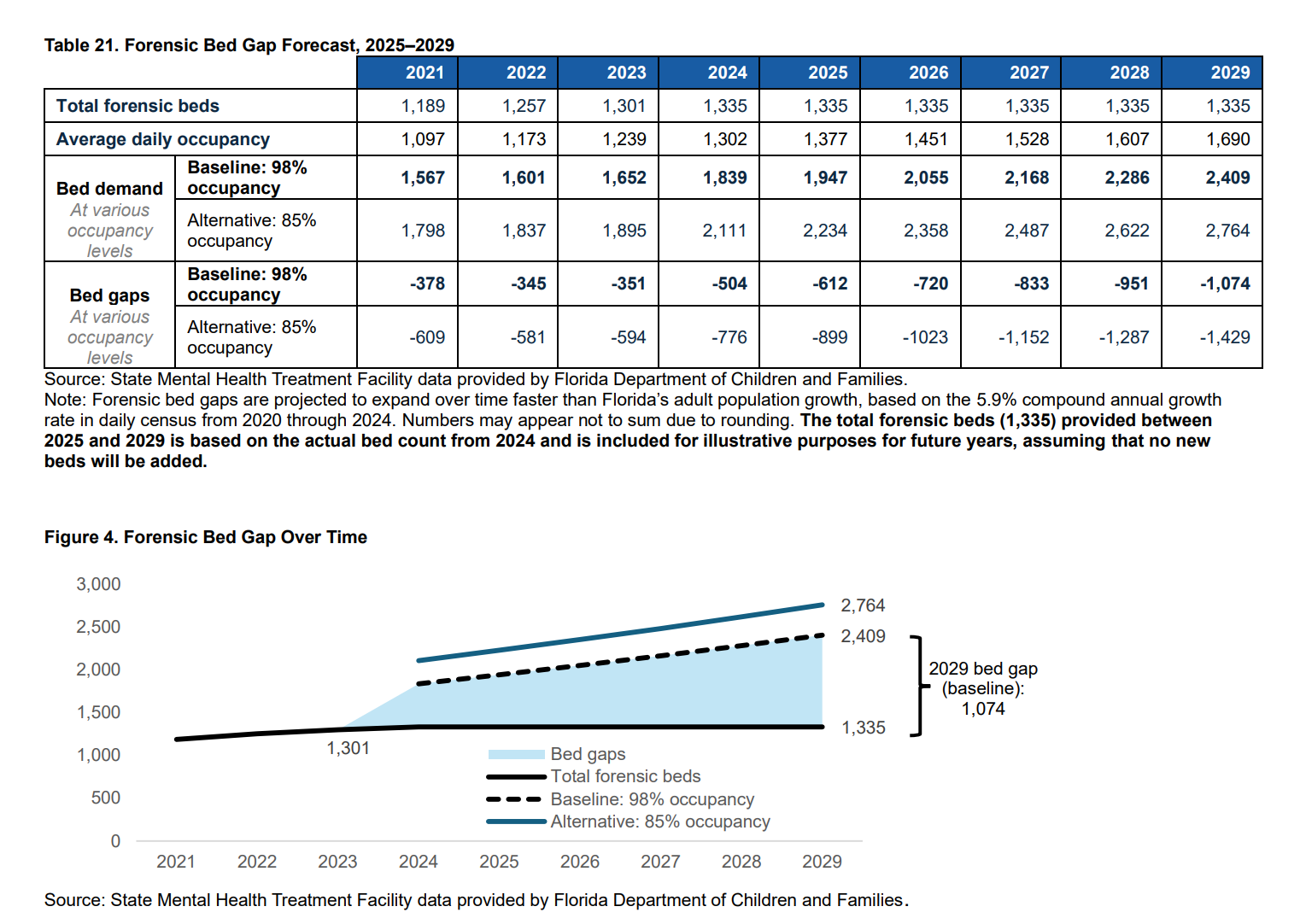
A January 2025 analysis by Miami accounting firm Ernst & Young, which Florida Politics flagged and the lawsuit references, projected a forensic bed shortage in Florida of up to 2,034 by 2029 if the state wanted to meet the industry standard occupancy rate of 85%.
The current occupancy rate was 98%, the firm noted, adding that Florida would still have to add at least 1,602 beds by 2029 to maintain that level.
Even so, the suit said, DCF’s 2026-27 budget request sought no money for new forensic hospital beds.
This isn’t the first time Florida has faced legal exposure due to forensic bed shortages. In a 2006 case, Pinellas County Judge Crockett Farnell fined then-DCF Secretary Lucy Hadi $80,000 over similar delays, and lawsuits against the agency multiplied.
At the time, 237 inmates were held past the cutoff, and DCF had 1,416 beds.
The next day, Hadi announced her resignation.
And while the current lawsuit seeks no monetary damages, the potential for a heavy financial hit persists, with legal precedents in other states.
In 2023, a federal court fined the state of Washington $100 million for violating inmates’ due process rights by delaying competency services and failing to add enough mental health treatment facility beds.
Three years earlier, a federal court approved a $650,000 class-action settlement for plaintiffs in a comparable California case. In California’s Contra Costa County, a Judge fined the Department of State Hospitals $17,400 for similar violations.
Other litigation over the same issue led to a Judge holding state officials in contempt in Maryland, a nonmonetary settlement with plaintiffs that required reforms in Utah and a judicial censure in Minnesota.
The post ‘Cruel and unconstitutional’: DCF sued, accused of jailing defendants unfit for trial for months appeared first on Florida Politics – Campaigns & Elections. Lobbying & Government..