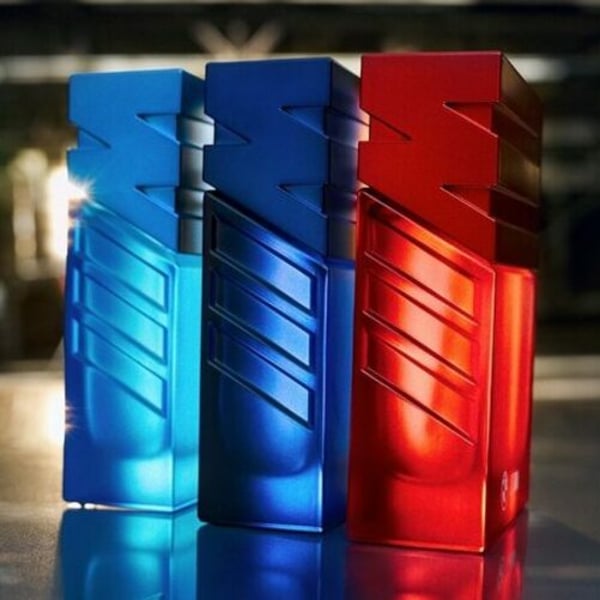
Responsible for creating models engineered to deliver a driving experience rooted in the world of racing, BMW’s “M” division- short for and synonymous with Motorsport- now translates that spirit into an olfactory experience with its first collection of three fragrances, created by the Italian company Mavive. This extends its partnership with the Bavarian manufacturer, formalised last May with the launch of the first two BMW‑branded fragrances, “Bergamood” and “Amberness”.
The three newest BMW M fragrances
The meticulous focus on precision, agility and dynamism that defines BMW’s Motorsport models- and the passion for engaging, dynamic and sporty driving, both on the road and on the track, that this performance arm seeks to convey- is distilled into the three debut fragrances. Their bottles prominently bear the division’s logo and echo the three colours of the BMW M stripes, pairing aluminium and glass for the packaging.
Created by world‑renowned perfumers Frank Voelkl and Alexandra Monet, the three eaux de toilette employ an innovative applied neuroscience approach designed to stimulate positive emotions through the sense of smell. Thanks to a collaboration with DSM Firmenich, a company specialising in flavours and fragrances, the line incorporates cutting‑edge, patented and certified neuroscientific technology into its ‘Emotiwaves’ formulations which, through the use of natural ingredients, positively influences mood and psychological wellbeing.
The Eau de Toilette “1972” is inspired by the BMW 3.0 CSL, the first sports car produced by BMW between 1972 and 1975 and derived from the BMW E9. A dominant force in touring car racing- particularly in the European Touring Car Championship (ETCC), where it won multiple times- the 3.0 CSL played a decisive role in building BMW’s reputation in motorsport. Presented in a bright blue bottle, the fragrance opens with a blend of citrus and ginger that mingles with delicate, fleeting notes, settling into a warm, woody, amber trail.
Meanwhile, “1985”, in the blue bottle, is an eau de toilette inspired by the BMW M3 E30: among the Bavarian manufacturer’s most beloved models, it debuted in 1985, when engineers from the Motorsport department created a new lineage of high‑performance models- both road‑going and competition- based on the 3 Series saloon. Elegant, fruity top notes add a distinctive twist to the woody, amber base.
The three BMW cars that inspired the Motorsport division’s first fragrances
Finally, “2025”, in the red bottle, represents the present‑day BMW M5, the saloon which, with 40 years of history behind it, has reached its seventh generation and, for the first time, introduces an electrified powertrain. This intense eau de toilette has a fougère character and stands out for its fresh, aromatic accords.
The BMW M fragrance collection is available at selected perfumeries and on Mavive’s and BMW’s own e‑commerce sites, priced at €85 for 100 ml and €62 for 50 ml.
Mavive S.p.A. manages a portfolio of brands ranging from masstige to niche perfumery and operates in more than 90 countries worldwide. The business has recently launched the brand Spezieria di San Marco – Venezia 1437.
BMW Group (brands BMW, MINI, Rolls‑Royce and BMW Motorrad) is one of the world’s best‑known automotive manufacturers, a leader in the production of luxury cars and motorcycles, as well as a provider of premium financial services. The BMW Group’s production network spans more than 30 sites worldwide, with a sales network covering over 140 countries. In 2024, BMW (Bayerische Motoren Werke) sold more than 2.45 million passenger vehicles and over 210,000 motorcycles globally. Its pre‑tax profit for the 2024 financial year reached €11 billion, with revenues of €142.4 billion. As at December 31, 2024, the German group has 159,104 employees.
Thanks to the extensive CV of its founder, who also works as a buyer, stylist, and fashion editor, particularly in the US and Brazil, Pop Closet has become a point of reference, despite the modest premises where it made its debut in the Portuguese capital.
The façade and interiors are defined by industrial finishes, in contrast to the century-old structural stone — salvaged from the fire that ravaged Chiado in 1988, starting at Armazéns Grandella and spreading through the area, destroying 18 historic buildings — and the restored wooden furniture that showcases second-hand clothing, eyewear, accessories, and footwear, as well as art and décor pieces.
@popclosetofficial / Instagram
The new Pop Closet also includes a space dedicated to art displayed on the walls, such as photographs by Cátia Castel-Branco, which are also for sale and will be replaced by works from other artists to foster a sense of dynamism and a changing atmosphere. There are even second-hand design pieces for the home — some recycled or part of collections from renowned brands such as Kartell.
“I want to have good items that anyone who comes in here feels they can wear, that aren’t specific to one type of customer. Above all, quality, beautiful and contemporary pieces,” António Branco told Time Out. He sources pieces in northern Europe or northern Portugal, from factories that offload leftover stock, in addition to those consigned by clients or bought directly by the shop, thus ensuring turnover.
The right and the far right joined forces in the European Parliament on Thursday to unpick a law on major corporations’ social and environmental “due diligence” — a bombshell in Brussels.
Shutterstock
By 382 votes to 249, MEPs approved scaling back the text’s ambitions, limiting the number of companies covered, and removing some obligations. A weakened version of the text had been rejected by MEPs on October 22.
In a break with the traditional “pro-European” majority, an ad hoc alliance between the right (the EPP) and the far right sparked an outcry among the other groups.
The EPP “has torpedoed any moderate compromise,” lamented Social Democrat René Repasi. The vote serves as a warning to the pro-European camp, just as Parliament begins to tackle a series of measures to “simplify” business life.
The far right savoured a “great victory” on Thursday. “Another majority is possible” and “this is just the beginning”, declared the Patriots group, chaired by Jordan Bardella.
Adopted only eighteen months ago, this due diligence law is bearing the brunt of the European Union’s pro-business turn, buffeted by competition from China and tariffs in the US.
Its implementation had already been postponed by a year, from 2027 to 2028. But Brussels wants to go even further to lighten the administrative burden on companies across the continent.
Backed by penalties, the law adopted in 2024 required companies with over 1,000 employees to prevent and remedy human rights violations (child labour, forced labour, safety, etc.) and environmental damage throughout their value chains, including among their suppliers worldwide.
On Thursday, in line with the Member States, the European Parliament raised the thresholds for companies covered to more than 5,000 employees and over €1.5 billion in annual turnover.
Above all, MEPs scrapped the European civil liability regime, which served to harmonise companies’ obligations and their liability before the courts in the event of breaches.
Instead, parliamentarians opted to leave it to national legislation. They also abandoned the climate transition plans that companies were supposed to provide. A move that France, which has long boasted of having created the first national due diligence law, has pushed hard for since the beginning of the year, including through its president, Emmanuel Macron.
“Asphyxiation”
The law is now “completely empty”, laments centrist Pascal Canfin. This vote comes “during COP30” in Brazil and “represents a considerable setback for private-sector climate action”, he believes.
On the right, MEP François-Xavier Bellamy argues, by contrast, that this “simplification” will “save our businesses from regulatory asphyxiation”.
Following this vote, negotiations will begin with the Member States, with a view to the final adoption of the revised law.
“It is still possible to correct course”, says Jurei Yada of the E3G think tank, but the vote shows that “the far right is gaining influence” and that the pro-European majority is “crumbling”.
The absence of European civil liability risks introducing “competition between the 27 Member States to see who has the most lax regime to try to attract companies”, warns Swann Bommier of the NGO Bloom.
In the name of fighting bureaucracy, German Chancellor Friedrich Merz and French President Emmanuel Macron had called for the law to be scrapped altogether.
But even if it is only slashed, the pill is hard to swallow for some of the parliamentarians who had celebrated its “historic” adoption in April 2024 after several years of tug-of-war within the European institutions themselves.
There was no shortage of superlatives at the time, including among Macronists, such as the current president of the centrist Renew group, Valérie Hayer.
However, the political balance has shifted in the chamber since the June 2024 elections, marked by the strengthening of the right and the breakthrough of the far right, which wants to roll back the Green Deal, the package of environmental measures adopted during the previous term.
FashionNetwork.com with AFP.
This article is an automatic translation. Click here to read the original article.
Italy is considering a one-off levy for households to declare gold held off the books, an amendment to the 2026 budget law showed, in a move that could potentially yield the state more than 2 billion euros ($2.3 billion).
Gold jewels are seen in a jewellery shop in downtown Rome, Italy, December 11, 2017 – REUTERS/Max Rossi
The proposal would allow individuals to pay a 12.5% tax to certify the market value of bullion, gold jewellery, and collectible coins for which purchase records are missing, the same rate as on government bonds. The certification has to be done by June 2026.
Under current rules, the lack of proof of purchase can lead to a 26% tax on the entire sale value, rather than just the actual capital gain. This has discouraged people from selling their inherited gold on the official market and pushed some transactions into informal or undeclared channels, limiting market liquidity and tax revenues, lawmakers from the co-ruling League and Forza Italia party said.
Some estimates put privately held gold in Italy at 4,500–5,000 metric tons, worth roughly 500 billion euros at current prices. Italy’s network of “Compro Oro” shops — businesses that buy and sell gold — has seen a sharp rise in activity as prices hit record highs. Sales of used gold jumped by around 25% in 2025, with more than 1.2 million transactions per month, driven by households cashing in old jewellery and coins, according to Metropolitan Magazine, an Italian publication.
Under the proposed measure, taxpayers opting in would declare their holdings at market value, pay the substitute tax in one or three annual instalments, and obtain a stepped-up fiscal value basis for future sales. The process would be overseen by authorised intermediaries and advisers, with strict anti–money-laundering checks.
Supporters say the measure could generate significant one-off revenues for the Treasury, while improving transparency in a market long characterised by opaque holdings and informal family transfers. Based on an assumption that 10% of privately held investment gold is certified, the draft estimates additional revenue of up to 2.08 billion euros.
The proposal also seeks to encourage the “legal circulation” of gold by removing what stakeholders see as a punitive regime for individuals unable to document purchases made years—or generations—ago. The amendment still needs to clear parliamentary scrutiny and government vetting.