
Politics
Alexis Calatayud’s bipartisan appeal meets Richard Lamondin’s push for change in SD 38 clash
Republican Sen. Alexis Calatayud helped reshape Florida’s housing policy. Democrat Richard Lamondin wants voters to decide whether that achievement has made life more affordable or simply handed developers more power.
Their Senate District 38 contest pits a first-term incumbent with a record of bipartisan accomplishments against an entrepreneur promising a different approach to insurance, education and household costs.
No-party candidate Jeffrey “Doc” Solomon, a chiropractor, is also in the contest, which Florida Politics ranked No. 7 on its list of the 11 South Florida races to watch heading into the General Election.
SD 38 covers Cutler Bay, Key Biscayne, Palmetto Bay, Pinecrest and South Miami. It also includes parts of Coral Gables, Homestead and Miami, and Miami-Dade County’s unincorporated Kendall and Westchester neighborhoods.
The district’s electorate has shifted rightward in recent years, with Republicans now outnumbering Democrats by more than 19,400 voters. Republicans make up 37% of voters in SD 38, compared to 31% who are Democrats and 32% who belong to a third party or no party, according to the Division of Elections.
Calatayud, 33, won the seat, previously held by Democrat Annette Taddeo under a prior district map, by nearly 9 percentage points in 2022.
She came to the job with a background in government. Before entering the Senate, Calatayud worked as a Campaign Manager and legislative aide to former Republican Rep. Vance Aloupis and as Director of Public Policy and Programs at the Florida Department of Education.
At Florida International University, she served two terms as Student Body President.
Her signature accomplishment to date is the Live Local Act, a 2023 package combining housing funding, tax incentives and homebuyer assistance with overrides of local development restrictions.
Under the measure, which has been updated three times since it originally passed, qualifying projects can bypass certain zoning, height and density limits if at least 40% of their units remain rentals affordable to households earning up to 120% of the area median income for 30 years.
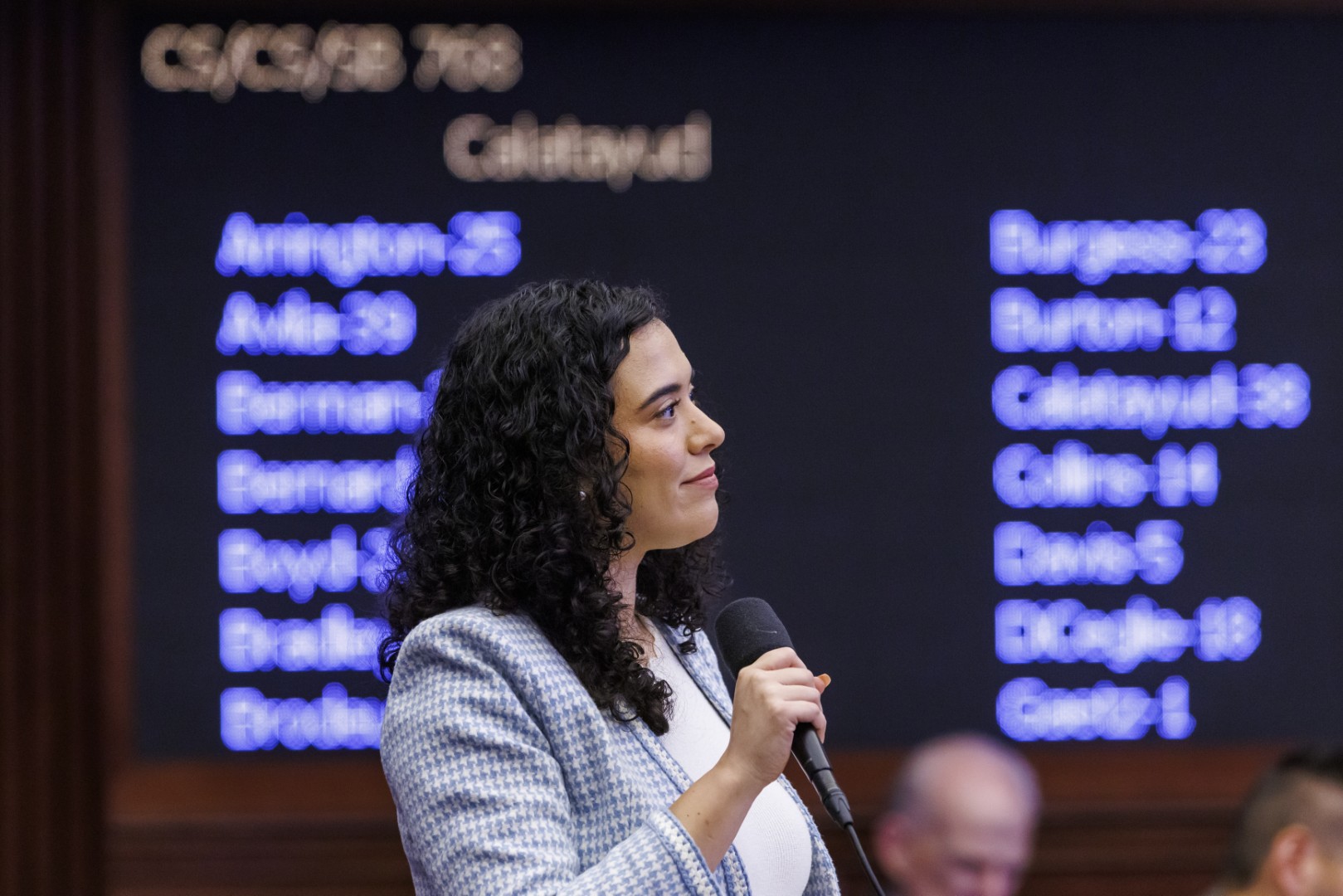
Beyond housing, Calatayud carried the Senate companion to a domestic violence package developed with Democratic Rep. Debra Tendrich and Republican Rep. Danny Nix that increased penalties for repeat offenders, raised victims’ financial relocation assistance, addressed threats against pets in protective injunctions and created an electronic-monitoring pilot program in Pinellas County.
She also amended a sweeping land-use law this year to preserve Miami-Dade’s Everglades- and Biscayne Bay-protecting Urban Development Boundary, helped provide stopgap HIV medication funding, and broke with most Republicans on abortion and climate policy, voting against Florida’s six-week abortion ban and this year’s restrictions on local net-zero policies.
Further, she successfully carried legislation to provide additional funding for Jewish school security amid a sharp rise in antisemitic incidents, expand subsidized children’s health coverage, improve Florida’s school-readiness programming and strengthen the state’s employment standards for people with disabilities.
After racist and antisemitic messages surfaced in March from a chat tied to then-Miami-Dade GOP Chair Abel Carvajal and Ian Valdes, President of the Turning Point USA chapter at Florida International University, Calatayud’s alma mater, Calatayud was among the Florida Republicans who demanded accountability.
Lamondin, 39, has argued the stands Calatayud has taken against some of her party’s policy priorities haven’t outweighed her broader record of generally toeing the GOP line. He has criticized her votes to renew an emergency fund used for the now-shuttered Alligator Alcatraz immigration-detention facility, provide $1 billion in state-backed reinsurance subsidies and curtail policyholders’ ability to recover attorneys fees while providing additional protections for insurers against bad-faith claims.
His latest advertising has portrayed the Live Local Act as favoring developers at residents’ expense, and he has called for local zoning authority to be restored and affordability requirements to better target low-income households.

A Miami native making his first run at public office, Lamondin originally filed to compete in Florida’s 27th Congressional District before switching to the SD 38 contest in April. He is the co-founder of environmental services company ecofi, which installs high-efficiency plumbing fixtures that reduce water and energy consumption.
He says his experience leading a business, creating jobs and lowering operating costs makes him well prepared to tackle broader affordability issues in the district.
Lamondin vows, if elected, to expand prekindergarten education, raise teacher pay, hold voucher-funded private schools to public school standards and reduce insurance, healthcare and childcare costs.
Republican advertising has portrayed him as a democratic socialist, a label his campaign and the Miami-Dade Democratic Party reject.
Solomon, a longtime Democrat-turned-independent who turns 67 the day after the election, is pitching himself as a sensible alternative to the institutional party system. However, during a mid-June candidates forum in Homestead, he was unable to name a single policy position of Lamondin’s with which he disagreed.
He opposes Live Local as it is written and proposes a public dashboard tracking government performance and spending.
In private life, he has worked for more than four decades as a chiropractor and is a past President of the Florida Chiropractic Association. He has also served on the Pinecrest Zoning Board and Miami-Dade Sports Commission.
Calatayud’s endorsers include Associated Industries of Florida, the Everglades Trust, Florida Chamber of Commerce, Florida Police Benevolent Association, Florida Professional Firefighters and SEIU Local 1991. The Miami Herald also endorsed her.
Lamondin has support from Senate Democratic Leader Lori Berman, Miami-Dade Mayor Daniella Levine Cava, a slew of other state and locally elected Democrats and anti-gun violence group Giffords.
October polling of the district by Democratic firm Impact Research found Calatayud and Lamondin tied at 40%, with Solomon at 4% and 15% of voters undecided. Calatayud led 43% to 36% in the firm’s July survey, suggesting an opening for Democrats in the Midterm.
Money matters in a race this tight, and Calatayud has been a fundraising powerhouse.
Since winning office four years ago, she has amassed over $4.3 million between her campaign account and political committee while receiving more than $405,000 in in-kind aid from the Republican Senatorial Campaign Committee for consulting, polling, research and staffing costs.
With just one week before the election, she had more than $1.76 million left to spend.
Lamondin, meanwhile, raised about $528,000 between his campaign account and political committee, including $100,000 in self-loans, while getting close to $300,000 in in-kind aid from the Florida Democratic Legislative Campaign Committee and Florida Democratic Party.
As of Oct. 27, he had about $44,500 remaining.
Solomon raised $28,000 and spent $26,000. He also loaned his campaign $7,000, which he can fully recoup if it goes unspent.
Election Day is Nov. 3.
The post Alexis Calatayud’s bipartisan appeal meets Richard Lamondin’s push for change in SD 38 clash appeared first on Florida Politics – Campaigns & Elections. Lobbying & Government..