
Politics
Sydney Gruters pulled an ‘8 Mile’ move on Eddie Speir, but that didn’t stop him from throwing barbs
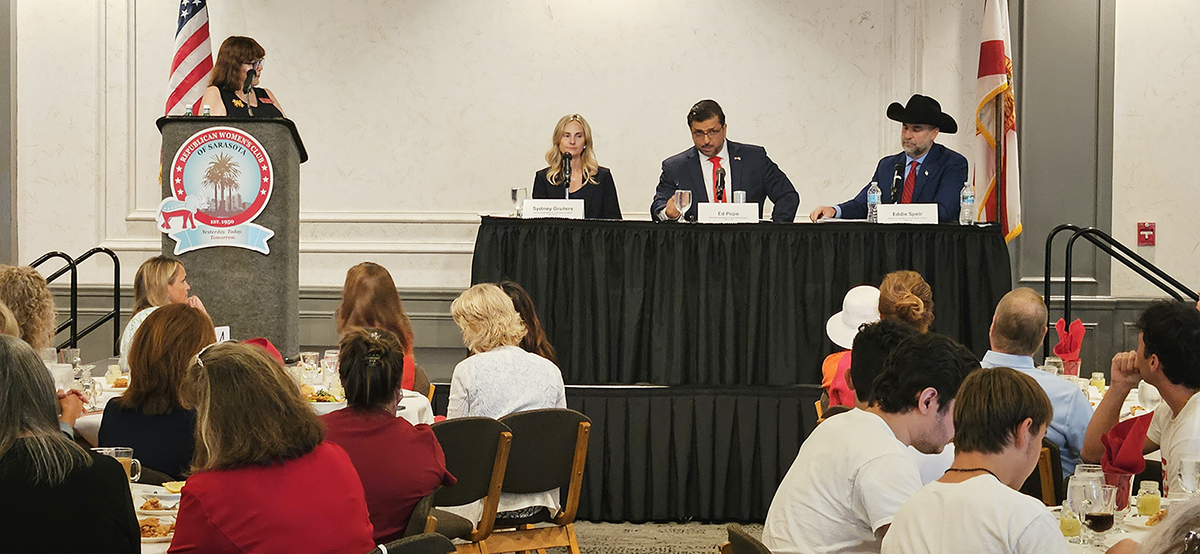
Sydney Gruters opened Friday’s Republican congressional forum by borrowing a page from B-Rabbit.
In the final rap battle of “8 Mile,” Jimmy Smith Jr. beats Papa Doc — real name Clarence, private-school graduate, still living at home with both parents — by rattling off every insult his opponent could possibly use against him. By the time Clarence gets the microphone, there is nothing left to say.
Gruters did the same thing to Eddie Speir on Friday, except he fired back anyway. At least, the parts the emcee and Republican Women’s Club of Sarasota President Linda Ivell were willing to tolerate during a political forum featuring all three GOP candidates vying for Florida’s 16th Congressional District.
Before Speir had spoken a word, Gruters predicted he would talk about her husband, Republican National Committee Chair Joe Gruters. She also predicted he would bring up her donors and that he would say she was controlled by developers because she attended an event for gubernatorial candidate Byron Donalds.
Speir would spend the next 45 minutes proving her right. It took him only one minute and 21 seconds to mention Joe Gruters, and two minutes and 24 seconds to get interrupted and nearly kicked out by Ivell.
Gruters defended her track record in her community and said she stands on her own successes while also being a proud spouse.
“I have lived in this community for over 20 years, I have worked under President (Donald) Trump’s administration, New College of Florida, and for two Congressmen — Congressman (Vern) Buchanan and Congressman (Gregg) Steube — and I am very proud of the work that I have done for them,” Gruters said.
“This is why President Trump endorsed me in the only open seat in Florida. He has put his name behind me, as well as the six Sheriffs that are in this district. I am a mother. I am a very proud wife, so let me get that out there. I’m a conservative, and I am the most experienced and qualified candidate to take this job day one.”
Speir painted Gruters as the product of a Republican establishment that rewards political connections, major donors and party loyalty throughout the event. But Gruters predicted it first, and drove home the point that she spent two decades learning the machinery of government before ever asking for a single vote.
An awkward introduction

Before the candidates began, Ivell warned that personal attacks, questions about another candidate’s motives or character, interruptions and disruptive conduct would not be permitted.
Speir flirted with those restrictions in his opening argument.
“Special interests have captured the leadership of the Republican Party and forced patronage to the candidates of their choosing,” Speir said.
Speir then turned to internal Republican Party disputes in Manatee County and state party intervention in the selection of local party officers. He invoked Joe Gruters and criticized Sarasota County School Board candidate Heidi Brandt.
That brought the first interruption of the event, just minutes into Speir’s introductory remarks.
Ivell told Speir the club would not permit what she considers unsubstantiated attacks against people on or off the stage. She also reminded him that Brandt was not running in the congressional race and directed him back to his own candidacy.
“You are to talk about you, and the fact that you’re having trouble doing that speaks volumes,” Ivell said to applause.
Ivell also noticed Speir had his phone out and instructed him to turn it off, reminding him that candidates and audience members were not permitted to record the event. Speir objected that he was using the phone for another purpose, but Ivell again made clear that recording was not allowed except for credentialed media.
The exchange established a pattern that continued throughout the event.
Speir argued he could not expose corruption or establishment control without identifying the people he believed were responsible. Ivell maintained that he had agreed to participate under rules requiring candidates to discuss their own records and policy positions.
She interrupted his response to two questions, cutting his time short each time.
Ed Pope makes his mark
Meanwhile, Ed Pope, the third Republican seeking the newly redrawn CD 16 seat, largely stayed out of the fray, though he still found ways to make his mark.
The Navy veteran, former law enforcement officer and private-sector executive presented himself as an outsider with experience in public service and business rather than partisan politics.
His delivery was more conversational than his opponents, often prefacing answers by telling the audience he was about to “share a secret” before offering what he considered a common-sense solution.
The “secret” bit became a running joke until he eventually promised no more secrets. The routine drew laughs, but Pope’s broader pitch was serious. He believes Washington has become too complicated, too political and too disconnected from the people it serves.
He pointed to more than three decades of public service, along with his work negotiating national and international contracts for a logistics company involved in delivering medications. Pope said his company helped navigate major changes in health care delivery during the COVID-19 pandemic, when more providers began treating patients in their homes and needed medications delivered reliably.
“I have not worked in politics,” Pope said. “I have been a public servant over 30 years.”
Pope also highlighted his background as a police officer and disabled veteran, arguing those experiences give him a perspective that could not be learned from roles working inside government offices or attending political events.
He said successful executives do not surround themselves with people who simply agree with them. They hire people willing to challenge assumptions, identify problems and explain when an idea does not make sense.
That included Trump.
“I’m going to share another secret,” Pope said. “I don’t care who you are. We make mistakes. We do, okay. I voted for President Trump. I support President Trump. But you know what? Sometimes he gets things wrong. It’s proven.”
Pope pointed to administration officials Trump later fired and candidates he endorsed who went on to lose, arguing that even strong leaders need advisers willing to push back.
“Leadership is not a title, it’s an action,” he said. “And you are only as good as a leader based on the people you surround yourself with. That model follows everyone.”
Pope offered himself as the candidate who had spent his career managing people, solving practical problems and making decisions outside the political bubble.
“I’m not running on endorsements, and I am not running because I’ve got an ax to grind on local corruption,” Pope said. “I’m running on service, leadership and results.”
Gruters leans on experience and constituent services
Gruters’ answers throughout the remainder of the forum reinforced the case she made in her opening remarks, indicating that her experience working within government has prepared her for serving on Capitol Hill.
Her first priority would be opening district offices and preventing a lapse in constituent services when Buchanan, who the candidates are seeking to replace, leaves Congress.
Gruters said residents throughout Pinellas, Manatee, Sarasota, Hardee, DeSoto and Polk counties should be able to call her office for help with Social Security, veterans’ benefits, federal disaster assistance and other government agencies.
“When a senior calls and needs help with their Social Security, they don’t care that there is a new representative and the old representative has retired,” she said. “They need assistance immediately, and it is my commitment to Pinellas County, Manatee County, Sarasota County, Hardee County, DeSoto and part of Polk, that they will have … access to myself and my staff if they are having an issue with the Federal Government.”
Gruters said serving the newly redrawn district — which now spans six counties — would require maintaining a visible presence across coastal communities, fast-growing suburbs, agricultural areas and rural counties.
She said the new congressional map changed the nature of her campaign, producing long days that begin near her home in east Sarasota County and can carry her through DeSoto, Hardee, Manatee and Pinellas counties before returning to Sarasota.
The addition of Pinellas County to the district as part of mid-decade redistricting also required Gruters to introduce herself to a new group of voters and community leaders. She acknowledged that she did not initially know many stakeholders in St. Petersburg and some beach communities, but said repeatedly visiting the area has already allowed her to develop relationships there.
Gruters said she entered the race with more established connections in Hardee and DeSoto counties through her work with the U.S. Department of Agriculture during the Trump administration. She said that experience also gave her an understanding of the challenges facing farmers and citrus growers in the district’s rural communities.
“You have to have a presence,” Gruters said. “You have to get to know each community the best that you can and give them the confidence that you care and that you’re going to show up when it matters.”
Asked about support for the Trump agenda, Gruters said his endorsement reflected the President’s familiarity with her character, values and work ethic, and warned that losing the Republican majority in the U.S. House would allow Democrats to obstruct Trump and possibly lead to a third impeachment.
“We need to make sure he has another two years and he has the support in the House,” Gruters said. “If not, the Democrats will impeach him on day one … and it will be chaos.”
She said accomplishing Trump’s priorities would also require building relationships with other members of Congress.
“You can’t go up there and just say, ‘I’m going to burn the whole place down.’ It doesn’t work that way,” Gruters said.
Gruters also called voter identification a “no-brainer.”
“I think a lot of the people who are concerned about it are women’s groups. As a woman, I think I can say this. I find it very insulting that we are not able to figure out how to get an ID if we get married or if we change our name. We are more than capable,” Gruters said.
“Every state has agencies and services in place that can help women get their necessary documentation if they are unable. I’ve gone through this and its not hard. Everyone should have a Voter ID to vote in an American election.”
Gruters also supported recently approved bipartisan housing legislation, particularly provisions intended to prevent large investment firms from buying starter homes and pricing out individual families.
She recalled purchasing her first home more than 20 years ago and said “there is no way we could have competed with a big firm that’s paying cash.”
Gruters said she began her career as a congressional staffer in 2004 and had watched the quality of candidates seeking federal office decline. Too many people reach Congress without the experience to perform the job, she argued, while others use public office to build their personal wealth.
Gruters said she supports congressional term limits and a ban on stock trading by members of Congress.
“I want to serve this community because its what I’ve been doing for 20 years,” Gruters said. “I’m not running on an endorsement. If I was running on an endorsement I wouldn’t be here right now. I wouldn’t be going to Pinellas and Polk and Hardee every single day.”
Pope pitches practical leadership
Pope argues Washington needs people who have led employees, solved real-world problems and made difficult decisions outside the political bubble.
His first priority would be congressional term limits, arguing lawmakers who remain in Washington for decades become disconnected from voters and prevent younger leaders with new ideas — particularly those with a better understanding of technology — from entering government.
Pope said regular turnover could also weaken the power of entrenched donors, political organizations and endorsers.
He carried that philosophy into his answer about working with Trump. Pope made clear that he supported the President, but said support should not require pretending Trump is incapable of making a mistake.
Pope also proposed creating advisory councils with members from the six counties who understand the distinct problems facing individual communities.
“You have to get members of the community that are familiar with the issues and the problems in order to understand,” Pope said.
On election integrity, Pope said proof-of-citizenship and voter-identification requirements are “common sense.”
“People that are invested in their communities, people that are invested nationally, that pay their taxes, they’re the ones that have the right to vote,” Pope said. “Not someone that comes in here illegally and tries to manipulate the system.”
On affordability, Pope blamed unnecessary regulations, high interest rates and rising construction costs for putting homeownership increasingly out of reach for younger families.
“Congress’ responsibility should be cutting unnecessary regulations to allow people and companies to build homes and allow these young people to be able to purchase their first home,” Pope said.
Speir promises to confront the establishment
Speir himself had difficulty separating his policy positions from his argument that political institutions, major donors and special interests have corrupted government.
His first priority would be returning Congress to single-subject legislation, preventing lawmakers from burying unrelated spending and policies inside omnibus packages.
Speir also called for breaking up Big Tech monopolies and repeatedly questioned whether candidates who accept money from powerful industries would be willing to confront them after taking office.
On election integrity, Speir said he supports the SAVE Act that would require proof of U.S. citizenship to vote. He said elections should ordinarily be administered by state and local governments, but added that the country had reached a crisis requiring federal action.
Speir also highlighted his brief tenure as a New College of Florida trustee. He took credit for helping eliminate diversity, equity and inclusion programs, removing gender-studies programs and launching an athletics program. Speir said he did the work without compensation and offered it as evidence that he could produce results when given institutional authority.
Spier called affordable housing a “canard” used to justify higher-density development and profitable rezonings. He proposed changing the federal 1031 tax exchange provision, arguing developers use the tax code to profit from property transactions while shifting infrastructure expenses onto existing residents.
While all three candidates committed to endorsing whoever wins the Republican Primary, Speir returned to his criticism of Gruters in his closing remarks, urging voters to closely examine her campaign’s finances.
“Make sure that you follow the money. Follow the money. See who is bought and paid for, see who is already pre-bought and prepaid for and who’s not,” Speir said.
He then delivered the attack Gruters had warned the audience was coming.
“I’m going to ask you to ask yourself. Question: if Joe Gruters wasn’t the RNC Chair, if he didn’t have a relationship with Trump, would that endorsement have happened?” Speir wondered aloud.
The Republican Primary is Aug. 18. The winner will advance to the Nov. 3 General Election.