
Politics
Winner and Loser of the Week in Florida politics — Week of 4.12.26
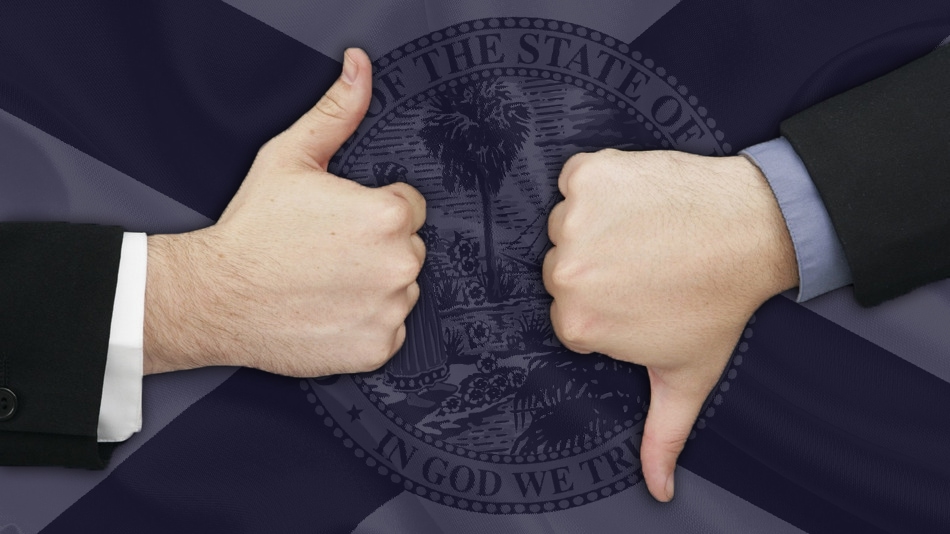
For years, Florida has sold itself as a state outperforming the rest of the country economically.
Now, some of the pillars of Florida’s growth model are starting to wobble. Florida’s unemployment rate has climbed above the national rate for the first time in nearly five years, rising to 4.5% in January, with about 499,000 Floridians out of work. Consumer sentiment in Florida also fell in March for the first time this year as households grew more anxious about the broader economy.
It’s not a huge surprise that Florida is experiencing some issues given the moment. The war in Iran has ripped through global energy markets, knocking more than 500 million barrels of oil off the market, while crude surged 64% in March, hit a peak of nearly $120 a barrel, and was still hovering near $100 this week.
That is not just a foreign-policy headache for Washington. It is a direct threat to states like Florida, where long drives, construction and consumer spending all get more painful when fuel gets expensive.
Nationally, the housing market is already feeling it: homebuilder sentiment fell to a seven-month low in April, and mortgage rates are jumping as war-driven inflation fears spread.
So, is Florida’s bubble bursting? Not quite yet. But the old swagger suddenly looks less convincing. And the longer this war of choice goes on, the threat to Florida’s dominance will only increase.
Now, it’s onto our weekly game of winners and losers.
Winners
Honorable mention: Florida Democrats. As we’ve written previously, Democrats have recently gotten reasons for hope about 2026. This week saw those reasons for optimism continue.
This week started with an MDW/EDGE poll, which absolutely comes with an asterisk. The firms behind it are Democratic-aligned, and Republicans are right to note that before anybody starts assuming Florida is going blue in November.

But even with that caveat, the numbers are still attention-getting. The survey of 1,834 likely found David Jolly trailing Byron Donalds by less than a point, Alex Vindman trailing Ashley Moody by just over a point, and José Javier Rodríguez leading James Uthmeier by nearly 3 points. Democrats also held a narrow edge on the generic congressional ballot, 46.0% to 45.2%.
That isn’t proof Florida is blue. It is proof the usual GOP air of inevitability looks a little less inevitable than it did a few months ago.
The more politically useful part of the poll isn’t even the horse-race numbers. It is why they are close. The memo found Donald Trump underwater statewide by 6.1 points and absolutely toxic with no-party voters at -39.3. That same bloc broke 51.9% to 25.7% for Democrats on the generic ballot in the survey.
If that pattern is even half-real, Republicans could have a problem, because Florida GOP dominance has depended on crushing Democrats with independents or at least keeping them from drifting too far away.
And then came the part Democrats probably enjoyed most: Ryan Tyson affirming that Republicans can’t take this cycle for granted. Tyson is not some far left MS NOW enjoyer. He is one of Ron DeSantis’ top pollsters. And even he is admitting that while Democrats winning statewide is still unlikely, it isn’t impossible.
Nobody should get carried away. Florida is still hard terrain for Democrats, and a few friendly polls don’t erase years of pain. But there are at least signs of life, and more of those signs popping up in the coming weeks and months will continue to fuel Democrat’s hope.
Almost (but not quite) the biggest winner: Haitian Floridians. The House voted 224-204 this week to extend temporary protected status (TPS) for Haitians for three years, a rare bipartisan rebuke to Donald Trump’s immigration line and a genuine jolt of hope for families whose status has been hanging in the balance.
The bill would protect roughly 350,000 Haitians from deportation. And if you’re wondering how this bill got through a GOP-controlled House, that’s thanks to several South Florida Republicans helping to push it through.
With the Senate still needing to pass the bill, this doesn’t finish the job. But it is a sign enough House Republicans are willing to play ball, perhaps on a larger compromise — unless the courts act first
South Florida is home to the nation’s largest Haitian community. That explains why Republican U.S. Reps. Mario Díaz-Balart, Carlos Giménez and María Elvira Salazar joined Democrats in backing the bill.
The Trump administration moved to end Haiti’s TPS protections, but lower courts blocked that move, and the Supreme Court is set to hear arguments on the dispute. That could also provide an out for Haitians averse to returning to a still dangerous country, given that the Senate and White House may not play ball.
But after months of legal limbo, Haitian Floridians got something they have not had enough of lately following the House’s move: a visible, bipartisan public win.
The biggest winner: DeSantis. On paper, DeSantis looks like he took a hit this week. His much-hyped redistricting Special Session got bumped back a week, and the path on maps is still murky. Senate President Ben Albritton has already told Senators they are not drafting their own proposal and will instead wait for one from the Governor’s Office. The Governor’s Office, meanwhile, is saying lawmakers should lead.
But the delay is also giving DeSantis runway to focus on his one true passion during his time leading the state: stoking needless culture wars.
DeSantis hasn’t just postponed the redistricting Special Session — he expanded it. Now, along with congressional redistricting, he wants lawmakers to take up leftovers from the Regular Session by passing his “medical freedom” push on vaccines.
The vaccine bill would expand school-age vaccine exemptions by creating a new “conscience” opt-out, which would essentially serve as a blanket way to further undermine the effectiveness of vaccines in the state (more on that later).
And DeSantis is also trying to revive a pet project to establish an AI bill of rights as he continues to pump up his anti-artificial intelligence bona fides ahead of a possible 2028 run.
So what looked like a scheduling snafu is giving DeSantis a fresh chance to drag his preferred fights back onto center stage. The delay also gives DeSantis more time to pore through proposed budget plans and consider potential vetoes once lawmakers finally agree on a spending deal.
So yes, DeSantis was forced to delay his redistricting plan while he continues waiting for the Callais decision from the Supreme Court, and there is more chatter than ever questioning whether this plan will even go forward at all.
But all that does is allow DeSantis time to cook up more red meat for his base to get some attaboys from his bot army on X. And what more could he ask for?
Losers
Dishonorable mention: Joseph Ladapo, Department of Health. This is what happens when the people in charge of public health start treating vaccine skeptics like a potent political constituency.
Florida’s childhood immunization rates keep sliding, and the state is now paying for that slide in exactly the way doctors warned it would. Kindergarten vaccination coverage is sitting below 89%, far below the 95% level generally needed for measles herd immunity. At the same time, Florida’s measles outbreak has blown past anything the state has seen in years.
By early April, Florida had recorded more than 140 measles cases and ranked fourth in the country for 2026 cases, with at least 107 of them in Collier County alone.
We’re now moving beyond abstract policy arguments and facing real-world consequences all because some parents feel inconvenienced by school-entry rules.
And Surgeon General Joseph Ladapo has been a leading architect on this mess. Last September, he declared vaccine mandates “wrong” and said Florida would work to end all vaccine mandates in state law.
The Department of Health then moved to strip four vaccines — chickenpox, hepatitis B, pneumococcal conjugate, and Hib — from the rules it can change on its own, while allies in the Legislature pushed bills to create broader opt-outs based on parents’ conscience. That push stalled this Session, but not for lack of effort, and Gov. Ron DeSantis has already signaled he wants vaccine exemptions back in play.
None of this was hard to foresee. Johns Hopkins recently warned that Florida’s MMR coverage is below national levels and that its nonmedical exemption rate among kindergartners is higher than the U.S. median.
In plain English: fewer kids are protected, more parents are opting out, and it’s largely because the state’s leadership has spent months feeding the idea that routine vaccination is some oppressive government overreach rather than one of the most basic functions of modern public health.
Almost (but not quite) the biggest loser: Jay Collins. Collins felt compelled this week to declare there was a “0% chance” he was suspending his campaign and call the exit chatter a “100% bullshit rumor,” then went on the radio to insist, again, that he was staying in and “in this to win it.”
Collins canceled campaign multiple events during the week, leading to the speculation. His team tried to explain away the movies, blaming scheduling issues, and the internet rumor mill certainly exacerbated the speculation here.
But can you blame people given the reality of the race? Collins is continuing to flounder in polls, endorsements and the money race. When you are getting flattened in all aspects and appearances start being canceled, people are going to wonder whether the end is near.
Serious candidates spend their time raising money, consolidating support and expanding their path. Struggling candidates spend their time telling everyone they’re in this to the end. Collins is now doing the latter in public.
And once you are publicly reassuring people that you are not dropping out of an election, you’ve already lost.
The biggest loser: University of South Florida. Making sure you effectively protect free speech rights while hosting a person like James Fishback, whose sole ethos is to stoke controversy, is a tricky balancing act for any university, to be sure.
USF showed those difficulties this week in its failure during a Fishback event.
Three students say they were denied entry to the campus event, which should have otherwise been open. All three were Jewish.
In a statement, the university said one person was turned away because event representatives reported that those individuals had made threats at similar events on other campuses. The others, USF said, had tried repeatedly to skip the line.
“University personnel made decisions to deny access to the event strictly based on the information they received about behavior observed at the USF event and at past events. No university decisions were made based on the appearance or perception of religious beliefs or affiliations. USF does not tolerate antisemitism and any other harassment, discrimination or hateful expression targeting individuals because of their religion, shared ancestry or cultural heritage,” the statement said.
That sounds like a plausible defense until you factor in this bit that we reported: “Fishback’s team handled security on its own, and USF police were present but not in charge. Instead, Fishback’s team decided who could enter.”
“Fishback’s team spoke with USF police and told them the three students were not allowed in,” the report continued. “After that, USF police denied the students entry without providing a reason.”
Now that process appears way more flimsy, especially for a candidate who has courted multiple accusations of antisemitism during his campaign.
Why wouldn’t USF put some more independent safeguards up to make sure this event was run properly? It’s especially troublesome considering that eyewitnesses reported antisemitic remarks while waiting in line.
Fishback thrives on chaos. USF’s mistake was letting his chaos become its own.