
Business
Tesla cofounder JB Straubel’s failed pitch to Elon Musk led to a $1.3 trillion success story

Before Tesla became a $1.3 trillion juggernaut eyeing a potential megamerger with SpaceX, Elon Musk was writing a check to a then-27-year-old Stanford engineer who couldn’t get anyone to take his electric car idea seriously.
JB Straubel had spent years building solar-powered vehicles in his spare time “basically as a hobby,” he told Fortune earlier this month on the sidelines of Brainstorm Tech in Aspen, Colo. “That was sort of my pathway into becoming passionate about electric vehicles, and then also meeting Elon, ultimately.”
But when he made his first pitch to the now-world’s richest person during a fateful lunch in 2003, it had absolutely nothing to do with cars. Straubel, a recently minted Stanford master’s graduate, sat across from satellite pioneer Harold Rosen and Musk, a “PayPal Mafia” member fresh off the company’s sale to eBay. He was hellbent on pitching the multimillionaire on an unmanned, hydrogen-powered airplane.
“I was seriously pitching the electric airplane idea to him, and he had absolutely no interest in it,” Straubel told Stanford students during a 2024 fireside chat. Instead, Straubel pivoted to his other passion: building an electric sports car powered by the same lithium-ion cells found inside laptop computers.
“I was kind of shameless in those days just telling everybody I could talk to about this stuff, seeing if anyone would give me a few thousand dollars,” he recalled, adding that Musk “immediately wrote a check.”
Within weeks of that lunch, the two were sketching out plans for a high‑performance electric sports car, and Musk soon led Tesla’s first major funding round. Straubel formally joined the company in 2004 as its fifth employee and chief technology officer. In that role, he developed the battery pack used in Tesla’s first vehicle, the Roadster, bundling nearly 7,000 battery cells together that delivered 244 miles of range, further than other EVs at the time.
Fortune/Katie Fehrenbacher
Inside Tesla’s early days
Straubel quickly became the architect of Tesla’s core technology, driving everything from battery manufacturing, to the groundwork for the company’s Supercharger network, to planning its first Gigafactory. Dubbed the “Woz to Musk’s Jobs” in a 2019 Bloomberg profile, Straubel’s name appears on a large share of Tesla’s early patents. After a 2009 legal settlement resolving a bitter feud over the company’s origins, Straubel was officially recognized as a cofounder alongside Musk, Martin Eberhard, Marc Tarpenning, and Ian Wright.
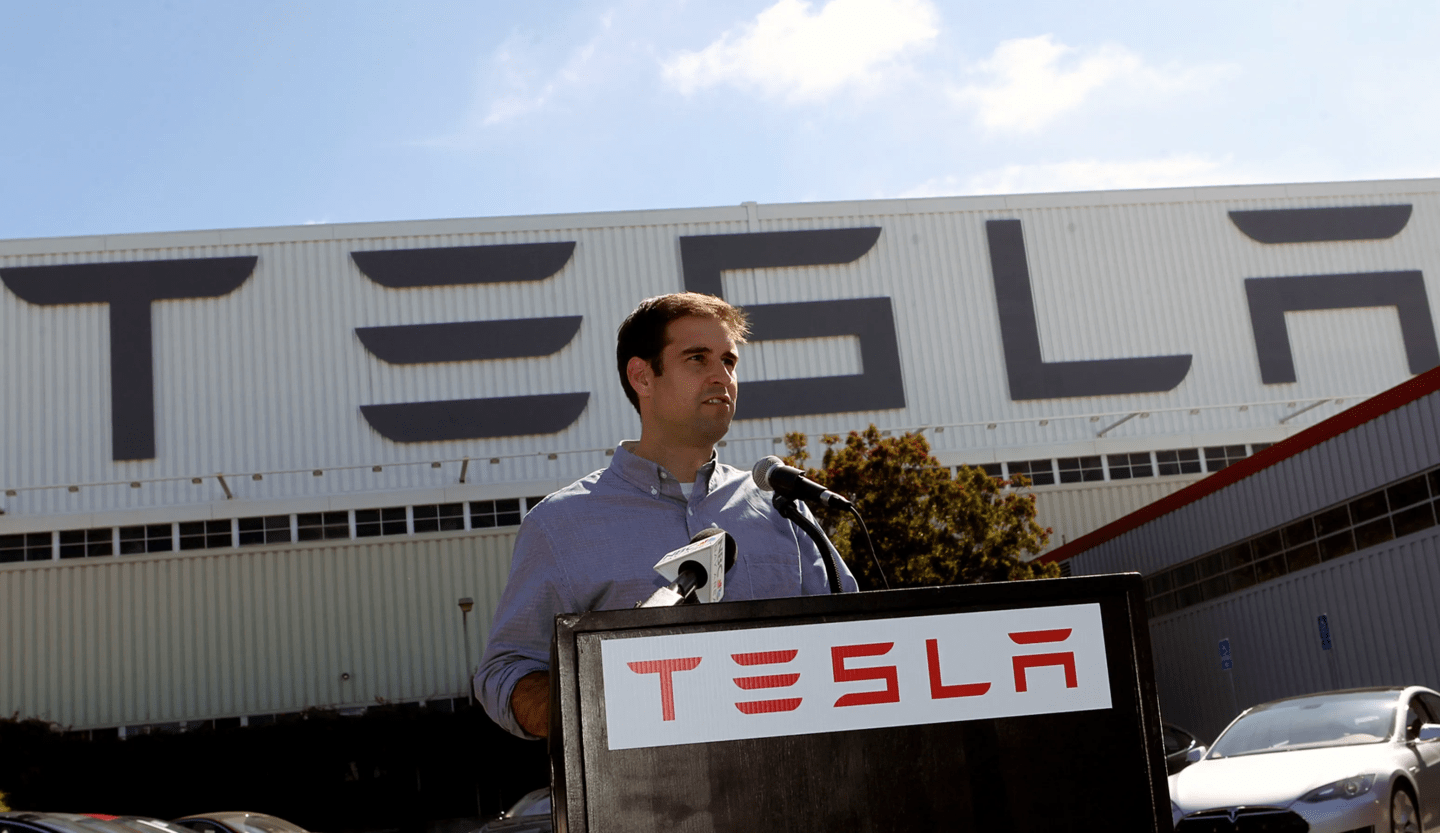
Straubel described Tesla’s early years as “incredibly fun, but also stressful.” Indeed, the carmaker’s history was marked by internal power struggles, brushes with bankruptcy, and technical setbacks as a small team sought to build a sports car out of thousands of laptop batteries. A now-iconic photo captures Straubel in his backyard, hand-gluing lithium-ion batteries into a case for what would become Tesla’s first prototype.
“Those are some of the fondest memories I have, because it was a tight-knit group of people trying to do something very hard, but something that we all basically would do for free, and felt it was important for the world and needed to be done,” he recalled, adding the group assumed Tesla was “probably as likely to fail as not.”
Musk has been more blunt in his retelling of the company’s origins. During a 2016 shareholders’ meeting, he said he had given Tesla only a 10% chance of succeeding in its early days, and admitted the team had “no idea what we are doing.” He has expressed similar criticism about SpaceX, which endured three consecutive rocket failures and came close to bankruptcy in 2008 before ultimately staging the largest IPO in history. Speaking to employees before ringing the opening bell on its first day of trading earlier this month, Musk said he gave SpaceX the same low odds of survival when he founded it in 2002. “I gave SpaceX less than a 10% chance of succeeding at all,” he said of the company that would go on to power his rise as the world’s first trillionaire.
It wouldn’t be until 2006 that Tesla unveiled its first‑generation Roadster prototype, an electric sports car able to travel 200 miles on a single charge and accelerate from zero to 60 mph in just under 4 seconds. Regular production began in 2008, and the first model year quickly sold out.
“[Elon] was inspiring even way back then,” Straubel recalled to Fortune. “I loved working with a group of engineers we pulled together. We were all very like-minded and banded together around a very similar mission.”
Anda Chu — AP
From Tesla to battery supply chain
After 15 years as Tesla’s chief technologist, Straubel left to focus on Redwood Materials, a battery‑recycling startup he founded while still at the automaker. In an earnings call announcing the departure, Musk said: “If we hadn’t had lunch in 2003, Tesla wouldn’t exist, basically.” One Wall Street analyst, Alexander Potter of Piper Jaffray, credited Straubel as “probably the second-most-important person” at the company.
Straubel’s startup has raised over $2.3 billion in venture funding from firms and strategic backers including Google, Microsoft, and Nvidia’s NVentures, among others. In 2023, Redwood also secured a $2 billion conditional loan from the Department of Energy’s Advanced Technology Vehicles Manufacturing program, the same initiative that helped put Tesla on the map. Today, Redwood is valued at roughly $6 billion according to TechCrunch, and counts Volkswagen, Volvo, Toyota, and BMW as its partners.
Straubel didn’t stray for long from his old company, however. In 2023, he joined Tesla’s board of directors.
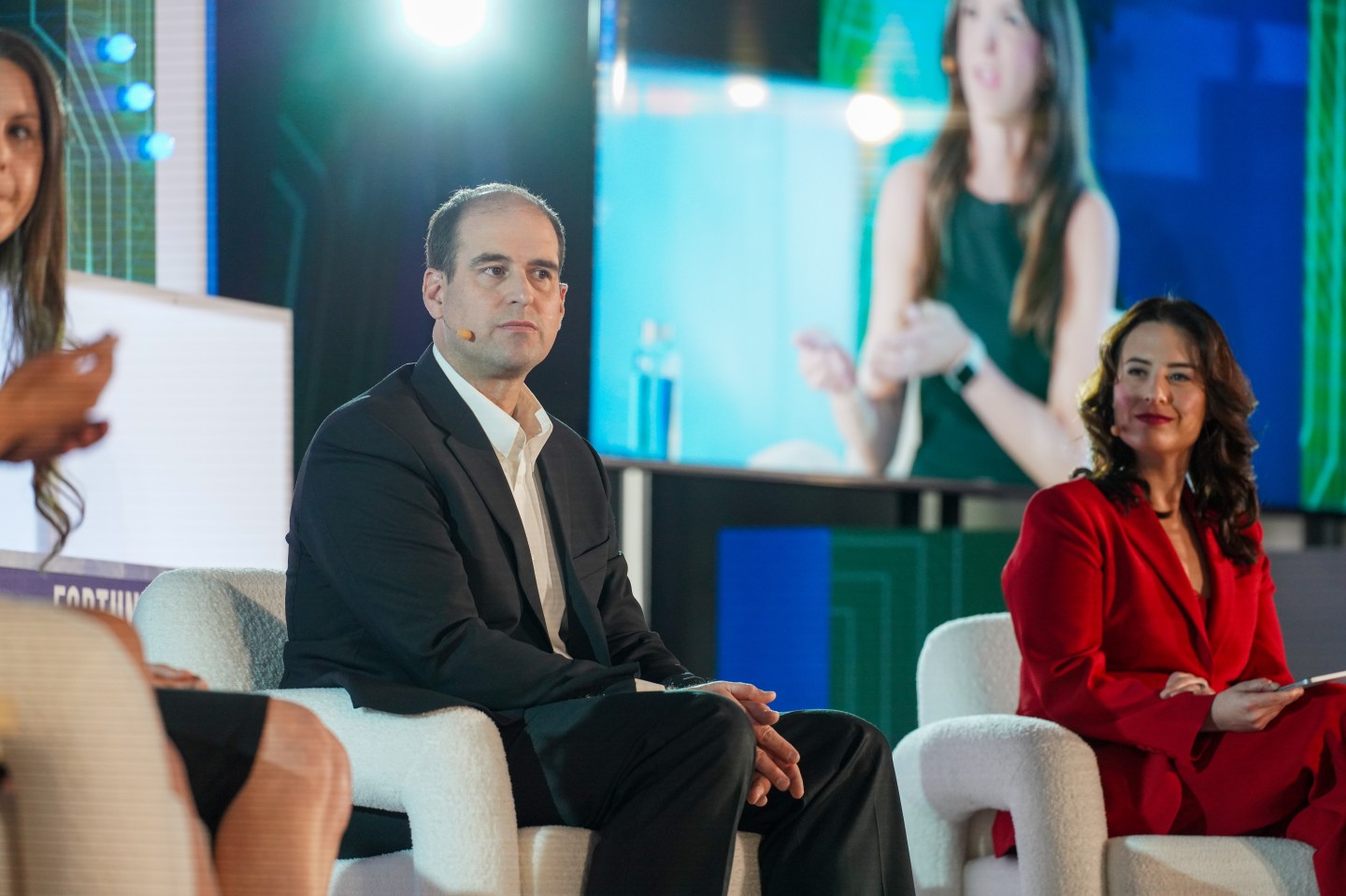
Now, Straubel is trying to solve the supply chain problem that could define the next phase of EVs and AI infrastructure. Onstage at Fortune’s Brainstorm Tech conference, Straubel warned the U.S. grid is already straining under the surge of new data centers built to fuel the AI boom.
“The pace of growth and demand of energy is unprecedented,” he told Fortune’s Allie Garfinkle.
Tesla cofounder’s advice for future entrepreneurs
Two decades after taking a chance on a small startup, Straubel distills his advice to future entrepreneurs and engineers down to a willingness to pursue hard problems, even if the odds don’t look great.
“You have to be willing to dive into something, even if you’re reasonably sure it might fail,” he told Fortune. “It’s still worth doing.”
That often means tuning out the skeptics.
“As an entrepreneur, you will receive 10 or 20 people telling you everything you’re doing is a bad idea, it’s not going to work, you should try something else,” he said. “There have been so many [times] where people said a certain investment was a bad idea, said Tesla was a terrible idea, all those different things.”
Among some of Tesla’s early backers were Google cofounders Larry Page and Sergey Brin, who allegedly considered buying the carmaker in 2013 when it was on the verge of bankruptcy. Musk gave the two executives a test drive in an early Roadster, but due to a bug in the car’s system, the vehicle wouldn’t drive above 10 miles per hour.
“I was like, ‘Look, I swear guys it goes way faster than this,’” Musk said during a 2016 shareholders’ meeting. “They were kind enough to put a little investment into the company nonetheless, despite the world’s worst demo.”
Despite the early setbacks at Tesla, Straubel said he learned to follow his passion, and advises others to believe in what they’re building.
“Follow something that really matters to you as a founder, an entrepreneur, or an engineer,” he said. “Try not to get caught up in what other investors may say is the right thing to do, or what may seem trendy at the moment.”
That often requires ignoring the contrarians.
“I had mentors in the early days who really just pushed me to think bigger and pushed me to focus on what I was really passionate about,” he said. “When you’re challenged and you want to try something smaller, you want to be a little bit safer, it’s hard to think big, but in hindsight, on something that’s been very successful, I always wish I would have dreamed bigger or tried bigger, scaled faster.”
To succeed, Straubel said: “You really have to have the personal conviction to know that what you’re doing is fundamentally worthwhile.”