
Politics
Tampa’s stadium debate is starting to sound a lot like St. Pete’s
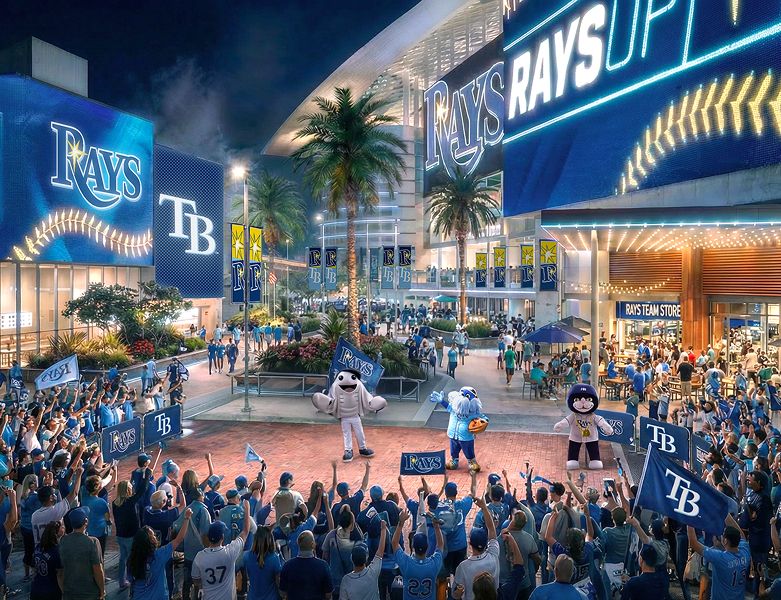
For months, Mayor Ken Welch has taken political heat for the collapse of a deal to keep the Tampa Bay Rays in St. Petersburg, with critics accusing him of fumbling what was supposed to be a transformational redevelopment project for the city.
But as Tampa and Hillsborough County officials now wrestle publicly with their own proposed Rays stadium agreement, the debate across the Bay is beginning to sound strikingly familiar.
The same questions that plagued a Rays’ deal in St. Petersburg for years before one was finally struck are now surfacing in Tampa: How much public risk is too much? And, perhaps more importantly, if redevelopment is the true prize, does it truly require a $2.3 billion ballpark attached to it? It’s worth noting that the deal that was ultimately reached failed after Hurricane Milton damaged Tropicana Field and the team decided to play its next season in Tampa, causing delays to the deal that ultimately killed it.
Still, tensions were on full display during a lengthy Tampa City Council workshop this week. Rays CEO Ken Babby and Hillsborough College President Ken Atwater mounted an aggressive public push urging Tampa officials to finalize a memorandum of understanding (MOU) before a rapidly approaching June deadline tied to the team’s desired 2029 opening timeline.
However, Tampa officials focused less on baseball and more on whether the region could justify the financial exposure attached to the project.
“We could spend $1 billion with the county to fund a real estate project without a ballpark” Tampa City Council member Bill Carlson told Babby. “I know you are a huge fan of baseball. Could you just tell us what are the reasons … that baseball in particular is such a good investment for the community?”
Babby argued Wednesday that the economic impact of an entertainment district anchored by a major league sports team, as well as a Hillsborough College campus, is significantly higher than a district without one.
“The economics of Major League Baseball bring 81 home games to your community, and we’re talking about the Rays, so that means we’re talking about playoffs as well,” he said.
He said a Rays ballpark would add to the city’s portfolio of major venues. But in defending the proposal, Babby was also forced to acknowledge the benefits he touts in a new baseball stadium development already exist not far away where the Tampa Bay Buccaneers and Lightning play.
“You’re talking about world-class events. You’re talking about concerts. You’re talking about collegiate events, festivals, all of which would not be possible without a climate-controlled indoor stadium in Tampa,” Babby said.

“Look at the work of the other teams in our community, in how they have successfully — of which this body has made investments in wisely — to be able to achieve events like we’ve had at Raymond James Stadium and at Benchmark Arena. Each of those facilities took bold investment to be able to achieve Super Bowls, world-class concerts, events, festivals and championships.”
The city already possesses a growing collection of major sports and entertainment venues, including Raymond James Stadium, Benchmark Arena and the Tampa Convention Center — all of which either already receive public support or are expected to seek future public investment. That begs the question: How much more are Tampa residents willing to pay for sports venues?
The Tampa Bay Buccaneers have already announced plans to redevelop Raymond James in a way that will likely include shading solutions similar to a $1.4 billion renovation of EverBank Stadium in Jacksonville or shading at the Hard Rock Stadium in Miami. The Camping World Stadium in Orlando is undergoing its own renovations, and would likely serve as a temporary home base for the Buccaneers as proposed renovations take place.
And a lack of a rooftop did not stop BTS from successfully launching its long awaited “ARIRANG” World Tour with sold out shows on April 25, 26 and 27 at Raymond James Stadium, drawing an estimated 190,000 fans to the venue and the attention of many more from across the globe in the process, according to the Tampa Bay Times.
Meanwhile, Hillsborough and Tampa officials have acknowledged mounting uncertainty surrounding the financing structure for the Rays stadium deal.
The Rays proposal requires so much public funding that the city and county would ultimately need to bond large amounts of future Community Investment Tax (CIT) revenue upfront to satisfy the Rays’ funding demands. That has prompted growing uncertainty after state lawmakers eliminated the state sales tax on commercial leases and continue to push for property tax reform that would gut a major local revenue stream.
County staff recently revealed the situation is not as simple as it seems. They warned that keeping portions of the borrowed money tax exempt would require staying below a certain amount of borrowed money — thresholds the Rays themselves have resisted increasing because doing so could significantly raise debt service costs, records show.
To bridge the gap, staff indicated that Hillsborough County may ultimately need to tap reserve funds originally intended for other purposes to avoid borrowing higher amounts. City and county officials have also raised concerns that CIT revenue may not meet projections, raising questions about how local governments would repay bonds if they ultimately borrow more than the tax can realistically support.
Those concerns are similar to the financial anxieties that emerged in St. Petersburg before the collapse of the Gas Plant District agreement, where hurricane-related costs, construction inflation, delayed financing approvals and questions about public exposure gradually shifted the political conversation away from baseball and toward broader redevelopment priorities.
Even Welch himself began signaling months ago that the Rays’ desired 2029 stadium timeline may not be realistic.
He said as early as November that he believed a lease extension at Tropicana Field would “probably have to happen” and acknowledged the city may ultimately pursue a “whole different funding model” if stadium talks resumed in St. Petersburg.
The Rays have not signaled a desire to return to St. Petersburg as a long-term home for the team under its new ownership, but other locations such as Orlando or places out of state could soon be under consideration if Hillsborough and Tampa don’t meet the Rays self-imposed June deadline for a funding deal.
Simply put, the central question for years was whether the region could afford to lose the Rays. Now officials are asking whether the community can afford to keep them. And it means the Rays issue is still far from settled in the Tampa Bay region.