
Fashion
One year on from its founder’s death, Armani faces an “inevitable evolution”
By
Reuters
Published
September 4, 2026
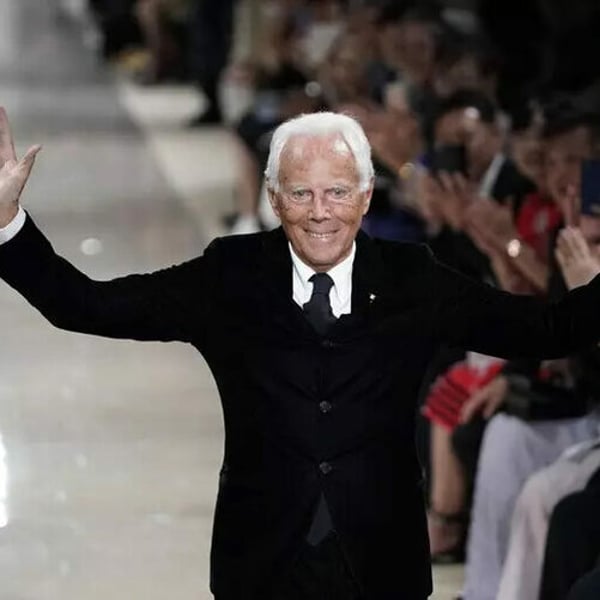
One year after the death of its founder, Giorgio Armani, the Italian fashion house, is entering a pivotal phase. Meanwhile, the planned sale of an initial stake is edging closer, following a year in which the group focused on corporate governance.
Armani, who died on September 4, 2025 at the age of 91, stipulated in his will that an initial stake of around 15% in the company should be sold within 12 to 18 months of his death. Thereafter, either a larger stake would be sold or an initial public offering (IPO) pursued. However, industry executives and analysts warn that, a year on from the late designer’s death, his heirs and advisers must now prioritise the company’s evolution to keep the brand contemporary and relevant.
“Continuity is the right decision to get through the first year. It becomes a risk, or could become one, if it turns into inertia,” said Francesco Fiorese, a partner at the management consultancy Simon-Kucher. According to Fiorese, the real test for the company will be “to transition from a succession model based on Giorgio Armani’s legacy to a more autonomous system capable of making its own decisions while preserving the brand’s identity.”
The Armani Group declined to comment.
Last year, Armani’s turnover fell by 2.8% at constant exchange rates to 2.2 billion euros (2.56 billion US dollars). At the same time, investors remain cautious about the luxury-goods sector, as the war with Iran drags on and consumer spending in China slows.
CEO Giuseppe Marsocci, a long-serving executive at the group, is currently drawing up a new business plan. Speaking at an event in July, he said Armani would not rely on short-term fixes. At the same time, the company intends to remain true to the founder’s long-term vision: a pared-back, elegant style with particular attention to detail and wearability.
Armani remains in a transitional phase and is seeking a new equilibrium, he said. In this process, the founding family is working closely with new board members, including former Gucci CEO Marco Bizzarri.
Marsocci cited a joint venture to develop new Armani Hotels & Resorts as an indication of future strategic moves. “The major challenge will be to maintain the balance between the identity that defines us and the inevitable evolution that we must drive forward,” he said.
In his will, Armani named the French group LVMH, as well as licensing partners EssilorLuxottica and L’Oréal, as potential buyers- or another luxury group of comparable size and significance. The fashion house, which according to sources is working with Rothschild as financial adviser on the sale, had net liquidity of 500 million euros at the end of 2025.
Two people familiar with the matter said there was no pressure to finalise the sale. Furthermore, the deadlines set out in the will were not strictly binding.

The process is likely to gather pace in the coming weeks. However, a deal could be postponed if market conditions do not allow for an appropriate valuation, according to the sources. Bankers and advisers interviewed by Reuters estimate the group’s value at around 5 to 7 billion euros.
For L’Oréal and EssilorLuxottica, a stake in Armani would help secure the licensing agreements that generated revenue of almost 2 billion euros for the two groups last year- as well as royalty income for Armani.
“The licensing agreements with L’Oréal and EssilorLuxottica have been profitable. Given rising market demand for more accessible entry-level products such as accessories and beauty, amid falling consumer spending, these areas offer great potential for further growth,” said Gonzalo Brujó, CEO of the management consultancy Interbrand Global.
EssilorLuxottica is interested only in a smaller stake and could consider a partnership with other bidders, said two people familiar with the matter. L’Oréal has little interest in entering the fashion business but wants to secure a beauty licence running until 2050, said another person familiar with the matter.
LVMH, which is large enough to integrate the fashion, eyewear, and beauty sectors, has closely examined the possibility of a standalone investment, said a source directly familiar with the matter. However, LVMH tends to retain control of the brands in its portfolio. An initial public offering (IPO) could complicate any bid for Armani should the heirs decide to list the company, the source said.
EssilorLuxottica declined to comment, while LVMH could not immediately be reached for comment.
L’Oréal told Reuters by email that the group’s position on a possible stake in Armani had not changed and that it felt honoured that Armani had named the French cosmetics group as a potential buyer. “L’Oréal will examine this opportunity, which builds on our long-standing shared history, as soon as representatives of Armani S.p.A. are ready to enter into discussions,” the statement continued.
© Thomson Reuters 2026 All rights reserved.