
Politics
Hillsborough County outlines risks tied to $1B Tampa Bay Rays ballpark proposal
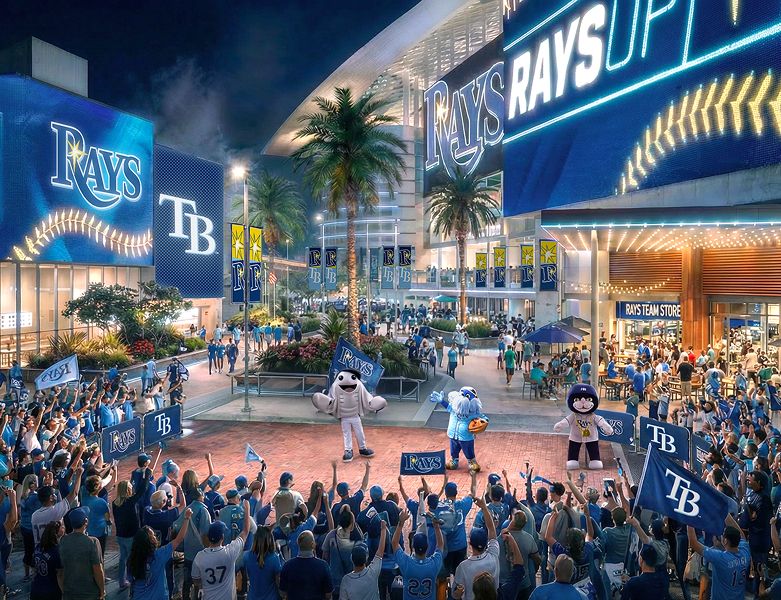
Hillsborough County officials laid out the most detailed look yet at the financial risks associated with a proposed Tampa Bay Rays stadium deal ahead of a workshop meeting planned for Thursday.
The team is asking Hillsborough and the city of Tampa to commit roughly $1 billion in public funding for a proposal to develop a new ballpark and mixed-use recreational district at the Hillsborough College Dale Mabry campus.
Documents released ahead of Thursday’s County Commission workshop suggest that funding sources are largely in line for the project, but that debate lies on whether or not the city is willing to project more aggressive Community Investment Tax (CIT) revenue growth — which would allow for more upfront public funding for the project — and a number of unresolved negotiation points.
The team’s public funding request from Hillsborough County includes $272 million in CIT funds, $268 million in Tourist Development Tax (TDT) funds, $132 million from reserve funds, and $30 million from Community Development Block Grant-Disaster Relief stormwater funds — bringing the team’s total ask from the county to $702 million.
The team also requested $160 million in Community Redevelopment Area funds and $64 million in CIT funds from the city of Tampa, amounting to a $224 million ask of the city.
Combined, the $926 million request still leaves a difference of about $75 million from the total funding request, valued at just over $1 billion after being reduced from a previous $1.15 billion.
In negotiations with the team, county staff has already pivoted away from the Rays’ push to assume the CIT will grow at a 4% rate, based on historical data from previous years, after learning it would trigger requirements for more expensive taxable bonds — thus losing about $100 million in borrowing power in the process.
Staff has proposed a middle-ground approach assuming the CIT will grow at a 3.7% rate to modestly increase upfront borrowing capacity, while only losing about $50 million in borrowing capacity instead.
The approach would allow the county to require the team to cover any revenue shortfalls. A “make whole” guarantee from the Rays would help the county ensure that other projects funded with CIT funds are protected from cost overruns associated with the Rays ballpark, according to the presentation.
County staff warned in the presentation that the Rays’ request for aggressive CIT revenue projections comes at a time when CIT revenues are under uncharacteristic pressure and economic downturn.

Voters renewed the CIT in November. At the time, County staff estimated roughly “$200 million per year the first year of renewal.” However, staff cautions that those projections will fall short after the state eliminated sales tax from commercial leases in July 2025 — resulting in an 8% drop in revenue. Revenue has also been affected by economic slowdown, leading staff to estimate a weaker CIT return in 2026.
CIT funds are not the only question. County officials are also evaluating use of TDT, which could generate roughly $268 million for the project if fully implemented. The proposal would rely primarily on issuing long-term bonds backed by the tax’s “sixth cent,” with additional support from existing tourism tax revenues, alongside about $40 million in available cash reserves.
But those dollars are already committed in part to existing priorities. Currently, 30% of the first 3 cents of TDT supports Visit Tampa Bay, and the sixth cent also funds the county’s Cultural Assets Program, including $2 million committed to the Tampa Convention Center each year through 2031, according to the presentation.
Beyond dedicated tax revenues, the county is weighing whether to tap into as much as $132 million in reserve funds, drawing from a mix of state-shared revenue, economic development reserves and other sources. Staff cautioned that while those funds are technically available, using them would reduce the county’s financial flexibility and limit its ability to respond to future needs or economic downturns.
The presentation also outlined a range of potential, but more speculative, funding tools including tax credits, special districts and public-private partnerships.
The proposal has already sparked public debate over the use of CIT dollars to support a professional sports facility. In a legal memorandum, bond counsel Bryant Miller Olive concluded that it can.
Olive said a publicly owned ballpark would qualify as a “recreational facility” under state law — and therefore as a permissible “public facility” eligible for CIT funding — even if leased to a professional team. The memo also found that no legal restriction exists preventing such use, despite public messaging that the funds would not be used for sports team facilities.
Because no formal vote was ever taken to include that limitation in the ballot language or ordinance, the surtax can still legally be used for the project.
Still, any use of CIT funds for the stadium would require Commissioners to amend the county’s approved project list following a public hearing — setting up a key policy decision that will ultimately determine the fate of the Tampa Bay Rays proposal.
Officials have until June to cast a final vote if the Rays are going to stand a chance of meeting an aggressive 2029 opening day timetable that coincides with the end of the team’s lease in St. Petersburg, according to the team.
Thursday’s workshop will not include a vote, but it gives County Commissioners one of the first public opportunities to discuss details about the Rays’ proposal in a formal setting. Any funding agreement would require approval from both the Hillsborough County Commission and Tampa City Council, along with additional public hearings and potential legislative actions.
Negotiations are ongoing, and while county staff negotiates the potential funding framework, Commissioners ultimately have final word on the proposal — and how much public risk they are willing to assume to do it.