For two decades, 5-hour Energy, an energy drink sold in colorful two-ounce bottles in convenience store chains nationwide, has been the go-to booster for thousands of tired truckers and cramming college students. But last year, for the first time, it was reportedly surpassed as one major national convenience store chain’s top energy drink—by a product that had been on that chain’s shelves for only four months.
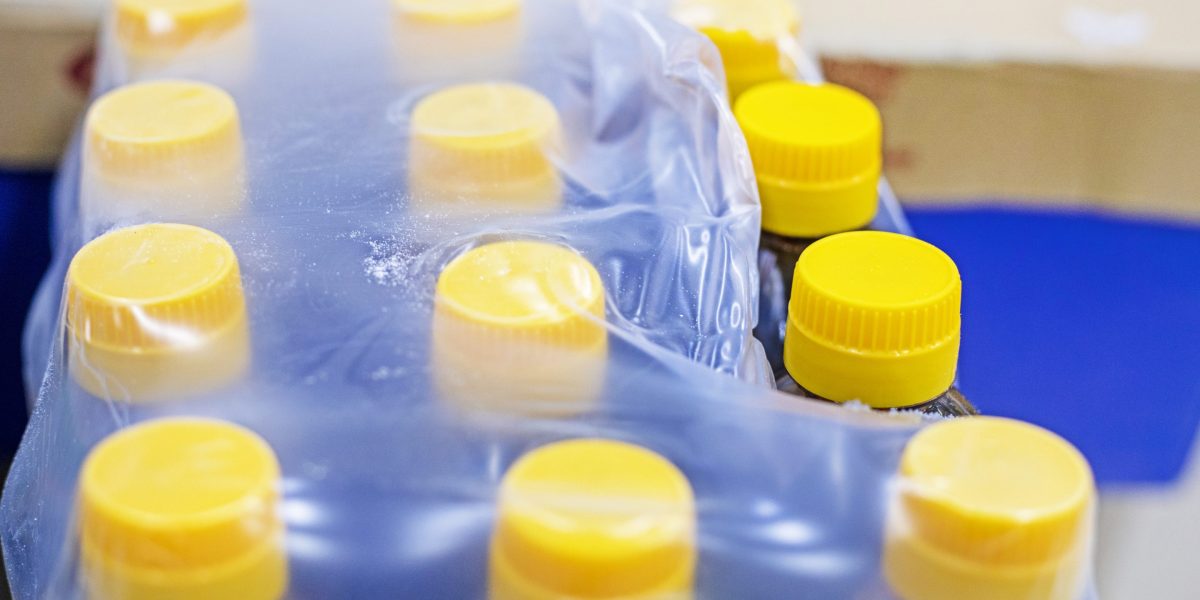
This up-and-coming brand, Feel Free, was marketing itself as something slightly different. As it declared in a white, scrolling font over the deep blue of its own two-ounce bottle, Feel Free was a “plant-based herbal supplement,” a proprietary blend of extracts from the botanicals kratom and kava, boasting properties that could amplify focus and boost mood.
For many users, however, the beverage didn’t have the advertised effect. Drew Barrett, of Champaign, Ill., says he was enticed by Feel Free’s serene packaging and its offer of relaxation and enhanced energy. But he soon found that after the immediate euphoria from the shot, he would be hit with a cycle of unpleasant symptoms, including a runny nose and achy body.
Still, the euphoria was real, and in a matter of months, Barrett says, he became addicted to the supplement. Barrett, 46, says he would down a two-ounce bottle of Feel Free 10 to 12 times a day—far surpassing the recommended dosage of one per day. At about $8 per bottle, the habit cost him about $2,000 a month; he bought so much that the local smoke shop where he was purchasing the bottles began giving him an employee discount. He lost 35 pounds; his eyes sunk into his head, and his skin took on a gray color. Barrett says he became so dependent on the drink he had to close down the thrift store he owned and seek in-patient treatment.
“The stuff is poison,” he told Fortune.
Barrett’s experience was alarming, but it isn’t unique: Complaints from aggrieved consumers are easy to find online, thanks in part to a range of viral social media posts. Those users share certain key concerns: that Feel Free’s marketing downplayed the fact that the drink contains kratom, creating problems for people who didn’t realize what they were ingesting.
Those dangers can be significant, according to multiple studies: Kratom is a psychoactive substance, and in larger doses it has been linked to seizures, high blood pressure, vomiting, liver damage, addiction, and hallucinations.
Indeed, in September 2024—the same month the product topped the sales charts at the convenience store chain—its manufacturer, Botanic Tonics, paid $8.75 million to settle a class-action lawsuit involving allegations that Feel Free’s labeling didn’t make clear just how much kratom is in each bottle, and had failed to alert consumers to the dangers of taking the substance in large quantities. (The company did not admit to any wrongdoing.) That settlement capped a tumultuous two-year stretch during which U.S. Marshals seized hundreds of thousands of bottles of Feel Free—and during which the founder of Botanic Tonics stepped down as CEO and publicly disclosed that he had formerly served federal prison time.
And yet, despite that chaos, the company’s business has continued to thrive. Today, Feel Free can be found in around 30,000 stores and counting, and has sold 130 million units, generating more than $250 million in annual sales and earning a steady profit for Botanic Tonics. During the second week of this October, Feel Free sales surpassed those of Red Bull and Monster Energy at a top-five convenience store chain, according to a Botanic Tonics press release citing Nielsen IQ data.
“Our product has the strongest safety record of any kratom product on the market, backed by government testing, clinical trials, and expert medical review,” a Botanic Tonics spokesperson told Fortune.
The company is working within the limits and at the edges of a hobbled American regulatory system that has largely looked away from the potential hazards in dietary supplements. The Food and Drug Administration, for its part, has a clear position on the substance: “Kratom is not appropriate for use as a dietary supplement,” its website says, adding that there’s insufficient information to prove that the substance is safe. But under lenient laws enacted in the 1990s, supplement manufacturers have incredible leeway to market their products—enabling them to operate in a legal gray area where consumer protections are few, and where sellers can be vague about ingredients and side effects, even when the potential for harm is serious.
“Feel Free is no different than any dietary supplement,” says Robert Durkin, former deputy director of the FDA office responsible for regulating dietary supplements, and now a lawyer who previously represented Botanic Tonics. “If it’s following the rules, it could legally be on the market.”
A powerful herb, an unusual founder
Kratom was largely unknown in the U.S. until a few decades ago, but it has always been associated with medicinal and psychoactive properties. As a minimally processed botanical usually served as a tea, kratom has been used for centuries as an analgesic and to treat ailments like cough and digestive issues—and, more recently, to aid those weaning off opiates. Indeed, Drew Barrett and other Feel Free users told Fortune they had previously used kratom as an attempt to alleviate other substance abuse issues.
Soren Shade, a kratom advocate and cofounder of kratom tea company Top Tree Herbs, says that the herb was likely brought stateside in the 1970s by Vietnam War veterans who had developed heroin habits while serving overseas, and were using kratom as a harm reduction tool. The leaf may also have come to America via Southeast Asian immigrants, who used and sold the plant within their communities.
The gradual loosening of restrictions against cannabis and cannabinoids helped make room in the market for other herbal and botanical products. By the time Botanic Tonics was founded in 2020, kratom products had become a $2 billion industry; according to one study, kratom was used by about 1.7 million Americans in 2021.
JW Ross, Botanic Tonics’ founder, has said he was inspired to launch the company by multiple trips to the South Pacific and Southeast Asia; he was determined to create an herbal supplement product that promoted what he envisioned as a healthy lifestyle, he said, particularly as he had struggled in the past with his own sobriety. One of the results, Feel Free, hit the market in 2020.
Sales skyrocketed, but so did consumer complaints. In April 2023, a class action lawsuit was filed in California against Botanic Tonics and a handful of retailers selling Feel Free, accusing them of fraud and false advertising.
The suit alleged that Botanic Tonics’ packaging did not disclose how much kratom was in Feel Free, or that Feel Free could have significant side effects. Plaintiffs claimed that Feel Free was marketed as a drink that could induce calmness and relaxation, and was no more habit-forming than caffeine—but that using the product had led many customers to become addicted to it. Lead plaintiff Romulo Torres had been hospitalized for symptoms including “vomiting, lapses in consciousness, delirium, and psychosis,” the lawsuit claimed. (Drew Barrett cited similar issues but was not one of the plaintiffs in the suit.)
According to the plaintiff, the class could have more than 5,000 members; Botanic Tonics said it has received fewer than 1,000 adverse event complaints from users. Still, the suit got results: In September 2024, Botanic Tonics agreed to the $8.75 million settlement.
As a result of the agreement, Botanic Tonics has improved product labeling “with clear warnings about potential effects and visible serving size indicators,” the company said. It also proactively raised the minimum purchase age for its products to 21. A company spokesperson told Fortune, “This product is not for people who have previously struggled with substance abuse and is only intended for healthy adults.”
Launching the company, it turns out, was part of a broader reinvention: About 15 years ago, Ross was living under a different legal name, Jerry Cash. As Cash, Ross was an oil and gas industry mogul in Oklahoma who was convicted in court and served federal prison time for failing to disclose the diversion of $10 million in corporate funds for personal uses. According to authorities, more than $5 million went toward renovating his Oklahoma City-area home.
Ross stepped down as CEO of Botanic Tonics in April 2024, while the class-action litigation was still ongoing; he was replaced by Cameron Korehbandi, who holds the role today. Ross disclosed his previous identity to investigative journalist Scott Carney in June 2024 and shared that he lived under a different identity in a letter on his website. Botanic Tonics did not respond when asked if Ross is still involved in its operations, and Ross did not respond to Fortune’s multiple interview requests.
Skepticism and pushback
The kratom Ross encountered in his travels to Southeast Asia was likely different from the substance packaged in Feel Free’s blue bottles, according to scientists who have studied the plant. When reprocessed as a powder or capsule, and in higher dosages, kratom has been associated with the swath of symptoms outlined in the 2023 class action lawsuit, leading some scientists to say that kratom in general is a potential public health threat.
For its part, Botanic Tonics has cited third-party research on the safety of Feel Free when taken at recommended dosages, saying those studies deemed Feel Free Classic Tonic to be safe with mild to moderate adverse events, including nausea, headaches, and fatigue for those in the highest-dose group of one bottle per day.
Ultimately, public health experts feel there isn’t enough research to determine whether the potential benefits of kratom outweigh the risks. “The regulatory market and research on its theoretic use hasn’t advanced enough at the same pace that [kratom] has become available as a supplement,” Silvia Martins, director of the Substance Use Epidemiology Unit at Columbia University Mailman School of Public Health, told Fortune.
Some politicians and jurisdictions have heard enough that they’ve made up their minds. In August, Ohio Gov. Mike DeWine called on the Ohio Board of Pharmacy to schedule kratom compounds as illegal drugs. Alabama, Arkansas, Indiana, Rhode Island, Vermont, Wisconsin, and Washington, D.C. have banned the substance, and eight other states have set a legal age limit of 21 to buy products containing kratom.
The FDA also disapproves of kratom’s use, stating on its website, “FDA has concluded…that kratom is a new dietary ingredient for which there is inadequate information to provide reasonable assurance that such ingredient does not present a significant or unreasonable risk of illness or injury.”
But despite that stance, the FDA has done little to restrict kratom. That’s due in large part, experts say, to the regulator having been essentially defanged about 30 years ago, creating what would become the Wild West of dietary supplements. “The agency has very weak enforcement powers, but most frequently, [doesn’t] even use the weak powers that they have,” Pieter Cohen, an associate professor of medicine at Harvard Medical School whose research is in dietary supplement safety, told Fortune.
The FDA did not respond to multiple requests for comment for this story.
The defanged FDA
For the better part of the 20th century, the FDA tried to classify dietary supplements as drugs, and later as food additives, in order to regulate products before they hit the market. In the late 1980s and early ‘90s, Congress even weighed a series of bills that would have strengthened the powers of the FDA, particularly in how it regulated product labels.
But those measures faced strident and well-financed pushback from the supplement industry. (One famous 1994 advertisement from a pro-supplement organization featured a fictional scene of actor Mel Gibson being arrested in his home by the FDA for taking vitamin C.) In October 1994, Congress passed the Dietary Supplement Health and Education Act (DSHEA), an amendment to the Federal Food, Drug, and Cosmetic Act that made it much easier for supplements to reach the market without having to demonstrate their safety or efficacy.
Ultimately, Congress justified DSHEA on the principle that customers should be informed, but also empowered with access to a marketplace of products with the potential to enhance their health. While the act outlines certain labeling practices a product must abide by, it does not require companies to gain—or even seek—FDA approval before a product hits the market, nor to prove the product is safe for human consumption. Instead, the FDA can take action against a product only once it finds sufficient evidence it is dangerous.
In practice, that’s a path the regulator will only pursue in extreme cases, such as where deaths are strongly linked to a product, said Marion Nestle, professor emerita of nutrition, food studies, and public health at New York University. DSHEA “was a total win for the industry,” Nestle told Fortune. “The public health community thinks it’s a travesty because there’s no federal guarantee that what’s in the product is what the product says it has.”
Indeed, with little risk of being taken off the market, supplement companies have taken liberties with even the skeletal labeling framework outlined by DSHEA. A 2023 analysis of 57 sports supplements, conducted by Harvard professor Cohen, found 89% of the products failed to accurately label their contents by FDA standards.
A seizure, but no ban
While FDA actions against supplement-makers are rare, the agency has taken at least one action against Feel Free. In May 2023, FDA investigators and U.S. Marshals seized more than 250,000 units of kratom-containing bottles along with other Feel Free products, a haul worth a total of more than $3 million, from Botanic Tonic’s production facility in Broken Arrow, Okla. The seizure, which came after a routine inspection, followed a forfeiture complaint filed on behalf of the FDA by federal prosecutors: The complaint claimed Feel Free was a “new dietary ingredient,” and that there was not enough information about the product to determine it was not dangerous to consume.
The seizure appears to have been related to bureaucratic slip-ups rather than safety complaints.
The FDA requires distributors and manufacturers of dietary supplements to submit a “new dietary supplement notification” if their product was not on the market prior to the passage of DSHEA. Even today, no new dietary ingredient notification from Botanic Tonics appears on the FDA’s list of submitted notifications, and the company did not respond to Fortune’s inquiry about whether the company has submitted a notification.
But despite the seizure, Botanic Tonics did not stop operations—because the FDA did not have a necessary injunction to stop production or prevent the product from reaching the market. Moreover, the court case is still ongoing. Weeks after the seizure, Botanic Tonics filed a motion to dismiss the forfeiture order and submitted a counterclaim, asserting its products should be returned to the company and that the government does not have enough proof to say that Feel Free is adulterated or misrepresented, or that it contains a new dietary ingredient with not enough research to deem it safe. On Dec. 10, a federal court judge assigned to the case last month denied Botanic Tonics’ motion to dismiss the case. The company declined to comment on the matter, as it is an ongoing action.
What’s in Feel Free?
Beyond the FDA’s misgivings, industry experts and public health professionals have questions about Botanic Tonics’ labeling practices, with some sources alleging the company has violated regulations around what is required on a label.
Feel Free is one of a handful of kratom products that uploaded its label to the National Institutes of Health’s Dietary Supplement Label Database of more than 200,000 labels. The product label currently available in the database dates to 2022, before the Feel Free class-action settlement.
Paul Coates, the former longtime director of the Office of Dietary Supplements at the NIH, which conducts research to inform regulation, reviewed the label at Fortune’s request, and said he still has his doubts—chiding the product for not spelling out on the label exactly what it contains. In particular, Coates called out Feel Free’s proprietary blend, which he describes as “2,600 milligrams of goop.”
“They talk about potassium, iron, and 2,600 milligrams of a proprietary blend that includes kratom alkaloids—25 milligrams—and kavalactones from kava root—250 milligrams,” Coates said. “That tells me that there’s an awful lot more in that 2,600 milligrams.” A full bottle of Feel Free is one fluid ounce, or about 29,500 milligrams.
Botanic Tonics has posted up-to-date labels for Feel Free products on its website that differ from what is uploaded to the label database, but Coates’ observation still stands: The label for Feel Free Classic does not contain information about the total amount of kava root extract or ground kratom leaf in each bottle, a requirement in the FDA’s nutrition labeling of dietary supplements.
Coates said Feel Free is hardly unique in the dietary supplement industry, where there’s little fact checking to ensure what is in the product matches what is on the label. “Unless you know what to look for, you can’t measure it,” Coates said. “I don’t have any idea how that’s broken down any further, and it’s probably not. There are no standard methods for measuring, and that is part of the problem.”
Botanic Tonics said it has undergone multiple certifications and clinical trials to verify that Feel Free Classic labels match what is in the product. It added that the kratom leaf and kava root in its product are manufactured in an FDA-registered facility and that Feel Free contains no kratom extract, concentrates, or synthetic ingredients.
A search for transparency
Ashley Snider, 34, wants kratom products to be more strictly regulated. Snider used to work at a supplement store and was introduced to Feel Free after a company representative dropped off sample products at her workplace. Soon, she says, she was spending $105 per month on a 12-pack subscription box of Feel Free—and then driving to a nearby convenience store to pick up more, sometimes taking six per day.
Snider told Fortune Feel Free made her continuously ill, and that she has not used it in nine months. When she cancelled her subscription, Snider said, the company sent her a pamphlet of mocktail recipes one can make using Feel Free. (Botanic Tonics denies that this book had been positioned as a cocktail or mocktail recipe book, stating rather that it was simply a book of recipes, and said Snider may have received the recipe book because it was mailed prior to her unsubscribing from the company. The company has a list of recipes on its website containing Feel Free products, none of which contain alcohol.)
What concerned Snider most, she said, was that while there are warnings about serving sizes on Botanic Tonics’ website (added to the brand’s label in 2022, according to the company), there were no guardrails in place that prevented her from ordering the product in much larger quantities than were recommended on the label. Botanic Tonics said its website is age-gated, required users to confirm they are over 21, and that one-third of its site is dedicated to consumer education. It did not say whether there are preventative measures on ordering a certain amount of product.
“I would like for there to be more transparency,” Snider told Fortune. “There needs to be something that separates them from just being readily available at gas stations, at supplement shops, not having reps go around and handing it out like Halloween candy.”
Even if the FDA were to crack down on Feel Free, other kratom beverage-makers could easily take its place in the market. The FDA makes assessments of a product’s safety based on health outcomes from that particular product’s dosage or blend of ingredients. In an industry with no standardized dosages for products, the FDA would be unable to generalize a takedown of one company to the whole industry.
“They might have to address it on this company-by-company basis. And that’s very inefficient,” said Cohen, the Harvard Medical School professor. “So fundamentally, we’re going to need to have a reform of the law…and I don’t see that in the near future.”
Industry experts tell Fortune there is little likelihood of regulatory changes under the current administration. In the leadup to the 2024 presidential election, Robert F. Kennedy Jr. vowed to end the “aggressive suppression” of dietary supplements and vitamins; Kennedy is now the secretary of Health and Human Services, with jurisdiction over the FDA.
The current enforcement system isn’t just inefficient, said Shade, the kratom advocate; it’s dangerous. If the FDA were to ban a particular alkaloid or compound in kratom demonstrated to be harmful, there’s nothing stopping a company from finding another alkaloid, just barely distinguishable from its prohibited predecessors, and sticking it on the market. Meanwhile, it typically takes the bureaucracy about a year to catch up and ban any given product, enough time for a new one to pop up on the market.
“It is an infinite game of Whack-a-Mole,” Shade said, “where every mole that pops up ends up being more unknown, more potent, and potentially more toxic.”







 Politics8 years ago