
Politics
Delegation for 6.12.26: Qualifying Week Special Edition
Special edition
With a high number of retirements and a mid-decade redistricting, the 2026 Midterms could produce change unseen in years in Florida’s congressional delegation. That added a layer of intrigue to qualification week, which formally ended at noon today.
For the occasion, this special issue of Delegation looks ahead to the election now that the field has fully taken shape.
Replacing Dunn
In Florida’s Big Bend, the greatest drama surrounded a retiring Rep. Neal Dunn’s seat in Florida’s 2nd Congressional District. A packed 12-person field of announced candidates all made the ballot, including several hard-hitters in the GOP field.
The top fundraiser in the field to date is Keith Gross, an attorney who previously challenged Sen. Rick Scott in a GOP Primary last year. Republican Party of Florida Chair Evan Power, a longtime Leon County GOP leader, also qualified for the ballot, as did Austin Rogers, a former staff counsel to Scott.

Other Republicans to qualify include Desert Storm pilot Lee Jon Jones, Kingdom Insurance owner Nick Lewis, Purple Heart veteran Luke Murphy, Gulf Coast Superintendent Jim Norton and retired Leon Sheriff’s chief deputy Audie Rowell.
But the open seat has also drawn interest on the Democratic side. Three Democrats, including attorney Yen Bailey, former foreign aid contractor Amanda Marie Green and tech entrepreneur Nic Zateslo, were preparing to challenge Dunn already, and disabled families advocate Brice Barnes jumped into the race quickly after Dunn announced his departure. All made the ballot.
How competitive could the seat be in November? Well, more than 59% of voters in CD 2 voted for Donald Trump for President in 2024, and just 40% backed Democrat Kamala Harris. That suggests it could be a stretch to take the seat.
But Dunn succeeded Democratic former Rep. Gwen Graham (who recently was tapped as gubernatorial candidate David Jolly’s running mate), so Democrats hope the current anti-Trump climate could mean a flip of a Panhandle seat.
Panhandle positioning
Other North Florida seats all have Republican incumbents running for re-election in districts that have remained reliably red this decade. But none will get a complete pass on campaigning this year.
Rep. Jimmy Patronis won his seat in Florida’s 1st Congressional District in a Special Election last year. The Fort Walton Beach Republican now faces GOP Primary opponents in Doug Chico, a Navy veteran, and John Frankman, a Green Beret. In November, the incumbent (or whoever wins the August nomination) will face Gay Valimont, a Democrat who overperformed in the Special Election and even won Escambia County, and Tyler Davis, who is running as an independent.

But Rep. Kat Cammack, a Gainesville Republican seeking a fourth House term, won the GOP nomination without Primary opposition in Florida’s 3rd Congressional District. Multiple Democrats will compete in an August Primary to face Cammack in November, including Navy veteran Troy Albers, University of Florida media professor Seth Harp, Kaia Ventures President George Hubac and physicist Tom Wells. Mike Klein, a candidate without party affiliation, qualified and advanced straight to the General.

Chill in Jacksonville
Rep. Aaron Bean, a Fernandina Beach Republican, also avoided any GOP opposition in Florida’s 4th Congressional District. But attorney Michael Kirwan, perennial candidate L.J. Holloway and Veteran Affairs designer Brit Robinson will face off for the Democratic nomination in the District. Mike Sell, a member of the Florida Future Party, also qualified for a slot on the November ballot, as did Todd Schaefer, a candidate without any party affiliation.

And Rep. John Rutherford, a Jacksonville Republican, qualified to make another run in Florida’s 5th Congressional District, where he will be the dean of North Florida. He must contend with a Republican Primary challenge from Mark Kaye in August. Three Democrats will fight for the chance to face the former Sheriff in the General Election, including biomedical engineer Rachel Grage, software developer Alex Hazen and project manager Mark Heggestad. A write-in also qualified.
Race to the right
In Florida’s 6th Congressional District, Rep. Randy Fine will face America First activist Aaron Baker, social media influencer Dan Bilzerian, retired Army Reserve Brig. Gen. Charles Gambaro and investment firm founder Manuel Asencio in a Republican Primary.
Each of those candidates offers different criticism. Bilzerian drew national scrutiny for his antisemitic rhetoric, including calling Fine a “fat Jew.” Gambaro also criticized Fine’s rhetoric and said his anti-Palestinian language creates a “security risk” for the District. Baker, who ran against Fine in a Special Election last year, has said Fine puts the interests of Israel ahead of those in the U.S.

Meanwhile, four Democrats also qualified, including Marine Rob Cooper, brewery owner Steve Morgan, first responder Ronnie Murchinson-Rivera and retail manager Eric Yonce. A write-in also made the ballot. Michael Gist files as a no-party candidate, and Libertarian Andrew Parrott will also challenge Fine after facing him in last year’s Special Election. There is also a write-in candidate in the race.
More than 64% of voters in CD 6 supported Trump in 2024, and Fine won the seat despite massive Democratic spending in a Special Election last year, with 57%. That means the GOP Primary, where Fine expects his Trump endorsement to carry the day, will likely decide the race.
From left and right
After flipping a seat red with little effort in 2022, Rep. Cory Mills has become the top target this cycle for the Democratic Congressional Campaign Committee in Florida. That’s mostly thanks to a series of personal scandals landing him in headlines.
He managed to attract significant opposition in Florida’s 7th Congressional District from the left and right.

Ryan Elijah, a former news anchor for Fox 35 in Orlando, will challenge Mills in a GOP Primary, as will Sarah Ulrich, a Port Orange business owner. And Michael Johnson, who campaigned against Mills in 2024 and before filing a complaint that launched a House Ethics Investigation into the incumbent, also made the ballot.
Democrat Bale Dalton, a former NASA Chief of Staff already added to the DCCC’s Red to Blue Program, also must win a Democratic Primary before running for Mills’ seat in November. Marialana Kinter, a fellow veteran in the race since last year, also qualified for the ballot. The biggest surprise in the race came this week when former Rep. Alan Grayson, an Orlando Democrat, made a last-minute entry into the Primary field.
Libertarian Christopher Dennison also made the ballot.
Democrats hope to take on Mills, believing he will underperform in a District where Trump won 55% of the vote to Harris’ 43%. The question now may be how bruised candidates become in contested Primary votes.

Space Coast race
A new map may mean first-term Rep. Mike Haridopolos, an Indian Harbour Beach Republican, faces more serious competition this year than expected.
After seeing voter data in Florida’s 8th Congressional District swing farther left under the map than any other seat in the state, former Brevard County School Board member Jennifer Jenkins decided to take on Haridopolos, a former Florida Senate President.

Jenkins was the only Democrat to qualify for the race, while Haridopolos avoided any Republican Primary challenge this cycle. This is still a seat where Trump won 57% of the vote in 2024, still GOP-leaning but not the ruby-red territory where Haridopolos won the election on the old map.
Soto in the sights
The most vulnerable Democrat in Florida, thanks to the change in cartography, is now Rep. Darren Soto, a Kissimmee Democrat who qualified in Florida’s 9th Congressional District and must seek another term in a jurisdiction where 58% of voters supported Trump in 2024. The seat now stretches from Kissimmee south into agricultural communities around the Florida Everglades.

The front-line Democrat won’t have to contend with a Democratic Primary and won as the only member of his party to qualify.
But several Republicans were drawn to the race, including cattle rancher Ben Butler, combat veteran Marcus Carter, former Osceola School Board member Thomas Chalifoux, Trump appointee Dan Green, Orlando businessman Jorge Martinez, Air Force veteran Steve Rance and veteran Marine Justin Story.
Whoever wins the GOP nomination will go head-to-head with Soto in the Fall.
On the other hand, Rep. Maxwell Frost finished qualification week a victor, securing his third term in Congress without opposition.
Late developments
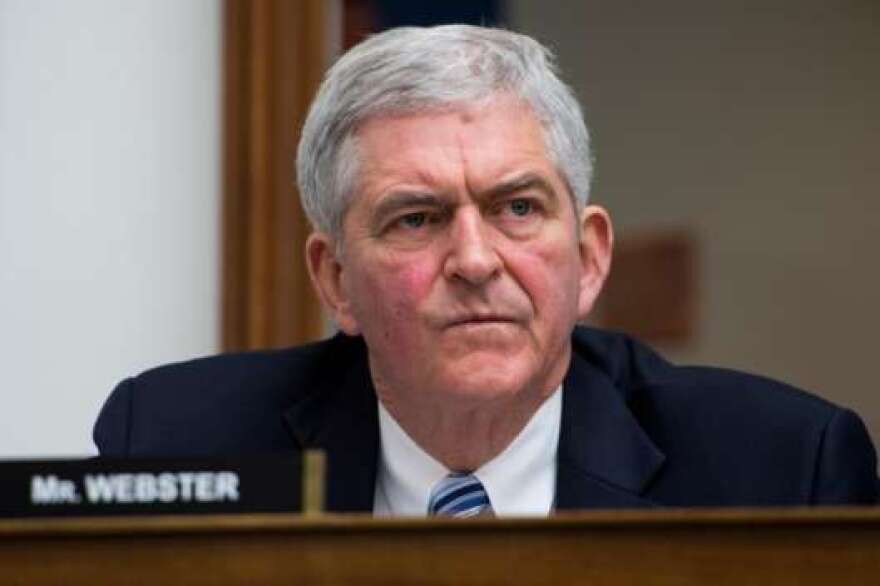
Another retirement leaves an open seat covering The Villages, as Rep. Daniel Webster opts against another run.
Lake County Commissioner Anthony Sabatini made a surprise announcement shortly before the qualification deadline that he would drop out and endorse former Property Appraiser and state Sen. Carey Baker.
But other contenders remain in a crowded Republican Primary. Those include physician Nizam Razack, air conditioning business owner Joe Strada and comedian Tim Wilkins. Bushnell Republican Ivette Palomo also qualified at the last minute, just before the GOP Primary deadline.
On the Democrats’ side, the biggest surprise was Barbie Harden Hall, Webster’s 2024 opponent, dropping out. But Bill Clinton administration veteran and lobbyist James Pericola, Army veteran Royal Webster (no relation) and Professor Dan Williams all qualified for the Democratic Primary.
This District was carried by Trump in 2024 with 57% of the vote, compared to Harris at under 42%.
Libertarian Ralph Groves also qualified for the General Election ballot.

Mashing up districts
The new congressional map notably shook up Florida’s 12th and 15th Congressional Districts, represented respectively by Reps. Gus Bilirakis, a Palm Harbor Republican, and Laurel Lee, a Thonotosassa Republican.

The result? Bilirakis was the only Republican to qualify in CD 12, but he attracted some Democrats who once challenged Lee, including former Hillsborough County Commissioner Kim Overman. Former Veterans Affairs physician Darren McAuley also jumped from challenging Lee to battling Bilirakis. An August Primary will determine which Democrat advances.
Branden Scrivener qualified without party affiliation.
Meanwhile, Lee qualified in CD 15 without a GOP challenger. But Chris Irizarry, a former Bilirakis opponent, is vying for the Democratic nomination against veteran Robert People. A write-in also qualified for the ballot.
While Lee technically remains on a list of DCCC targets, she’s now running in a District where Trump won 59% of the vote. Bilirakis, meanwhile, ends up in a seat where Trump won almost 57% to Harris’ under 42%
Fight to face Luna
But Rep. Anna Paulina Luna, a Pinellas Republican, remains clearly in DCCC crosshairs. She won the GOP nomination without competition in Florida’s 13th Congressional District.

Meanwhile, retired Brigadier Gen. Leela Gray qualified as a Democrat. She has been working with the DCCC, but still faces a Democratic Primary battle with intelligence analyst John Liccione and educator Brandt Robinson. Gray has raised dollars and endorsements in the Tampa Bay area.
Tony D’Arrigo qualified without party affiliation.
In 2024, Democrats made it clear early in the cycle that they intended to prioritize unseating Luna, a two-term incumbent. The new map hasn’t changed that, with CD 13 remaining a battleground where Trump won 56% of the vote and Harris about 43%.
Crowding against Castor
On the other side of Tampa Bay, Rep. Kathy Castor hasn’t officially been named as a target of the National Republican Congressional Committee (NRCC) but almost surely will be. That’s after redistricting left the Tampa Democrat in a version of Florida’s 14th Congressional District where nearly 55% of voters backed Trump and just 44% backed Harris.

Castor was the only Democrat to qualify for the seat, but like Soto, her situation drew numerous Republican competitors.
Former state Rep. Mike Beltran, construction industry professional Michael Marcel, franchise owner John Peters, Navy veteran Rocky Rochford, farmer Gavriel Soriano, state Rep. Kevin Steele, builder Ergin Tek, former Sen. Ashley Moody adviser Bea Valenti and construction professional Keith Varian all qualified to run for the GOP nomination. But the rush of prominent candidates and potential self-funders did drive Dan Weldon, previously the top fundraiser challenging Castor under old lines, to run for the state House instead.
Libertarian Brian Lambert will also appear on the November ballot. A write-in candidate also qualified.

Succeeding Buchanan
A crowded field of candidates has also rushed to succeed retiring Rep. Vern Buchanan in Florida’s 16th Congressional District.
Most notably, Sydney Gruters, a former New College Foundation leader and the wife of Republican National Committee Chair Joe Gruters, will run for the seat. She previously worked for Buchanan.

But she must first win a Republican Primary against Christian school founder Eddie Speir, a former Buchanan Primary challenger, and Ed Pope, a Navy and law-enforcement veteran.
Several Democrats also hope that an open seat in the current environment will create an opportunity to flip the District, which has significantly changed under the new map and now includes South Pinellas County.
Army veteran Jon Harris, former Sarasota Mayor Kelly Kirschner and Air Force veteran and teacher Tamika Lyles qualified for a Democratic Primary, as did former broadcast journalist and business owner Glenn Pearson and healthcare policy expert Jan Schneider.
Mark Davis also made the ballot without party affiliation.
Heartland happenings
Reps. Greg Steube and Scott Franklin both won GOP Primaries without opposition but will face Democratic opponents in this cycle.
In Florida’s 17th Congressional District, Democrats Matthew Montavon, a former United Nations official, and financial broker Allen Spence qualified for a Primary. The winner will face Steube, a Sarasota Republican, and no-party-affiliation candidate Michael Quirk.

As for Florida’s 18th Congressional District, Franklin, a Lakeland Republican, qualified to run what’s now a much more compact seat covering most of Polk County. Democrat Curtis Gibson, a former Lake Wales Commissioner, also qualified for the race. So did Deva Simmons, who is running without party affiliation.
Both districts lean heavily Republican.
Southwest Florida heat
With Rep. Byron Donalds running for Governor, a rush of candidates qualified in Florida’s 19th Congressional District for what could be one of the state’s most expensive Primary contests.
The Republican Primary field includes two former Congressmen who previously represented other states: Madison Cawthorn and Chris Collins. Major self-funders include Jim Oberweis, a dairy farm owner and former Illinois lawmaker, and Jim Schwartzel, president of Sun Broadcasting.

But others with high profiles include author and health activist Catalina Lauf and former congressional staffer Ola Hawatmeh. Veteran Mike Pedersen also qualified, as did late entries Greg “Tex” Bukowski, a Sarasota County Charter Review Board member, and Linda Sawyer, a former researcher at the National Institutes of Health. Pardoned Jan. 6 insurrectionist John Strand also has a place on the GOP Primary ballot. Constitutionalist Seth Haskin also qualified shortly before the deadline.
On the Democratic side, Howard Sapp, a former state House candidate and air traffic controller, and Victor Arias, managing attorney of Arias Law Firm, made the ballot. Shortly before the deadline, Robert Neeld, who previously challenged former GOP Reps. Connie Mack IV and Frances Rooney, also qualified for the Democratic Primary.
Seth Haskin also qualified in the race without party affiliation and, in November, will face whoever wins the Democratic and Republican nominations this August. A write-in candidate also qualified in the race.

Messy in Sunrise
The most controversial Democratic Primary in the state, in Florida’s 20th Congressional District, will have a more crowded field than some had hoped.
The seat, which has been vacant following former Rep. Sheila Cherfilus-McCormick’s resignation, has been a Black-majority seat since the 1990s. Still, the new congressional map was drawn to intentionally dismantle it and replace it with a race-neutral one. But the seat remains predominantly Black.

Rep. Debbie Wasserman Schultz, the longest-serving Democrat in Florida’s congressional delegation, also saw her seat carved up and was left effectively homeless under the new map. But it sparked controversy when the White Democrat jumped into the CD 20 race.
Now, Cherfilus-McCormick has also filed, despite remaining under federal indictment. She paid a qualifying fee to run on Thursday. An effort to get Black candidates to consolidate around one or two contenders appears to have completely failed as rapper-turned-community leader Luther Campbell, progressive activist Elijah Manley and former Broward Mayor Dale Holness all qualified for the Democratic Primary.
On the Republican side, perennial candidates Lateresa “LA” Jones and Rod Joseph, as did Brent Anderson and nurse Carla Spalding. Independent Kedner Maxime also made the ballot.
But the Democratic Primary will likely decide who represents the District in Congress next year. It remains a heavy Democratic stronghold where about 68% voted for Harris for President.
Treasure Coast
Rep. Brian Mast, a Stuart Republican, qualified for re-election in a largely unchanged Florida’s 21st Congressional District, even as the map reshaped the field of competitors around him. A field of Democratic challengers ultimately narrowed to two, with Coast Guard veteran James Martin and first responder Bernard Taylor facing each other in an August Primary to decide who will challenge Mast in November, while Alexander Cooke, a no-party candidate, has also qualified.

In Florida’s 23rd Congressional District, Rep. Lois Frankel, a West Palm Beach Democrat, staked a claim to the Palm Beach County seat. But she faces Democratic opponents Victoria Doyle and Mark Piper, both of whom qualified for the Primary. Republicans Deborah Adeimy and Paola Branda will face off in a GOP Primary in the blue-leaning District.

Cross-state seat
The redistricting shake-up means no incumbent has claimed Florida’s 22nd Congressional District as a home. This gives both parties a chance to take the expansive seat, which runs from Marco Island in Southwest Florida east to Wellington in Broward County. Trump won about 55% of the votes in the District in 2024, but more than 51% of voters supported Democrat Joe Biden there in 2020.
Both parties had several candidates scramble and often leave races against Democratic and Republican incumbents to run in this open seat.

This year, Republicans from both sides of the state qualified, including Naples businessman Casey Askar, West Palm Beach real estate broker Davis Burck, Cooper City fintech entrepreneur Michael Carbonara, Ave Maria risk analyst Richard Evans, Wellington political consultant Terri Hasdorff, and former Lee County GOP Chair Michael Thompson.
Belinda Keiser, Vice Chancellor of Keiser University, also emerged as a major contender. The politically connected Parkland Republican is a rumored favorite of Trump.
But the race also drew Democratic interest. Charter school leader Pia Dandiya, who had been a top fundraiser challenging Mast, jumped to this seat and will face Sunrise attorney Kaysia Earley, founder of Earley Law Firm.
Who follows Wilson?
A late retirement announcement by Rep. Frederica Wilson, a Miami-Dade Democrat, set up a major fight in Florida’s only other plurality Black seat.
Most notably, former Miami-Dade County Commissioner Oliver Gilbert and state Sen. Shevrin Jones both qualified in the Democratic Primary.

But Kendrick Meek Jr., son of former Rep. and Senate candidate Kendrick Meek, filed this week for the Primary. Other qualified candidates include Dr. Rudolph Moise, former Miami-Dade County Commissioner Jane Monestime and former Wilson staffer Roderick Vereen. Miramar Democrat Marshall Davis also qualified just ahead of the deadline.
Republican Te Brown, a real estate developer, also qualified for the seat. Realtor Andy Daro qualified as a no-party-affiliation candidate.
But in a District where almost 69% supported Harris, the Democratic Primary will likely pick Wilson’s successor.

Target on Moskowitz
The new map also dislodged Rep. Jared Moskowitz, leaving his old District in pieces. But he’s qualified to seek re-election in Florida’s 25th Congressional District, which spans along A1A from Boca Raton to Miami Beach.
Several Republicans followed him as well, hopefully for a GOP pickup in a seat Trump won last cycle with almost 54% of the vote. Even on the old map, the NRCC had identified Moskowitz as a target, and House Republicans remain confident the District can go red in November.

Republicans in the official mix include Delray Beach businessman Dan Franzese, conservative activist Raven Harrison, counterterrorism expert Joe Kaufman, former state Rep. George Moraitis, and former Boca Raton Mayor Scott Singer, many of whom were challenging Moskowitz before the redraw. An August Primary will determine who faces Moskowitz in the General Election.
Another person following Moskowitz? Progressive activist Oliver Larkin, who has challenged Moskowitz’s positions on Israel, has also qualified to run against the Congressman in a Democratic Primary.
Libertarian Peter Jassenoff and a write-in candidate also qualified for the General Election.
South Florida stays simple
Further south, Rep. Mario Díaz-Balart, a Hialeah Republican, qualified without Primary opposition in Florida’s 26th Congressional District. He will face Democrat Nicole Locklin, a Miami attorney, and Deborah Ann Meidinger Hosey, a party-unaffiliated candidate, in November.

And in Florida’s southernmost point, Rep. Carlos Giménez, a Miami-Dade Republican, also was the only GOP candidate to make the ballot. Phil Ehr, a military veteran who challenged Giménez last cycle as well, was the only Democrat to make the ballot, while Eddy Rojas qualified without a party designation.

Two-front battle
Rep. María Elvira Salazar saw boundaries in Florida’s 27th Congressional District shift little under the new map. But the Coral Gables Republican was already a target of the DCCC and remains in House Democrats’ sights.
But the moderate Republican also faces a challenge in the Primary. Former prosecutor Michael Arias qualified to face Salazar in an August contest for the nomination.

Democrats will also have a Primary to determine who appears on the November ballot. Both homicide prosecutor Robin Peguero and longtime news anchor Eliott Rodriguez will appear on an August ballot to determine the Democratic nominee.
That will set up the contest in the battleground seat where about 57% of voters supported Trump in 2024.
On this day
June 12, 1776 — “Virginia approves Declaration of Rights” via the National Archives — Virginia’s Declaration of Rights was drawn upon by Thomas Jefferson for the opening paragraphs of the Declaration of Independence. Other colonies widely adopted it and became the basis for the Bill of Rights. Written by George Mason, it was adopted by the Virginia Constitutional Convention. It started: “A Declaration of Rights is made by the representatives of the good people of Virginia, assembled in full and free convention, which rights do pertain to them and their posterity, as the basis and foundation of government.”
June 12, 1987 — “Ronald Reagan challenges Mikhail Gorbachev to ‘tear down this wall’” via History.com — In one of his most famous Cold War speeches, President Reagan challenges the Soviet leader to “tear down” the Berlin Wall, a symbol of the repressive Communist era in a divided Germany. With the wall as a backdrop, Reagan declared to a West Berlin crowd in 1987, “There is one sign the Soviets can make that would be unmistakable, that would advance dramatically the cause of freedom and peace.” He then called upon his Soviet counterpart: “Secretary-general Gorbachev, if you seek peace — if you seek prosperity for the Soviet Union and Eastern Europe — if you seek liberalization: come here, to this gate.”
___
Peter Schorsch publishes Delegation, compiled by Jacob Ogles, edited and assembled by Phil Ammann and Ryan Nicol.