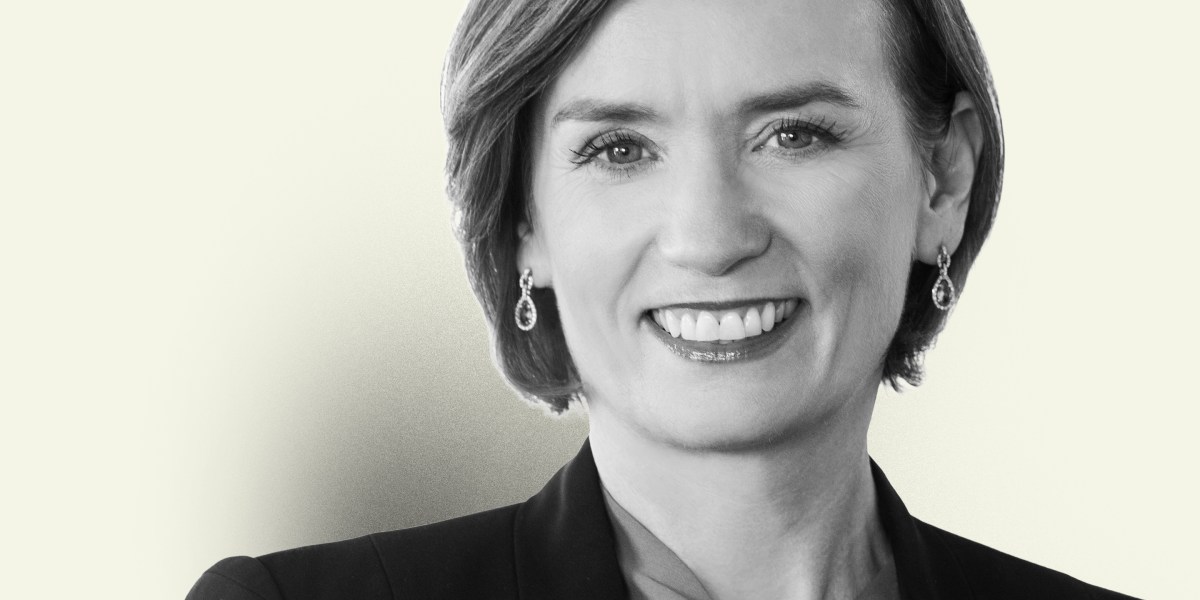
Good morning. Chevron is moving its CFO from the finance chair to the center of its operating business.
Eimear Bonner, Chevron’s CFO, will become president of oil, products and gas on Jan. 1, taking charge of the company’s core business across the value chain. Jeff Gustavson, currently president of new energies, will succeed her as CFO, the company announced on Monday.
Bonner’s career at Chevron has followed a unique sequence: engineer, technology chief, CFO, and now operating president. That combination could make her a particularly well-rounded candidate to lead an oil major, although Chevron is not saying whether CEO succession is part of the plan.
She joined Chevron in 1998 as an offshore petroleum engineer in the United Kingdom. Over more than two decades, Bonner held engineering, operating, and strategy positions, including general director of Tengizchevroil LLP in Kazakhstan. In 2021, she became Chevron’s first female chief technology officer. Three years later, she made the transition from CTO to CFO.
In her new role as president, Chevron said Bonner will be responsible for safe and reliable operations, disciplined capital allocation, asset-class excellence, and value-chain optimization.
The assignment is more than an operating role. It puts her in a position to apply the financial and strategic perspective she gained as CFO to some of Chevron’s biggest operational challenges.
I asked Chevron whether Bonner and Gustavson are considered potential internal successors to Chairman and CEO Mike Wirth, who has led the company for nearly a decade.
“Chevron maintains a robust succession planning process overseen by the board,” a spokesperson said in an email. “We have strong leadership across the company and a deep bench of experienced executives prepared to lead the business. Our strategy, priorities and commitment to disciplined execution remain unchanged, and we are well positioned for continued success.”
For recruiting experts, Bonner’s sequence of assignments is notable. Scott W. Simmons, co-managing partner at executive-search firm Crist Kolder Associates, described her progression as a “perfect script” for CEO development. Her technology and finance assignments gave her “in-the-weeds training” in two critical areas, he said.
“The CFO role provides an incredibly unique vantage point that allows an executive to see across the entire enterprise,” Simmons said. He expects boards to continue using rotations through the CFO job as part of CEO-development plans. “A variety of experience is most important for growing future CEOs, and Bonner’s background is an excellent blueprint,” he said.
Turning scale into returns
The CFO transition comes at a consequential moment for Chevron (No. 21 on the Fortune 500). In the second quarter, Chevron reported $12.1 billion in earnings and a 21% return on capital employed, along with record U.S. production and a 20% year-over-year increase in worldwide production, driven in part by legacy Hess assets and growth in the Permian Basin and Gulf of America.
The challenge now is to turn that scale into higher returns. Morningstar analyst Allen Good wrote Oct. 1 that Chevron is targeting higher returns and greater free cash flow through 2030, supported by volume growth, margin expansion, cost reductions, and operational improvements.
Those are precisely the objectives that put an operating executive’s judgment to the test: where to invest, which assets to prioritize, where to cut costs, and how aggressively to pursue growth. Bonner has seen Chevron from the engineering floor, the technology organization, and the CFO’s office. Now, she will have to run the business itself.
Sheryl Estrada
Sheryl.Estrada@fortune.com
Leaderboard
Sara Bonstein will step down as CFO of Insmed (Nasdaq: INSM), a biopharmaceutical company, on Oct. 30 after nearly seven years in the role. Bonstein said she plans to pursue a broader leadership role. During her tenure, Insmed raised more than $4.2 billion in capital, according to the company. She will remain CFO through Insmed’s third-quarter earnings report and participate in its Oct. 29 earnings call. Insmed has engaged an executive search firm to identify her successor.
James Dibbo was appointed CFO of Pinterest (NYSE: PINS), the visual search and shopping platform, effective Oct. 26. He succeeds Julia Brau Donnelly. Dibbo joins Pinterest from Amazon, where he most recently served as vice president and CFO for global entertainment, advertising and corporate development. During his decade at Amazon, he also served as CFO of worldwide consumer and North America consumer. His background includes serving as CFO of P.F. Chang’s and holding senior finance leadership positions at Tesco and BT Group. He began his finance career at PwC in London.
Big Deal
The era of low-cost, readily available capital has ended, and CFOs need to adjust their financing and investment strategies, according to a new EY-Parthenon report, “The new economics of capital.” The authors identify four structural forces pushing long-term borrowing costs higher: larger government deficits, stronger private-sector demand for capital—particularly for AI infrastructure—greater inflation volatility, and concerns about fiscal and monetary policy credibility.
These pressures extend beyond the Federal Reserve’s next interest-rate decision, creating a more demanding environment for refinancing, acquisitions, and investments dependent on inexpensive debt. The report urges business leaders to update cost-of-capital assumptions, stress-test investment hurdle rates, scrutinize debt maturities, and prioritize projects with measurable productivity gains and durable cash flows.
Going deeper
The latest episode of Wharton’s Future of Finance podcast series explores AI’s impact on financial services. Professor Itay Goldstein is joined by Wharton professor Jeremy Siegel and WisdomTree global chief investment officer Jeremy Schwartz to discuss the technology’s potential to increase productivity, transform investment research and workflows, reshape the financial workforce, and change how firms think about hiring and developing talent. They also explain why human judgment, trust, and accountability remain important.
Overheard
“We all have a tremendous amount of responsibility, and cannot let egos or incentives for profit or anything else get in the way.”
—OpenAI CEO Sam Altman said in an interview with Fortune’s Editor-in-Chief Alyson Shontell. Altman expressed his view that humans can stay in control of AI, even superintelligent AI. But that requires staying a few steps ahead of the technology’s capabilities.