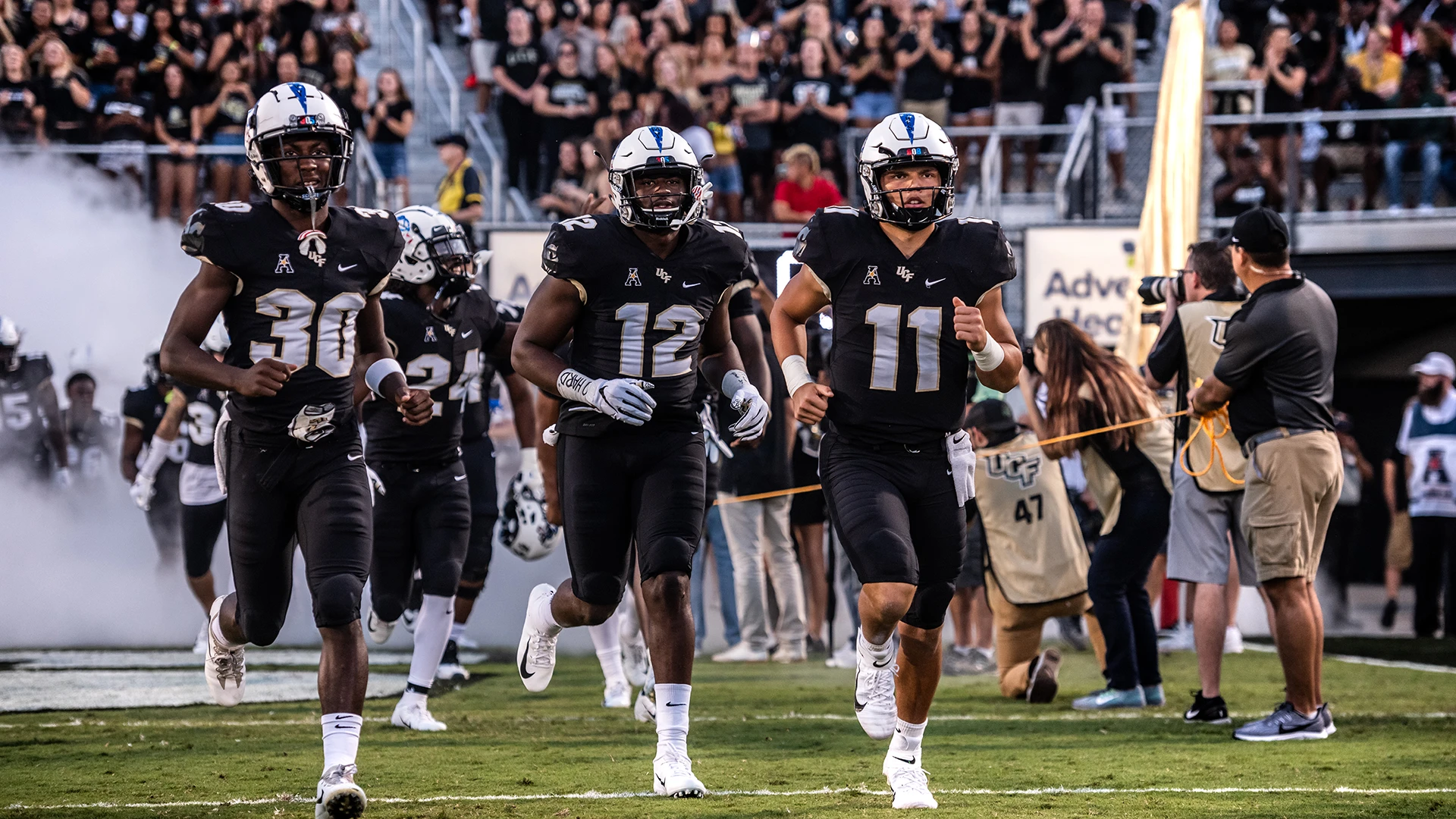
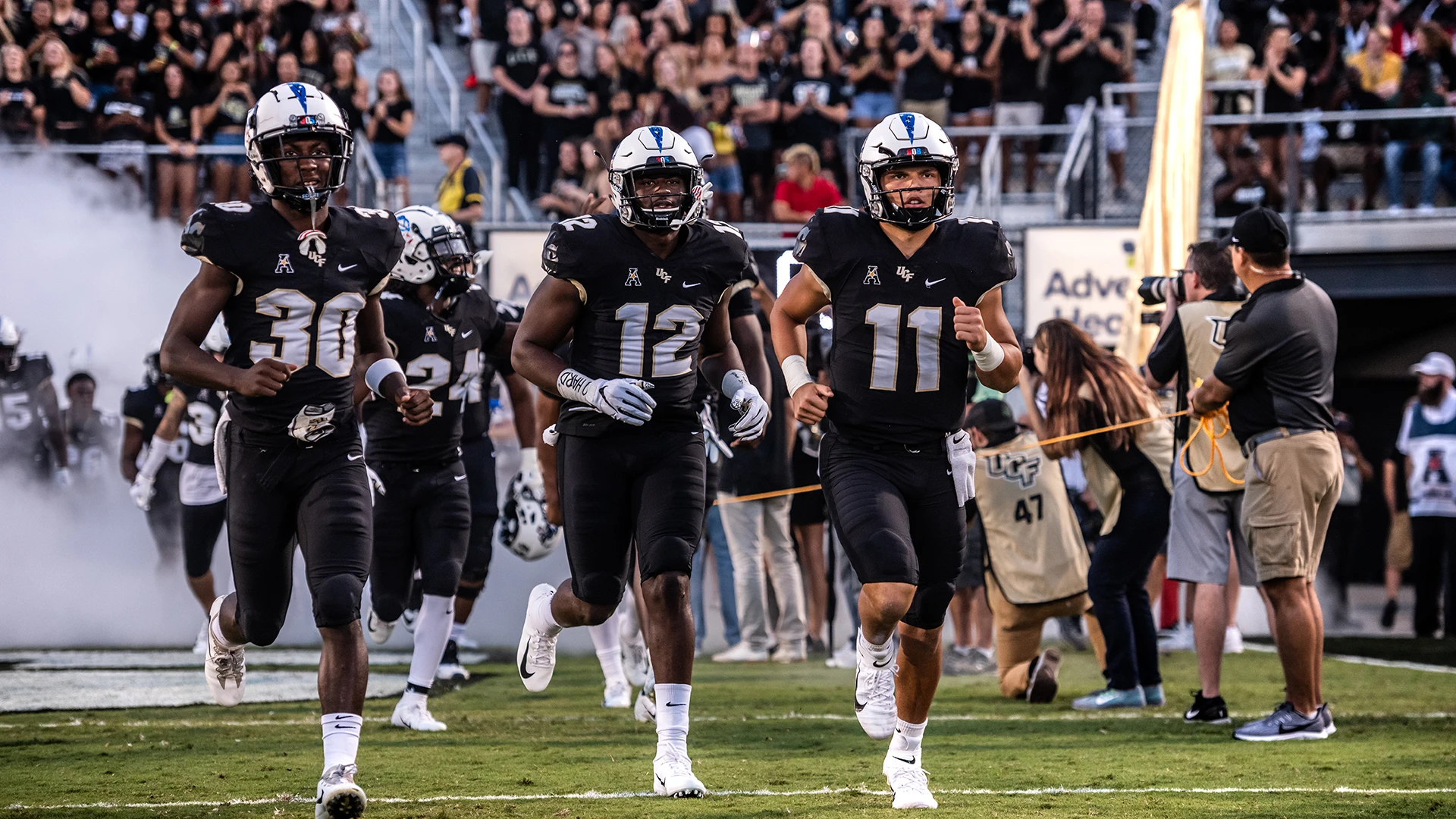
UCF enters the 2025 season looking to rebound from a disappointing 4-8 campaign, despite boasting one of the nation’s most potent rushing attacks. The Knights averaged 248 rushing yards per game, good for 5th in the country, yet the offense as a whole struggled—largely due to the passing game never materializing after quarterback KJ Jefferson went down early in the year. Now, with only one returning starter on offense and three on defense, UCF faces an uphill battle to improve on last year’s four-win total, including just two victories in Big 12 play. Heading into the fall, there are far more questions than answers.
While the ground game had its moments of magic, the overall offensive production was lacking. With just one returning starter, this unit is likely in for another year of growing pains. The quarterback situation remains murky. Jacurri Brown, the team’s second-leading rusher last season, is one option, but he’s more of a runner than a proven passer. Cam Fancher, a three-year starter at Florida Atlantic, transferred in, but his career 27-23 TD-INT ratio doesn’t inspire much confidence. Tayven Jackson, a career backup at Indiana, is also in the mix. Altogether, this quarterback room lacks a clear leader and proven playmaker.
The loss of star running back RJ Harvey is significant. Harvey carried the offense last season, racking up 1,577 rushing yards, 22 touchdowns, and averaging an impressive 6.8 yards per carry. Myles Montgomery returns after gaining valuable experience and will likely split duties with Western Michigan transfer Jaden Nixon, who rushed for 919 yards and 12 touchdowns for the Broncos last season.
On the offensive line, the lone returning starter is a good one—massive 330-pound tackle Paul Rubelt. Still, the line as a whole is a work in progress. Transfers like Gaard Memmelaar (Western Michigan) and Carter Miller (ULM) were brought in, but the talent level remains uncertain. Compounding the issue is the complete lack of returning production at wide receiver. UCF hit the transfer portal hard, bringing in DJ Black from Division II Limestone, hoping he can make the jump. Marcus Burke (Florida) is expected to stretch the field, while Ric Darious (West Virginia), Duane Thomas (Charlotte), and Chris Domercant (Chattanooga) add depth. But again, there’s no proven commodity among them. With a questionable passing game and no established stars, this offense may struggle even more than last year’s unit.
Defensively, the Knights are banking on development and transfers. Edge rushers Malachi Lawrence and Nyjalik Kelly return with more experience, and the addition of Sincere Edwards (Pitt) adds pass-rushing depth. Defensive tackle John Walker showed promise before an injury derailed his 2024 season, and Horace Lockett (Georgia Tech) provides size and strength inside at 315 pounds.
The linebacker corps was rebuilt through the portal. Cole Kozlowski arrives from FCS-level Colgate, joined by Phil Picciotti and Lewis Carter, both formerly with Oklahoma. Veteran Keli Lawson, who spent four years at Virginia Tech, brings valuable leadership. In the secondary, UCF hopes for a bounce-back season from Demari Henderson, while Phil Dunham (FAU) and returning safety Braeden Marshall offer some stability. Transfers Isaiah Reed (Brown), Jayden Bellamy (Syracuse), and DJ Bell (Memphis) are expected to push for starting roles and elevate the unit.
There isn’t much buzz surrounding this UCF team heading into the season. A 6-6 finish would be a major surprise and a testament to head coach Scott Frost’s ability to coach up a patchwork roster. The Knights open the season favored against Jacksonville State, followed by a visit from lowly NC A&T. A non-conference matchup against a rebuilding North Carolina team will still pose challenges. Once Big 12 play begins, UCF might not be favored in a single game.
At this point, even matching last year’s four wins feels optimistic. Unless several newcomers exceed expectations, UCF fans should brace for a long and trying season.
After a Thursday night loss to the Falcons that dropped the out of first place in the NFC South they got some good news Sunday. The Tampa Bay Buccaneers have reclaimed first place in the NFC South after a dramatic turn of events. Thanks to the New Orleans Saints’ last-second rally to defeat the Carolina Panthers 17-16, Tampa Bay moved back into the division lead at 7-7 with three weeks left in the regular season. The Saints’ upset win not only spoiled Carolina’s momentum but also reshuffled the playoff picture, giving the Buccaneers renewed control of their destiny.
Sunday’s clash at the Caesars Superdome was a showcase of resilience by New Orleans. Rookie quarterback Tyler Shough engineered two late scoring drives, capped by kicker Charlie Smyth’s 47-yard field goal with just two seconds remaining. The Panthers, who had led most of the afternoon, were undone by costly penalties—11 flags for 103 yards—and a sputtering rushing attack that managed only 127 yards. Wide receiver Chris Olave came alive in the fourth quarter, hauling in four catches for 78 yards, including a 12-yard grab that tied for a score. Carolina’s miscues opened the door for the Saints, who completed the season sweep of their division rival and knocked the Panthers into a tie with Tampa Bay.
Buccaneers Control Their Own Fate
For Tampa Bay, the Saints’ victory was a lifeline. Despite dropping five of their last six games, the Buccaneers now sit atop the NFC South with a chance to secure a fifth straight division crown. The path forward is clear: win the remaining divisional matchups. Tampa Bay travels to Charlotte next Sunday to face the Panthers in a pivotal Week 16 showdown. They then host the Miami Dolphins before closing the season against Carolina once more1. With the Falcons and Saints effectively eliminated from contention, the division race boils down to Tampa Bay and Carolina. If the Buccaneers can steady their form, they will not only clinch the South but also lock in a playoff berth. The stakes are high, but the opportunity is theirs to seize.
Wanted: Someone with deep pockets who loves women’s soccer located in a city with a ready to go soccer stadium, a good corporate base and a good media market contact Jessica Berman for details. The National Women’s Soccer League is now looking for an 18th franchise. The league awarded Home Depot co-founder and owner of the National Football League Atlanta Falcons franchise and Major League Soccer’s Atlanta United FC franchise, Arthur Blank, the league’s 17th franchise in Atlanta. Blank’s team will begin play in 2028. “It is our intention to admit Team 18, and we are targeting a 2028 launch,” NWSL Commissioner Jessica Berman said during an appearance in Atlanta one day after announcing the league’s 17th franchise in November. Arthur Blank did not bid for a franchise.
“I think the philosophy around our shift in strategy as it relates to expansion remains true, which is that we will now admit teams as we and a potential bidder deem is ready and appropriate, and really use a slightly different filter so that we can make decisions more on a case-by-case basis,” Berman said. “With that in mind, we’re definitely working on expansion. It will likely always be, at least for the foreseeable future, going on in the background, and when and if we determine that a deal is ready to be presented to our board and move forward, we’ll be able to add Team 18.” In January, 2025 the National Women’s Soccer League awarded its 16th franchise to the Denver market. Denver got the nod beating out Cincinnati and Cleveland. Presumably those two cities are in the mix for that 18th team along with places like Nashville, Minneapolis-St. Paul and Jacksonville. It has been a long road for professional women’s soccer leagues in the United States to find success. That may be changing.
Bucs Head Coach Todd Bowles Opens Up to Dan Sileo: Cutdown Day, Baker Mayfield, and Buccaneers Legacy
Todd Bowles walked into the postgame press conference knowing the truth: his future in Tampa Bay now rides on the final three games of the season. The Buccaneers blew a 28–14 fourth‑quarter lead and handed the Atlanta Falcons a 29–28 win, a collapse that mirrored the team’s month‑long freefall. Bowles didn’t hide his frustration, and his message hit harder than any hit delivered on the field.
Mike Evans returned from a broken clavicle and played like a man determined to drag the Buccaneers forward. He caught six passes for 132 yards, drew multiple penalties, and showed visible disgust as he walked off the field after the loss. Bowles praised him with purpose.
“He played winning football. He cares,” Todd Bowles said. “He’s one of the guys that cares. He gave his heart. He gave his all.”
Todd Bowles didn’t need to say the rest out loud. His tone made it clear: not enough players match Evans’ urgency. When pressed on who lacks that edge, Bowles backtracked, but the message already landed.
“They all care. It’s just a matter of execution,” Bowles said. “There’s nobody out there trying to mess it up. But at some point you’ve got to get it right. This is a player‑driven team in the last four or five weeks. You’ve got to execute. They’ve got to hold each other accountable.” (Reporting supported by NFL.com’s transcript of Bowles’ comments NFL and USA Today’s coverage of his postgame remarks USA TODAY.)
Mayfield Takes the Blame and Challenges the Locker Room
Baker Mayfield didn’t dodge responsibility. He threw a late interception and owned it immediately. He also echoed Bowles’ challenge to the roster.
“We have talent. Talent doesn’t get you anything,” Mayfield said. “Doing the work and executing on game day does. We didn’t do that.”
Mayfield didn’t sugarcoat the stakes.
“We have to win out to get to the playoffs. To win the division, we have to win out. If the guys don’t handle this the right way, then we have a much deeper issue.
What’s Working: The Run Game Shows Life
The Buccaneers produced 88 yards on 22 carries and created opportunities to control the clock. They didn’t lean on the run game enough, especially with a late lead. The ground attack gave them balance, but Bowles and the offense never fully committed to it.
What Needs Help: The Defense Collapses Again
The defense failed in every critical moment. Tampa Bay couldn’t pressure the quarterback, couldn’t cover tight ends, and couldn’t tackle in space. Atlanta faced third‑and‑28, gained 14 yards, and then converted fourth‑and‑14 on the game‑winning drive — a sequence that defined the night.
The Bucs surrendered 365 passing yards and recorded only one sack on an immobile Kirk Cousins. The numbers matched the eye test: the defense broke when it mattered most.
Stock Up: Mike Evans
Evans returned with fire, production, and leadership. His 132 yards and emotional edge set the tone. He played like a captain trying to save a season.
Stock Down: The Offensive Line
The offensive line allowed five sacks and constant pressure. The unit never settled, and its struggles disrupted the rhythm of the offense throughout the night.
Injuries Continue to Pile Up
The Buccaneers lost CB Zyon McCollum (hip) during the game. LG Ben Bredeson remained out after landing on injured reserve. DB Tykee Smith (neck/shoulder), LB SirVocea Dennis (hip), TE Cade Otton (knee), and CB Benjamin Morrison (hamstring) all missed the matchup.
Next Steps: A Season on the Brink
Tampa Bay travels to Carolina next, while the Panthers play at New Orleans on Sunday. The Buccaneers still control their playoff path, but control means nothing if they can’t finish games.
The Final Word: Bowles and the Bucs Still Hold Their Fate — But Time Is Running Out
The Buccaneers created this crisis, but they also hold the power to escape it. Bowles’ future, the team’s playoff hopes, and the direction of the franchise all hinge on the final three games. The ship hasn’t sunk yet. The question now is simple: