Connect with us

Business

NASA’s upcoming moonshot may let astronauts be the first to lay eyes on parts of the lunar far side that were missed by the Apollo program

Published

on


The moon and sun share top billing in 2026.

Kicking off the year’s cosmic wonders is the moon, drawing the first astronauts to visit in more than 50 years as well as a caravan of robotic lunar landers including Jeff Bezos’ new supersized Blue Moon. A supermoon looms on Jan. 3 and an astronomical blue moon is on the books for May.

The sun will also generate buzz with a ring-of-fire eclipse at the bottom of the world in February and a total solar eclipse at the top of the world in August. Expect more auroras in unexpected places, though perhaps not as frequently as the past couple years.

And that comet that strayed into our turf from another star? While still visible with powerful backyard telescopes, the recently discovered comet known as 3I/Atlas is fading by the day after swinging past Earth in December. Jupiter is next on its dance card in March. Once the icy outsider departs our solar system a decade from now, it will be back where it belongs in interstellar space.

It’s our third known interstellar visitor. Scientists anticipate more.

“I can’t believe it’s taken this long to find three,” said NASA’s Paul Chodas, who’s been on the lookout since the 1980s. And with ever better technology, “the chance of catching another interstellar visitor will increase.”

Here’s a rundown on what the universe has in store for us in 2026:

Next stop, moon

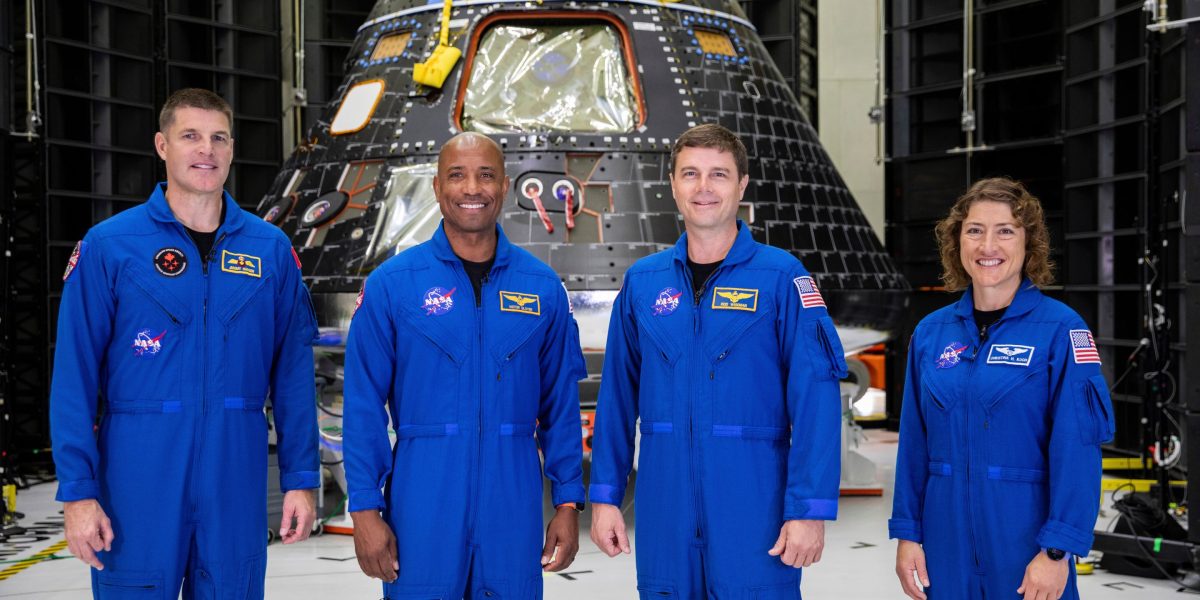
NASA’s upcoming moonshot commander Reid Wiseman said there’s a good chance he and his crew will be the first to lay eyeballs on large swaths of the lunar far side that were missed by the Apollo astronauts a half-century ago. Their observations could be a boon for geologists, he noted, and other experts picking future landing sites.

Launching early in the year, the three Americans and one Canadian will zip past the moon, do a U-turn behind it, then hustle straight back to Earth to close out their 10-day mission. No stopping for a moonwalk — the boot prints will be left by the next crew in NASA’s Artemis lunar exploration program.

More robotic moon landings are on the books by China as well as U.S. companies. Early in the year, Amazon founder Bezos is looking for his Blue Origin rocket company to launch a prototype of the lunar lander it’s designing for NASA’s astronauts. This Blue Moon demo will stand 26 feet (8 meters), taller than what delivered Apollo’s 12 moonwalkers to the lunar surface. The Blue Moon version for crew will be almost double that height.

Back for another stab at the moon, Astrobotic Technology and Intuitive Machines are also targeting 2026 landings with scientific gear. The only private entity to nail a lunar landing, Firefly Aerospace, will aim for the moon’s far side in 2026.

China is targeting the south polar region in the new year, sending a rover as well as a so-called hopper to jump into permanently shadowed craters in search of ice.

Eclipses

The cosmos pulls out all the stops with a total solar eclipse on Aug. 12 that will begin in the Arctic and cross over Greenland, Iceland and Spain. Totality will last two minutes and 18 seconds as the moon moves directly between Earth and the sun to blot out the latter. By contrast, the total solar eclipse in 2027 will offer a whopping 6 1/2 minutes of totality and pass over more countries.

For 2026, the warm-up act will be a ring-of-fire eclipse in the Antarctic on Feb. 17, with only a few research stations in prime viewing position. South Africa and southernmost Chile and Argentina will have partial viewing. A total lunar eclipse will follow two weeks after February’s ring of fire, with a partial lunar eclipse closing out the action at the end of August.

Parading planets

Six of the solar system’s eight planets will prance across the sky in a must-see lineup around Feb. 28. A nearly full moon is even getting into the act, appearing alongside Jupiter. Uranus and Neptune will require binoculars or telescopes. But Mercury, Venus, Jupiter and Saturn should be visible with the naked eye shortly after sunset, weather permitting, though Mercury and Venus will be low on the horizon.

Mars will be the lone no-show. The good news is that the red planet will join a six-planet parade in August, with Venus the holdout.

Supermoons

Three supermoons will lighten up the night skies in 2026, the stunning result when a full moon inches closer to Earth than usual as it orbits in a not-quite-perfect circle. Appearing bigger and brighter, supermoons are a perennial crowd pleaser requiring no equipment, only your eyes.

The year’s first supermoon in January coincides with a meteor shower, but the moonlight likely will obscure the dimmer fireballs. The second supermoon of 2026 won’t occur until Nov. 24, with the third — the year’s final and closest supermoon — occurring the night of Dec. 23 into Dec. 24. This Christmas Eve supermoon will pass within 221,668 miles (356,740 kilometers) of Earth.

Northern and southern lights

The sun is expected to churn out more eruptions in 2026 that could lead to geomagnetic storms here on Earth, giving rise to stunning aurora. Solar action should start to ease, however, with the 11-year solar cycle finally on the downslide.

Space weather forecasters like Rob Steenburgh at the National Oceanic and Atmospheric Administration can’t wait to tap into all the solar wind measurements coming soon from an observatory launched in the fall.

“2026 will be an exciting year for space weather enthusiasts,” he said in an email, with this new spacecraft and others helping scientists “better understand our nearest star and forecast its impacts.”

This story was originally featured on Fortune.com


Source link

Continue Reading

Business

How to win your money resolutions in 2026: From emergency funds to savings goals

Published

on


The start of a new year usually brings new motivation to achieve goals like eating healthier or finally cleaning your basement. Many resolutions also focus on financial goals, such as paying off credit card debt, saving for a new house, or simply getting more educated about money.

“New Year’s is a really good time to review and realign your financial goals overall,” said Erica Grundza, certified financial planner at Betterment, an investing and savings app.

When building your goals for 2026, Grundza recommends focusing less on the past and more on an optimistic, yet realistic, vision for the future. She recommends that you focus on reestablishing the “why” behind your approach to money and how you want to make it work for your life. This can be as simple as saving $10 each week in a savings account, or a bigger goal like saving to buy a house in the coming years. It’s all about your own journey.

The Associated Press spoke with people who are making financial resolutions for 2026. Here’s a look at what they’re planning and how you can draw inspiration for your own resolutions:

Making achievable plans

Resolutions can easily turn into unattainable goals that feel more like a dream, said MarieYolaine Toms, a coach and founder of Focused Fire, a financial coaching company. To avoid setting unrealistic expectations, Toms follows a “no resolutions” mindset and instead focuses on making an actionable plan.

“What I say every year is that I am not making resolutions, I’m making plans that can be tracked forward, traced back, and tweaked until completion,” Toms said.

Recently, Toms encouraged her clients to check their credit report with the three credit bureaus and, based on their credit reports, make an attainable plan to start a savings account. For example, adding $25 to their savings account every week.

Whether you’re trying to pay off debt or save for a vacation abroad, the first step towards making a plan can be creating a budget. When making a budget, it’s best to find a technique that works for you, whether it’s the classic 50/30/20 plan or another budgeting style.

If you’re building a budget for the first time, you can find some expert recommendations here.

Paying off debt

After losing her job as a magazine editor in September, Rachel Pelovitz, 33, had to take a closer look at her finances. Having acquired a significant amount of debt over the last few years due to her husband’s year-and-a-half-long unemployment, Pelovitz explored several options to pay it off. Ultimately, Pelovitz and her husband chose to sell their house and work with a debt consolidation organization.

“Rather than rely on getting more debt, we are currently selling our house,” Pelovitz said.

Pelovitz’s main goal for 2026 is to pay off half of her credit card debt. And, with some of the money from selling the house, start investing moderately.

If you’ve also experienced a layoff, you can read expert recommendations to help you take care of your finances and your mental health here.

Building a savings account

For Jenni Lee, 27, this is going to be the year when she gets strict about building her savings account. While Lee considers herself generally good with money, over the last six months she has overspent and wants to rein it in. The long-term goal for her savings journey is for Lee to buy a house.

“I’m now in my late 20s, I’m starting to really think about where I pinch now so it won’t hurt later when I finally decide to purchase and own a place,” said Lee, a tech worker and lifestyle TikTok creator based in Chicago.

As she saves for her future home and possibly a trip to South Korea, Lee wants to cut unnecessary spending on clothing items and eating out.

Social media microtrends are a common influence on people’s shopping decisions, and this can lead to overspending. If you’re looking to avoid spending money on microtrends, you can find experts’ recommendations here.

Building an emergency fund

If you are in a position to do so, having multiple financial goals you’re working towards at the same time can be a great way to speed up your progress. For Worcester resident Melanie Duarte, 23, her New Year’s money goals include paying off her student loans and credit card debt while building an emergency fund.

“I made sure to include it in my budget, even if it’s something as small as like $50. I just want to make sure I still put something in (my emergency fund) so that it eventually multiplies,” said Duarte, who owns a marketing agency.

Duarte’s family didn’t speak openly about finances when she was growing up. But, since she opened her own business, Duarte has been slowly working on rewriting her relationship with money.

If you’re looking to start an emergency fund or create better habits while you save, you can read some experts’ recommendations here.

Finding balance

Finding a balance between saving for your long-term goals while also making sure you enjoy your money is important, but it can also be challenging. After the death of her grandfather just a few years after retirement, Tiana Stewart, 26, felt that he didn’t get to enjoy the fruits of his labor. So, this past year, Stewart decided to enjoy her life and travel.

“I do understand saving for retirement is important, but I also want to enjoy my life and the money that I work for at this time, especially being in my 20s,” said Stewart, who lives in Maryland.

But now, as she reflects on her financial future, Stewart wants to focus on paying off debt, saving, and investing. Having a healthy balance between enjoying life and saving for the future is what she wants to work toward.

For some, participating in budgeting challenges such as the no-buy yearcan be a great way to set boundaries on your spending and set aside money towards your financial goals. Many people start such challenges at the beginning of the year and commit to keep going until the end, but others start with a no-buy month.

This story was originally featured on Fortune.com


Source link

Continue Reading

Business

Gen Z can skip college, and still earn big: Here are the top 15 highest-paying jobs that don’t require a degree

Published

on


Gen Z has been taking a harder look at the American Dream of pursuing a four-year degree as tuition costs have skyrocketed and AI takes over white-collar jobs. Luckily, they have an out—there are many careers that don’t require a bachelor’s and still pay six-figure salaries. 

The top high-wage job that doesn’t require a four-year degree and shows strong job growth may be unexpected: elevator and escalator installers and repairers. The role has a median annual salary of $106,580, only requiring a high school diploma, apprenticeship completion, and a state certification, according to a new report from Resume Genius analyzing U.S. Bureau of Labor Statistics data. 

The study placed transportation, storage, and distribution managers in second; by pursuing an entry-level role in logistics, new hires can put themselves on track to earn $102,010 per year. Flight attendants, chefs, athletes, and criminal investigators also made the list. 

Young people have been told that going to college is necessary for success, but Gen Zers wanting to skip costly degrees don’t have to sacrifice their careers. The report shows they have a litany of choices, from six-figure blue collar jobs to cushy office roles.

Resume Genius career expert Eva Chan told CNBC that “there’s no one way to get a high-paying job,” adding that all the ranked roles “have some degree of training, some have schooling, but they’re all very attainable without a degree.”

The top 15 high-paying jobs that don’t require four-year degrees

The top 15 highest-paying jobs that earn above the U.S. median, have positive projected job growth, and don’t require a four-year degree to apply, according to Resume Genius.

  1. Elevator and escalator installer and repairer (Median annual salary: $106,580)
  2. Transportation, storage, and distribution manager (Median annual salary: $102,010)
  3. Electrical power-line installer and repairer (Median annual salary: $92,560)
  4. Aircraft and avionics equipment mechanic and technician (Median annual salary: $79,140)
  5. Detective and criminal investigator (Median annual salary: $77,270)
  6. Locomotive engineer (Median annual salary: $75,680)
  7. Wholesale and manufacturing sales representative (Median annual salary: $74,100)
  8. Flight attendant (Median annual salary: $67,130)
  9. Property, real estate, and community association manager (Median annual salary: $66,700)
  10. Water transportation worker (Median annual salary: $66,490)
  11. Food service manager (Median annual salary: $65,310)
  12. Heavy vehicle and mobile equipment service technician (Median annual salary: $62,740)
  13. Athlete and sports competitor (Median annual salary: $62,360)
  14. Chef and head cook (Median annual salary: $60,990)
  15. Insurance sales agent (Median annual salary: $60,370)
Join us at the Fortune Workplace Innovation Summit May 19–20, 2026, in Atlanta. The next era of workplace innovation is here—and the old playbook is being rewritten. At this exclusive, high-energy event, the world’s most innovative leaders will convene to explore how AI, humanity, and strategy converge to redefine, again, the future of work. Register now.


Source link

Continue Reading

Business

OpenAI is hiring a head of preparedness, who will earn $555,000

Published

on


OpenAI is looking for a new employee to help address the growing dangers of AI, and the tech company is willing to spend more than half a million dollars to fill the role.

OpenAI is hiring a “head of preparedness” to reduce harms associated with the technology, like user mental health and cybersecurity, CEO Sam Altman wrote in an X post on Saturday. The position will pay $555,000 per year, plus equity, according to the job listing.

“This will be a stressful job and you’ll jump into the deep end pretty much immediately,” Altman said.

OpenAI’s push to hire a safety executive comes amid companies’ growing concerns about AI risks on operations and reputations. A November analysis of annual Securities and Exchange Commission filings by financial data and analytics company AlphaSense found that in the first 11 months of the year, 418 companies worth at least $1 billion cited reputational harm associated with AI risk factors. These reputation-threatening risks include AI datasets that show biased information or jeopardize security. Reports of AI-related reputational harm increased 46% from 2024, according to the analysis.

“Models are improving quickly and are now capable of many great things, but they are also starting to present some real challenges,” Altman said in the social media post.

“If you want to help the world figure out how to enable cybersecurity defenders with cutting edge capabilities while ensuring attackers can’t use them for harm, ideally by making all systems more secure, and similarly for how we release biological capabilities and even gain confidence in the safety of running systems that can self-improve, please consider applying,” he added.

OpenAI’s previous head of preparedness Aleksander Madry was reassigned last year to a role related to AI reasoning, with AI safety a related part of the job. 

OpenAI’s efforts to address AI dangers

Founded in 2015 as a nonprofit with the intention to use AI to improve and benefit humanity, OpenAI has, in the eyes of some of its former leaders, struggled to prioritize its commitment to safe technology development. The company’s former vice president of research, Dario Amodei, along with his sister Daniela Amodei and several other researchers, left OpenAI in 2020, in part because of concerns the company was prioritizing commercial success over safety. Amodei founded Anthropic the following year.

OpenAI has faced multiple wrongful death lawsuits this year, alleging ChatGPT encouraged users’ delusions, and claiming conversations with the bot were linked to some users’ suicides. A New York Times investigation published in November found nearly 50 cases of ChatGPT users having mental health crises while in conversation with the bot. 

OpenAI said in August its safety features could “degrade” following long conversations between users and ChatGPT, but the company has made changes to improve how its models interact with users. It created an eight-person council earlier this year to advise the company on guardrails to support users’ wellbeing and has updated ChatGPT to better respond in sensitive conversations and increase access to crisis hotlines. At the beginning of the month, the company announced grants to fund research about the intersection of AI and mental health.

The tech company has also conceded to needing improved safety measures, saying in a blog post this month some of its upcoming models could present a “high” cybersecurity risk as AI rapidly advances. The company is taking measures—such as training models to not respond to requests compromising cybersecurity and refining monitoring systems—to mitigate those risks.

“We have a strong foundation of measuring growing capabilities,” Altman wrote on Saturday. “But we are entering a world where we need more nuanced understanding and measurement of how those capabilities could be abused, and how we can limit those downsides both in our products and in the world, in a way that lets us all enjoy the tremendous benefits.”


Source link

Continue Reading

Trending

Copyright © Miami Select.