Connect with us

Business

‘You will see mass chaos. You will see mass flight delays. You’ll see mass cancellations’: Transportation Secretary desperate for shutdown to end

Published

on


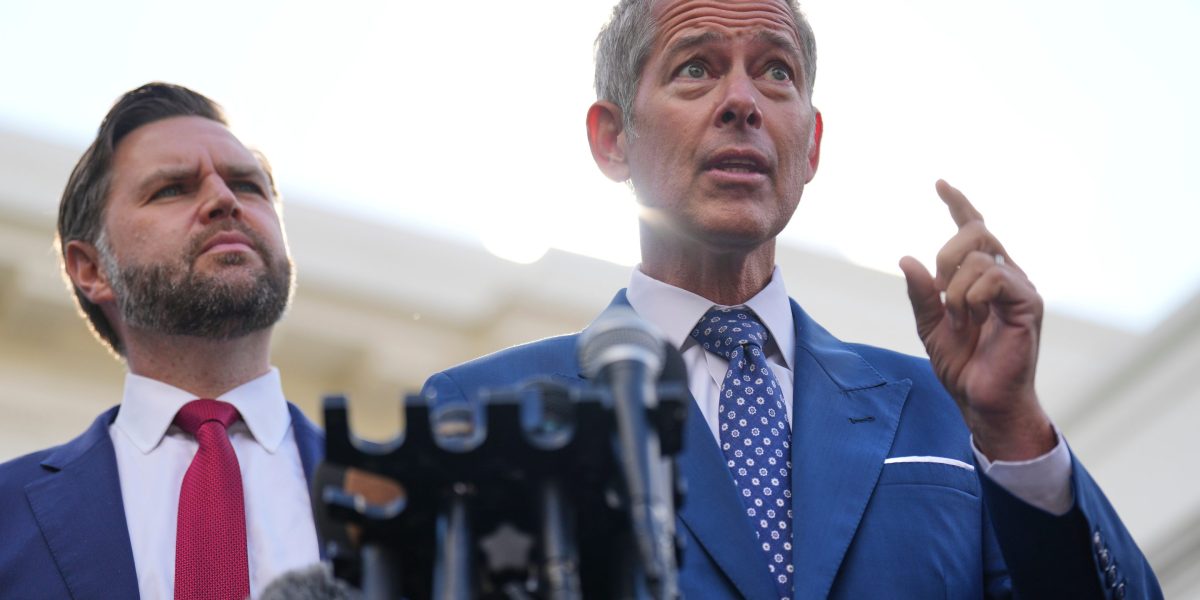
Transportation Secretary Sean Duffy predicted Tuesday that there could be chaos in the skies next week if the government shutdown drags on and air traffic controllers miss a second paycheck.

There have already been numerous delays at airports across the country — sometimes hours long — because the Federal Aviation Administration slows down or stops traffic temporarily anytime it is short on controllers. Last weekend saw some of the worst staff shortages and on Sunday, flights at Newark Liberty International Airport in New Jersey were delayed for several hours.

Duffy and the head of the air traffic controllers union have both warned that the situation will only get worse the longer the shutdown continues and the financial pressure continues to grow on people who are forced to work without pay. FAA employees already missed one paycheck on Oct. 28. Their next payday is scheduled for next Tuesday.

“Many of the controllers said ‘A lot of us can navigate missing one paycheck. Not everybody, but a lot of us can. None of us can manage missing two paychecks,’” Duffy said. “So if you bring us to a week from today, Democrats, you will see mass chaos. You will see mass flight delays. You’ll see mass cancellations, and you may see us close certain parts of the airspace, because we just cannot manage it because we don’t have air traffic controllers.”

Most of the flight disruptions so far during the shutdown have been isolated and temporary. But if delays become more widespread and start to ripple throughout the system, the pressure will mount on Congress to reach an agreement to end the shutdown.

Major airlines, aviation unions and the travel industry have been urging Congress to end this shutdown as soon as possible by voting to support the clean funding resolution that Republicans have proposed.

The U.S. Travel Association said in a letter to Congressional leaders this week that the economy has already lost more than $4 billion because of the shutdown, and the industry worries the impact will get significantly worse if the shutdown continues into the holiday travel season.

“With Thanksgiving, the busiest travel period of the year, imminently approaching, the consequences of a continued shutdown will be immediate, deeply felt by millions of American travelers, and economically devastating to communities in every state,” the U.S. Travel Association said.

Normally, airlines strive to have at least 80% of their flights depart and arrive within 15 minutes of when they are scheduled. Aviation analytics firm Cirium said that since the shutdown began on Oct. 1, the total number of delays overall has not fallen significantly below that goal because most of the disruptions so far have been no worse than what happens when a major thunderstorm moves across an airport.

But on Sunday, only about 56% of Newark’s departures were on time, and the Orlando airport reported that only about 70% of its flights were on time, according to Cirium.

As of midday Tuesday, there have been 1,932 flight delays reported across the United States, according to www.FlightAware.com. That is lower than what is typical although the FAA did say that flights in Phoenix were being delayed Tuesday morning because of staffing shortages. Strong winds are also causing delays at the Newark and LaGuardia airports Tuesday.


Source link

Continue Reading

Business

Credit card companies are jacking up annual fees for airport lounges

Published

on


For every passenger trying to decide if a $17 slimy ham and cheese croissant and their phone’s 34% remaining battery will sustain them for a four-hour layover, there’s someone smugly sipping a complimentary gin and tonic in a secret luxury lounge.

Once a refuge for frequent business travelers, airport lounges are increasingly becoming more popular (and crowded) with casual travelers, encouraging some companies to create even more exclusive spaces—or raise the barrier to entry:

  • Capital One opened its largest lounge (13,500 square feet) in June at NYC’s JFK Airport, complete with Ess-a-Bagels and a designated cheesemonger (as well as classic lounge amenities, like shower suites and a cocktail bar).
  • Over half of JFK’s overall Terminal 4 lounge space has been added in the last two years.

How much would you pay for exclusivity?

The increase in global airport lounge visits in 2024 (31%) has outpaced growth in air traffic overall (10.4%) compared to the previous year. And access isn’t cheap. United charges $750 annually for individual access to its airport lounge network. Amex recently announced that the annual fee for its Platinum card—which includes the perk of lounge access—is increasing from $695 to $895. And one of the most popular travel perk cards, the Chase Sapphire Reserve, just ratcheted up its annual fee from $550 to $795.—MM

This report was originally published by Morning Brew.


Source link

Continue Reading

Business

Trump’s $2,000 tariff ‘dividends’ would cost twice as much as the revenue coming in, budget watchdog warns

Published

on


President Trump’s recent proposal to pay Americans “at least $2,000 a person” from new tariff revenue—a policy he calls “tariff dividends”—is facing sharp criticism from a budget watchdog, who calculates that the plan will actually lose twice as much money for the country as the tariffs are generating.

Writing in a weekend post on Truth Social, Trump argued that tariff revenues could be redistributed directly to individuals in the form of annual payments, with “high income people” excluded from the payouts. The idea, pitched as a way both to reward taxpayers and possibly reduce the national debt, bears a strong resemblance to the structure of the COVID-era Economic Impact Payments, according to an analysis by the nonpartisan Committee for a Responsible Federal Budget (CRFB).

But the numbers reveal a steep fiscal challenge. The CRFB estimates that distributing just a single round of $2,000 payments to Americans—calculated to match the COVID payments, which included both adults and children—would cost the federal government around $600 billion per year. By contrast, the tariffs that Trump has championed have raised about $100 billion to date and, even accounting for pending legal cases, are only projected to raise about $300 billion annually going forward.

Deficits could skyrocket

“If tariff dividends are paid annually, deficits would increase by $6 trillion over ten years,” the CRFB writes, “roughly twice as much as President Trump’s tariffs are estimated to raise over the same time period.” This means not only that the revenue from tariffs would fail to cover dividend payouts, but also that the policy would exacerbate America’s long-term fiscal challenges.

To put the numbers in perspective, if dividends were paid out on a “revenue neutral” basis—matching payouts to actual tariff revenue—the analysis estimates that payments could be made only every other year, starting in early 2027. Should the Supreme Court uphold current lower court rulings that have deemed some of Trump’s tariffs illegal, remaining tariffs would only cover the dividend payments once every seven years.

Debt implications

Beyond blowing past the revenue generated, diverting all tariff proceeds to pay these dividends would restrict the government’s ability to use tariff income for reducing deficits or paying down debt, as some administration officials have proposed. The CRFB warns that using all tariff revenue for rebates would push federal debt to 127% of Gross Domestic Product (GDP) by 2035, compared to 120% under current law. If $2,000 dividends were paid annually, that figure could jump further, reaching 134% of GDP over the same period.

Such projections come at a time when annual budget deficits are nearing $2 trillion and national debt is quickly approaching an all-time high, making fiscal discipline a top concern for watchdogs and policy analysts.

Trump’s proposal draws inspiration from pandemic-era Economic Impact Payments (EIPs), but those measures were carefully income-tested to phase out payments for individuals earning over $75,000 and joint filers over $150,000. The CRFB said its analysis used similar eligibility parameters for its cost estimate, suggesting that without strict limits, the fiscal hit could be even higher.

For this story, Fortune used generative AI to help with an initial draft. An editor verified the accuracy of the information before publishing. 


Source link

Continue Reading

Business

Wendy’s plans hundreds of store closures to boost profits

Published

on


Wendy’s plans to close hundreds U.S. restaurants over the next few months in an effort to boost its profit.

The Dublin, Ohio-based chain said during a conference call with investors Friday that it planned to begin closing restaurants in the fourth quarter of this year. The company said it expected a “mid-single-digit percentage” of its U.S. stores to be affected, but it didn’t give any more details.

Wendy’s ended the third quarter with 6,011 U.S. restaurants. If 5% of those locations were impacted, it would mean 300 store closures.

The new round of closures comes on top of the closure of 240 U.S. Wendy’s locations in 2024. At the time, Wendy’s said that many of the 55-year-old chain’s restaurants are simply out of date.

Ken Cook, Wendy’s interim CEO, said Friday the company believes closing locations that are underperforming – whether it’s from a financial or customer service perspective – will help improve traffic and profitability at its remaining U.S. restaurants.

Cook became Wendy’s CEO in July after the company’s previous CEO, Kirk Tanner, left to become the president and CEO of Hershey Co.

“When we look at the system today, we have some restaurants that do not elevate the brand and are a drag from a franchisee financial performance perspective. The goal is to address and fix those restaurants,” Cook said during a conference call with investors.

Cook said in some cases, Wendy’s will make improvements to struggling stores, including adding technology or equipment. In other cases, it will transfer ownership to a different operator or close the restaurant altogether.

U.S. fast food chains have been struggling to attract lower-income U.S. consumers in the past few years as inflation has raised prices. In the July-September period, Wendy’s said its U.S. same-store sales, or sales at locations open at least a year, fell 5% compared to the same period last year.

Cook said $5 and $8 meal deals — which have been matched by McDonald’s — have helped bring some traffic back to its U.S. stores. But Wendy’s isn’t doing a good job of bringing in new customers, Cook said, so the company plans to shift its marketing to emphasize its value and the freshness of its ingredients.

Wendy’s shares dropped 7% Friday. On Monday, they were down 6% in afternoon trading.


Source link

Continue Reading

Trending

Copyright © Miami Select.