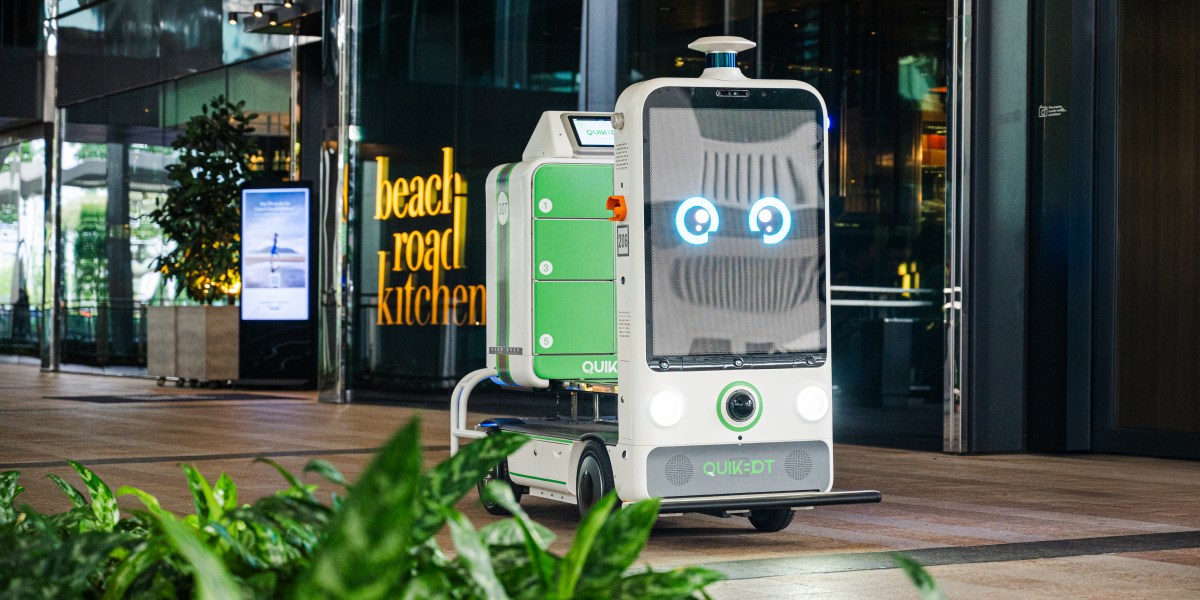
In Singapore’s central business district, delivery robots now pound the pavements alongside smartly-clad businessmen. With two googly, animated eyes and lockers on their back, the robots navigate automatic doors, elevators and turnstiles, delivering packages right to an office’s front door.
These robots are the creation of Singapore-based AI logistics firm QuikBot Technologies. Alan Ng founded QuikBot in 2021, during the COVID-19 pandemic. Restaurants and eateries shuttered as people sheltered in place, yet e-commerce boomed in the pandemic years, causing the demand for delivery services to skyrocket.
Yet Ng observed that there weren’t enough people to get goods where they needed to go. “We simply don’t have enough manpower,” Ng said, particularly in wealthier economies like Singapore, Japan and Korea.
A crucial, yet costly, part of the process is last-mile delivery: Getting a package from a local distribution hub to someone’s home or office. “A driver can take ten minutes to park the car below your building and bring the parcel to you,” he says. “Even with all our tech, we’re still stuck at the last mile.”
QuikBot, for now, has just two delivery robots and a smart locker. Together, they form an ecosystem that automates last-mile delivery in urban environments. Goods are stored in smart lockers, which sit atop a long-distance autonomous robot called the “QuickFox.” Boxes are then transferred onto the QuikCat, a smaller delivery robot that can travel shorter distances to drop off goods at their final destination. Customers will get a text message with a one-time password, which they can use to open the box and collect their parcels.
But Ng says QuikBot isn’t really a robotics company. “We don’t just sell robots. Our job is to help automate buildings,” he explains. “We connect the robot with the building so it can move freely within the space, and then whatever the company wants the robot to do, we can program it to help them with it.”
QuikBot is part of a handful of startups exploring how to make robots work for last-mile delivery. U.S.-based Serve Robotics is developing small vehicles for food delivery, and has signed agreements with both Uber and DoorDash.
The future of delivery
In July, QuikBot announced a partnership with global courier FedEx to roll out autonomous final-mile delivery services in Singapore. The two companies previously ran a successful pilot in two business districts: South Beach Tower and Mapletree Business City.
AI-enabled robots can help delivery firms like FedEx reduce their fleet size and reduce carbon emissions, Ng says, claiming that QuikBot can lead to deliveries that are 30% faster with 20% less emissions.
In 2026, the company will be showcasing their tech at the Singapore Airshow—one of Asia’s largest aerospace and defense exhibitions—for the first time.
Aside from fulfilling e-commerce deliveries, Ng hopes that his tech can be deployed in different spaces, such as in hangars where aircrafts are stored and maintained.
Aerospace workspaces are often large in size, he explains, and technicians may thus have to traverse long distances to obtain tools and spare parts while working to upkeep planes.
“Our robots help to reduce unnecessary workload, by shortening the distance people have to walk,” Ng says. “Robotic delivery can replace a lot of menial and repetitive work.”
Courtesy of QuikBot Technologies
QuikBot has begun scaling globally, and are currently expanding operations to Japan and the UAE. The company also hopes to enter other cities in the Asia-Pacific region, including Hong Kong, Sydney, Melbourne, Incheon and Seoul, Ng says.
Looking forward, the company also wants to automate other legs of delivery, Ng adds. “Our next step is medium-mile delivery, which can be done with autonomous vehicles.”
Ng, eventually, hopes to tap the public markets. “Hopefully we make it work, and get ourselves listed in NASDAQ or the Hong Kong Stock Exchange by 2030, and become a unicorn.”
While the rest of the trucking industry faces a driver shortage, Walmart has managed to boost its driver numbers with six-figure starting pay and other perks that are catching the eye of even non-traditional applicants.
The mega retailer, which has claimed the top spot on the Fortune 500 for the past 13 years, has increased its number of in-house truck drivers by 33% over the past three years in part thanks to better wages and benefits.
In 2022, it boosted drivers’ starting pay to around $115,000 from an average salary of $87,000 previously. At the high end, drivers can make $135,000 per year, according to a Walmart spokesperson. The 2024 median pay for heavy and tractor-trailer truck drivers was $57,440 per year, according to the Bureau of Labor Statistics.
Apart from a pay increase, Walmart also uses technology that allows for more reliable schedules compared to other companies. While some in the trucking industry are away for weeks at a time, Walmart gives its drivers consecutive days off of work and assigns them regional delivery territories to allow them to be home every week, a Walmart spokesperson told Fortune.
These perks, along with the better-than-average pay, have increasingly helped the company expand its pool of drivers and include more women. Just 9.5% of truck drivers in the U.S. are women as of 2024, according to the Women in Trucking Index—that’s compared to an estimated 18% of drivers at Walmart, according to a study by workforce intelligence company Revelio Labs that was viewed by Fortune. Bloomberg first reported on the study.
Through a 12-week training program that helps store associates transition to the trucking industry, Walmart has also increased its number of women drivers, a spokesperson said. Around 1,000 people have gone through the program, Bloombergreported, representing about half of the company’s new drivers.
Possibly due to its efforts, Walmart has a five percentage point oversupply of truck drivers compared to its demand, according to the study by Revelio Labs.
Walmart’s efforts to bring in more drivers, including those with less experience, is pivotal as the broader trucking industry faces a driver shortage that is expected to bring a shortfall of 160,000 drivers by 2028, according to the American Trucking Association. The broader category of U.S. retail, currently faces a shortfall of drivers, with demand for drivers exceeding supply by seven percentage points, according to Revelio Labs.
Older truck drivers are retiring and younger people aren’t keen to jump into trucking partly due to the long hours and time away from home. A 1,000-person survey from heavy-duty truck parts company FinditParts found that a quarter of Americans would not become truck drivers no matter what pay they were offered.
For Walmart, any disadvantage in its supply chain, including a driver shortfall, could put it at a disadvantage with Amazon, with which it has been increasingly competing with in recent years, especially with its Walmart+ membership.
Without enough drivers, supply chains are delayed and prices go up. Finding and retaining drivers is thus of the utmost importance for companies like Walmart, Paul Bingham, a director of transportation consulting at S&P Global Market Intelligence, told Bloomberg.
“Trucking companies will need more drivers,” he said. “and they’ll have to attract them from the non-traditional population cohorts.”
The “Warrior Dividend” that President Donald Trump announced during his televised address to the nation Wednesday is not a Christmas bonus made possible by tariff revenues, as the president suggested.
Instead, the $1,776 payments to troops are coming from a congressionally-approved housing supplement — money they were already set to receive — that was a part of tax cut extensions and expansions bill signed into law in July. Trump’s administration identified the source of the “dividend” payments Thursday.
In his remarks, Trump alluded to his “One Big Beautiful Bill Act” playing a role, but suggested that tariffs were largely responsible for the payments already on the way to 1.45 million members of the military.
“We made a lot more money than anybody thought because of tariffs and the bill helped us along. Nobody deserves it more than our military,” he said in announcing what he described as a “dividend.”
Trump has teased the idea of using his sweeping tariffs on imports to give Americans dividends ever since he imposed them in April. But these new payments are being disbursed by the Pentagon from a $2.9 billion military housing supplement that was part of Trump’s “One Big Beautiful Bill Act” to augment existing housing allowances, according to a senior administration official who requested anonymity to describe the payments.
The amount of the payments is a nod to next year’s 250th anniversary of the signing of the Declaration of Independence in 1776. In total, the measure is expected to cost $2.6 billion.
Trump’s announcement comes as he’s faced pressure to show he’s working to address rising costs for Americans, with prices remaining stubbornly high as the president has imposed double-digit tariffs on imports from almost every country. Trump has promised to lower prices, but he has struggled to do so. Inflation hit a four-decade high in June 2022 during Joe Biden’s presidency and then began to fall. But inflation has stayed elevated under Trump in part because of his tariffs.
Separately, members of the U.S. Coast Guard will be getting a similar one-time payment, the Department of Homeland Security announced Thursday. The “Devotion to Duty” payments, authorized by Secretary Kristi Noem a day earlier, will be $2,000 because, unlike the “Warrior Dividend,” they are subject to taxes. The amount Coast Guard members take home will be closer to $1,776.
The payments, according to the Coast Guard, will be classified as “special duty pay.” They will be paid for with money in a measure Trump signed in November, after a 43-day shutdown, that funds the government through January.
It’s not the first time Trump has brandished ‘dividends’
Sending money to voters is a timeworn tool for politicians and one that Trump has repeatedly tried to use, including this year.
Trump has for months suggested every American could receive a $2,000 dividend from the import taxes — an effort that seemed designed to try to shore up support for tariffs, which the president has said protect American industries and will lure manufacturing back from overseas.
But that particular pledge appeared to exceed the revenues being generated by his tariffs, according to a November analysis by the right-leaning Tax Foundation. The analysis estimated that the $2,000 payments being promised to taxpayers could add up to between $279.8 billion and $606.8 billion, depending on how they were structured.
The analysis estimated that Trump’s import taxes would produce $158.4 billion in total revenue during 2025 and another $207.5 billion in 2026. That’s not enough money to provide the payments as well as reduce the budget deficit, which Trump has also claimed his tariffs are doing.
Earlier this year, as his Department of Government Efficiency was slashing the U.S. government and its workforce, Trump had briefly proposed sending a DOGE “dividend” back to U.S. citizens.
Neither the tariff dividend or DOGE dividend has come to fruition, and members of Trump’s own party as well as officials in his administration have expressed some skepticism about the idea. There is also the risk that the payments being promised by Trump could push up inflation, as they would likely spur greater consumer spending. Republican lawmakers argued in 2021 that the pandemic relief package from then-President Biden — which included direct payments — helped trigger the run-up in inflation.
___
Associated Press writers Rebecca Santana, Konstantin Toropin and Lisa Mascaro contributed to this report.
House Democrats released several dozen more photos Thursday from the estate of the convicted sex offender Jeffrey Epstein, showing his associations with the rich and famous, as the Department of Justice faces a deadline to release many of its case files on the late financier by the end of the week.
The photos released Thursday were among more than 95,000 that the House Oversight Committee has received after issuing a subpoena for the photos that Epstein had in his possession before he died in a New York jail cell in 2019. Congress has also passed, and President Donald Trump has signed, a law requiring the Justice Department to release its case files on Epstein, and his longtime girlfriend and confidante Ghislaine Maxwell, by Friday. Anticipation about what those files will show is running high after they have been the subject of conspiracy theories and speculation about his friendships with Trump, former President Bill Clinton, the former Prince Andrew, and others.
House Democrats have already released dozens of photos from Epstein’s estate showing Trump, Clinton and Andrew, who lost his royal title and privileges this year amid scrutiny of his relationship with the wealthy financier. The photos released Thursday showed Epstein cooking with Sultan Ahmed bin Sulayem, an Emirati businessman. The photos also include the billionaire Bill Gates and images of a 2011 dinner of notable people and wealthy philanthropists hosted by a nonprofit group. The committee made no accusations of wrongdoing by the men in the photos.
There were also images of passports, visas and identification cards from Russia, the Czech Republic, Ukraine, South Africa and Lithuania with personally identifying information redacted, as well as photos of Epstein with women or girls whose faces were blacked out. The committee has said it is redacting information from the photos that may lead to the identity of victims being revealed.
Rep. Robert Garcia, the top Democrat on the oversight panel, said in a statement that the “new images raise more questions about what exactly the Department of Justice has in its possession. We must end this White House cover-up, and the DOJ must release the Epstein files now.”
Join us at the Fortune Workplace Innovation Summit May 19–20, 2026, in Atlanta. The next era of workplace innovation is here—and the old playbook is being rewritten. At this exclusive, high-energy event, the world’s most innovative leaders will convene to explore how AI, humanity, and strategy converge to redefine, again, the future of work. Register now.