We ‘don’t have enough manpower’ for the delivery boom, says Singapore-based robotics founder
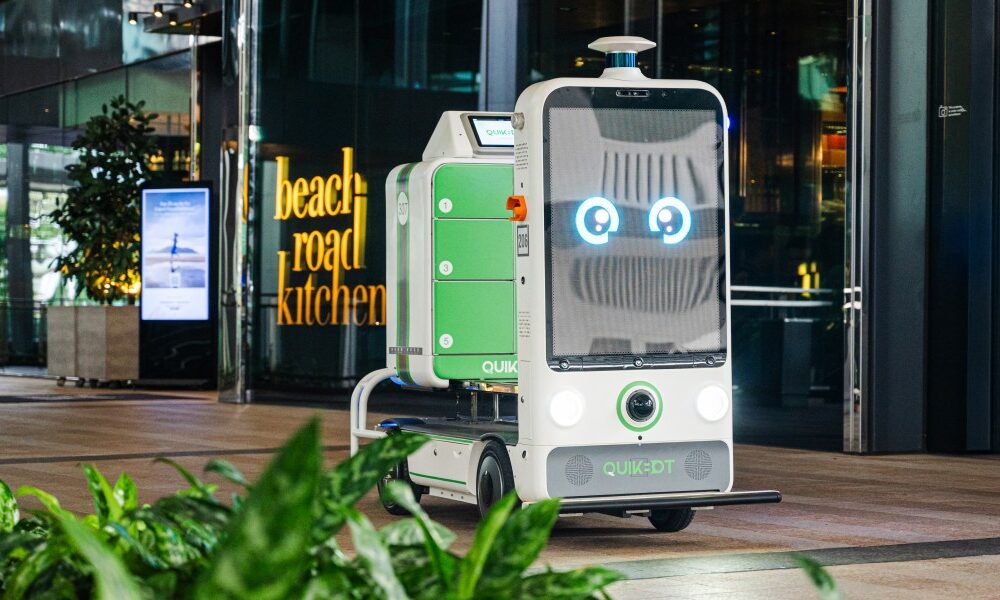
In Singapore’s central business district, delivery robots now pound the pavements alongside smartly-clad businessmen. With two googly, animated eyes and lockers on their back, the robots navigate automatic doors, elevators and turnstiles, delivering packages right to an office’s front door.
These robots are the creation of Singapore-based AI logistics firm QuikBot Technologies. Alan Ng founded QuikBot in 2021, during the COVID-19 pandemic. Restaurants and eateries shuttered as people sheltered in place, yet e-commerce boomed in the pandemic years, causing the demand for delivery services to skyrocket.
Yet Ng observed that there weren’t enough people to get goods where they needed to go. “We simply don’t have enough manpower,” Ng said, particularly in wealthier economies like Singapore, Japan and Korea.
A crucial, yet costly, part of the process is last-mile delivery: Getting a package from a local distribution hub to someone’s home or office. “A driver can take ten minutes to park the car below your building and bring the parcel to you,” he says. “Even with all our tech, we’re still stuck at the last mile.”
QuikBot, for now, has just two delivery robots and a smart locker. Together, they form an ecosystem that automates last-mile delivery in urban environments. Goods are stored in smart lockers, which sit atop a long-distance autonomous robot called the “QuickFox.” Boxes are then transferred onto the QuikCat, a smaller delivery robot that can travel shorter distances to drop off goods at their final destination. Customers will get a text message with a one-time password, which they can use to open the box and collect their parcels.
But Ng says QuikBot isn’t really a robotics company. “We don’t just sell robots. Our job is to help automate buildings,” he explains. “We connect the robot with the building so it can move freely within the space, and then whatever the company wants the robot to do, we can program it to help them with it.”
QuikBot is part of a handful of startups exploring how to make robots work for last-mile delivery. U.S.-based Serve Robotics is developing small vehicles for food delivery, and has signed agreements with both Uber and DoorDash.
The future of delivery
In July, QuikBot announced a partnership with global courier FedEx to roll out autonomous final-mile delivery services in Singapore. The two companies previously ran a successful pilot in two business districts: South Beach Tower and Mapletree Business City.
AI-enabled robots can help delivery firms like FedEx reduce their fleet size and reduce carbon emissions, Ng says, claiming that QuikBot can lead to deliveries that are 30% faster with 20% less emissions.
In 2026, the company will be showcasing their tech at the Singapore Airshow—one of Asia’s largest aerospace and defense exhibitions—for the first time.
Aside from fulfilling e-commerce deliveries, Ng hopes that his tech can be deployed in different spaces, such as in hangars where aircrafts are stored and maintained.
Aerospace workspaces are often large in size, he explains, and technicians may thus have to traverse long distances to obtain tools and spare parts while working to upkeep planes.
“Our robots help to reduce unnecessary workload, by shortening the distance people have to walk,” Ng says. “Robotic delivery can replace a lot of menial and repetitive work.”
Courtesy of QuikBot Technologies
QuikBot has begun scaling globally, and are currently expanding operations to Japan and the UAE. The company also hopes to enter other cities in the Asia-Pacific region, including Hong Kong, Sydney, Melbourne, Incheon and Seoul, Ng says.
Looking forward, the company also wants to automate other legs of delivery, Ng adds. “Our next step is medium-mile delivery, which can be done with autonomous vehicles.”
Ng, eventually, hopes to tap the public markets. “Hopefully we make it work, and get ourselves listed in NASDAQ or the Hong Kong Stock Exchange by 2030, and become a unicorn.”