Connect with us

Business

We ‘don’t have enough manpower’ for the delivery boom, says Singapore-based robotics founder

Published

on


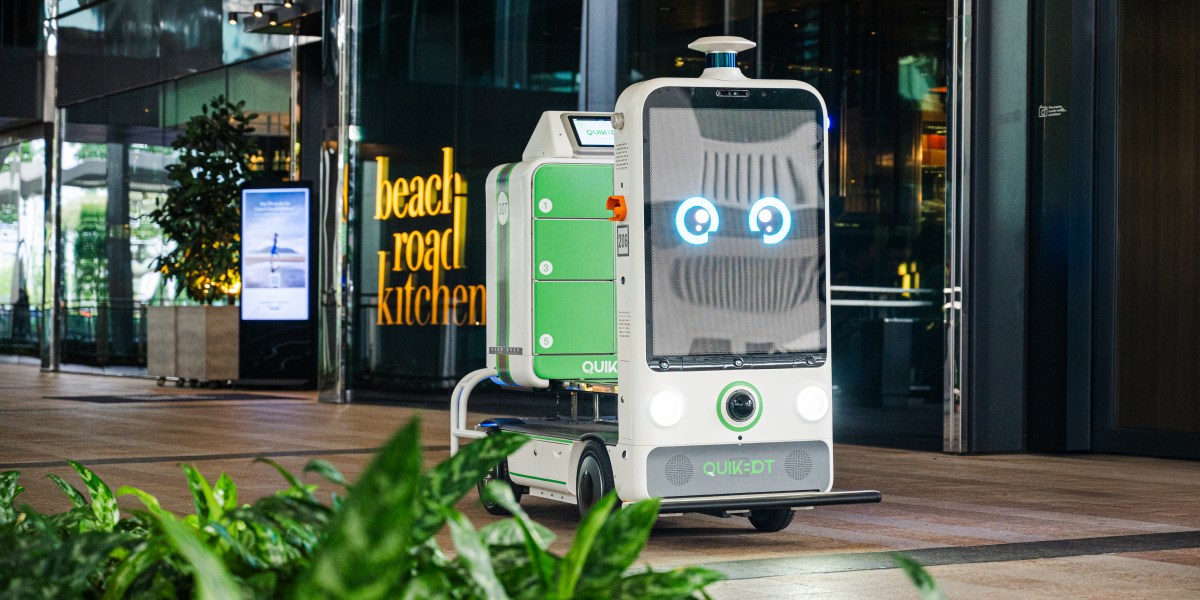
In Singapore’s central business district, delivery robots now pound the pavements alongside smartly-clad businessmen. With two googly, animated eyes and lockers on their back, the robots navigate automatic doors, elevators and turnstiles, delivering packages right to an office’s front door.

These robots are the creation of Singapore-based AI logistics firm QuikBot Technologies. Alan Ng founded QuikBot in 2021, during the COVID-19 pandemic. Restaurants and eateries shuttered as people sheltered in place, yet e-commerce boomed in the pandemic years, causing the demand for delivery services to skyrocket.

Yet Ng observed that there weren’t enough people to get goods where they needed to go. “We simply don’t have enough manpower,” Ng said, particularly in wealthier economies like Singapore, Japan and Korea.

A crucial, yet costly, part of the process is last-mile delivery: Getting a package from a local distribution hub to someone’s home or office. “A driver can take ten minutes to park the car below your building and bring the parcel to you,” he says. “Even with all our tech, we’re still stuck at the last mile.”

QuikBot, for now, has just two delivery robots and a smart locker. Together, they form an ecosystem that automates last-mile delivery in urban environments. Goods are stored in smart lockers, which sit atop a long-distance autonomous robot called the “QuickFox.” Boxes are then transferred onto the QuikCat, a smaller delivery robot that can travel shorter distances to drop off goods at their final destination. Customers will get a text message with a one-time password, which they can use to open the box and collect their parcels.

But Ng says QuikBot isn’t really a robotics company. “We don’t just sell robots. Our job is to help automate buildings,” he explains. “We connect the robot with the building so it can move freely within the space, and then whatever the company wants the robot to do, we can program it to help them with it.”

QuikBot is part of a handful of startups exploring how to make robots work for last-mile delivery. U.S.-based Serve Robotics is developing small vehicles for food delivery, and has signed agreements with both Uber and DoorDash.

The future of delivery

In July, QuikBot announced a partnership with global courier FedEx to roll out autonomous final-mile delivery services in Singapore. The two companies previously ran a successful pilot in two business districts: South Beach Tower and Mapletree Business City.

AI-enabled robots can help delivery firms like FedEx reduce their fleet size and reduce carbon emissions, Ng says, claiming that QuikBot can lead to deliveries that are 30% faster with 20% less emissions.

In 2026, the company will be showcasing their tech at the Singapore Airshow—one of Asia’s largest aerospace and defense exhibitions—for the first time.

Aside from fulfilling e-commerce deliveries, Ng hopes that his tech can be deployed in different spaces, such as in hangars where aircrafts are stored and maintained.

Aerospace workspaces are often large in size, he explains, and technicians may thus have to traverse long distances to obtain tools and spare parts while working to upkeep planes. 

“Our robots help to reduce unnecessary workload, by shortening the distance people have to walk,” Ng says. “Robotic delivery can replace a lot of menial and repetitive work.”

Courtesy of QuikBot Technologies

QuikBot has begun scaling globally, and are currently expanding operations to Japan and the UAE. The company also hopes to enter other cities in the Asia-Pacific region, including Hong Kong, Sydney, Melbourne, Incheon and Seoul, Ng says.

Looking forward, the company also wants to automate other legs of delivery, Ng adds. “Our next step is medium-mile delivery, which can be done with autonomous vehicles.”

Ng, eventually, hopes to tap the public markets. “Hopefully we make it work, and get ourselves listed in NASDAQ or the Hong Kong Stock Exchange by 2030, and become a unicorn.”


Source link

Continue Reading

Business

Intuit CEO says Gen Z is staving off recession by putting it on plastic: ‘Credit card balances are up 36-37%, but they still have jobs’

Published

on


A runaway affordability crisis is pushing Gen Z consumers to rack up their credit card balances to an all-time high.

As Intuit CEO, Sasan Goodarzi has a wealth of data at his disposal to piece together an outlook for America’s economy. The global financial technology company owns personal finance brands including TurboTax, QuickBooks, and Credit Karma. Goodarzi says while the job market is “still strong” Gen Z is still struggling with credit-card debt.

“Credit scores are lower than they’ve ever been, particularly with Gen Z,” Goodarzi told Editorial Director Andrew Nusca at Fortune Brainstorm AI last week. Credit balances across the board are also the highest they’ve been, Goodarzi added, but Gen Z are disproportionately hurting in this category, too.

“[Gen Z] credit card balances are up 36-37%,” Goodarzi added. But there’s one silver lining: “They still have jobs,” Goodarzi said. “And that’s what’s really keeping things together.”

When looking at median pay adjusted for inflation, Gen Z is faring better than previous generations at their age, according to a Pew Research Center report in 2024. But their purchasing power is lower than previous young generations as inflation continues to eat away at their paychecks. 

Despite inflation slowing since its pandemic spike, headline inflation ticked up to 3% in September, well above the Fed’s target rate of 2%, according to the Bureau of Labor Statistics.

A large portion of Gen Z resides in the lower half of the economy, with their median income totaling less than $50,000 in more than half of cities, according to a recent SmartAsset report. That’s lower than the median household income in 91% of cities SmartAsset surveyed last year.

In total, millennials and Gen Z, those born in 1981 or later, account for just 10.7% of America’s wealth, according to SmartAsset.

As inflation continues to drive up essential costs in grocery prices and energy bills, a K-shaped economy has emerged, with many Gen Zers stuck in the bottom half. Wealthier Americans who own financial and property assets have survived elevated inflation, while Americans with less financial means have been struck by sticker shock and rising energy prices. This has led to a downward trend in economic activity from low-income earners and an upward trend in assets owned by the wealthy, creating a “K” shape.

But it’s not just Gen Z experiencing the pinch.

“Everybody is being watchful about what they buy, what they don’t buy” and prices, Intuit’s Goodarzi said.

This story was originally featured on Fortune.com


Source link

Continue Reading

Business

Down Arrow Button Icon

Published

on


Claire Isnard can trace her 40‑year career—including 17 years at fashion house Chanel—back to one bad exam. Had she passed, she’d likely still be in a classroom, grading essays on Italian literature.

Looking back, in her first-ever sit-down interview ahead of her retirement, Isnard says she feels like she’s come full circle. Despite having zero HR qualifications, she wound up as Chanel’s chief people and chief organization officer. “When you draw my story back, the first compelling and meaningful thing that would end up spread across everything I’ve done is helping people become who they didn’t think they can become,” she told Fortune.

“For me, teaching was not about the speciality of French or Italian, it was about helping those young people—especially the ones who were having difficulty unleashing their skill set and couldn’t find themselves internally, I could help them become larger, bigger than what they thought,” she said. “And I loved it very much.”

At the time, Isnard took that career plan “very, very seriously” and was giving language lessons to teenagers in both Italy and France while studying, which made the final exam failure that would have cemented a lifelong academic career all the more confusing.

“Not only I failed,” Isnard said, “but I didn’t know what I wanted to do. I had no clear path ahead of me. I had no clear goal.” 

With no plan B, she went back to school and threw herself into student forums and networking events. It led to a chance encounter that would drag her from the classroom into consulting—and eventually, right into Chanel’s corner office.

Gen Z: Failure might be your lucky break—but not if you don’t get out

40 years later, Isnard still remembers how crushing that first experience of failure was—but she refuses to let younger generations see similar setbacks as the end of the story.

Now, the lesson she reminds her millennial children (who are 30 and 33) is that failure is simply “a roadblock on the road, not the end of the road.” 

“It hurts, it’s very uncomfortable,” Isnard said. “It can be very frustrating because you worked hard. Although it may not feel like it in the moment, this pause could be a blessing in disguise.”

Isnard recommends using failure as an opportunity to reassess the direction you’re going down—as well as whether you’re even enjoying it. 

“There is a signal here that either you’ve not worked enough—if you really want to do it again, work harder, and you will get it—or maybe there was something that was not for you,” she said. “Look at what you enjoyed in doing that, but also look at the thing you don’t enjoy, and go where your passion is… I’m really convinced that we cannot be good at something we don’t like doing.”

Of course, passion alone is not enough to land a big break after a failure. It doesn’t matter how much you love talking about luxury brands or coding—if you don’t get out of your comfort zone and show them, no one will know. That’s why Isnard recommends Gen Zers simply get out into the world.

“If you stay in your room, or behind your computer, you just don’t get those moments of connection that spark a different conversation, or open your mind to possibility, or let you meet someone who finds something interesting in you,” she said. 

She would know. Just one “lucky” conversation with the founder of a boutique consultancy at a student forum turned into a two-decade career in the industry, including climbing up Aon Hewitt’s ranks (formerly known as Hewitt Associates) to managing director.

“I was present in all forums, in all networks, where I could meet people that I would not meet otherwise, and it was a series of encounters that brought me to the woman who hired me,” she said. “So I really believe in connection. I really believe in going outside of your comfort zone—open that door, be curious, meet with people, enter the conversation.”

Isnard says you don’t need a slick five-year plan, or even a full-to-the-brim contacts book—just the courage to start up conversation in a room full of strangers. 

“Everyone knows someone,” she said. “So I didn’t hesitate to say, I’m hungry for work and I would like to do something that has to do with writing, thinking and being helpful to others.”

The brutally honest answer that got her poached by Chanel

Being courageous worked out in Isnard’s favour when Chanel was a client of hers. Soon after the company had hired its first-ever global CEO, Maureen Shekels, she directly asked Isnard one tough-to-answer question: Do I have what I need to act as a global CEO?

The answer, Isnard gave her, was brutally honest: No. 

For eight years, she had partnered with the fashion brand on “different, strategic problems.” And that proximity became vital when its new boss asked her to carry out a no‑nonsense diagnosis of her leadership and how to bring the luxury brand out of an outdated, fragmented structure.

“So we designed together a global model for the future,” Isnard said. “It’s easier for a consultant to tell [the harsh truth] because you have objectivity, you don’t have the emotion of being inside. I was not losing anything; I was helping my client to see through what she needed for the future.”

But what Isnard perhaps didn’t expect was to get poached by the CEO herself, just two years later in 2008: “I was very surprised, because I’ve never been an HR in my life before,” Isnard recalled, before adding she didn’t think twice before accepting despite feeling a mixture of honoured, intimidated, and frankly, a bit scared.

“I had to move with my family to New York from France,” she said. “I had to learn how to be an insider—I knew everybody, all the leaders, but from the outside. I had to build a team. There was no global team in HR. I had to do everything from scratch.”

Despite her lack of formal HR credentials, Chanel’s global footprint has expanded dramatically over the past two decades. Today, the brand operates in roughly 70 countries worldwide with over 600 boutiques. Under Isnard’s watch, its workforce has more than tripled, growing to 38,400 employees worldwide.

“It’s another story of someone placing trust in you,” she added. “Take risk, pivot, but do it with people you trust—who trust you too. And check that you have the passion for what is to come.” 

What comes after Chanel’s corner office?

Now, as she prepares to step down after over 17 years as Chanel’s chief people and organization officer, Isnard faces a familiar uncertainty—the same feeling she had after that first failed exam. Only this time, she’s looking forward to it.

“The next chapter for me is to be invented, which is also back to the first conversation, how will I take risk—or not? Am I going to meet with other people? It’s all about the new possibilities that will unfold.” 

The outgoing exec, who says she’s been reflecting on what her purpose is and will take some more time to ponder, already knows she wants to “continue being contributive,” even in retirement. 

“The worst is if you feel lost and you feel abandoned. But I think the other worst is that you get another kind of frenetic, but it has no meaning. It’s just a bunch of activities for the sake of not being by yourself. These are the things that I want to absolutely avoid,” she said.

In the end, she hints she may just go back to where it all began: In teaching, some way or another.


Source link

Continue Reading

Business

After Trump used prime-time speech to deny economic reality, his aides reassured him he did great

Published

on


President Donald Trump delivered a politically charged speech Wednesday carried live in prime time on network television, seeking to pin the blame for economic challenges on Democrats while announcing he is sending a $1,776 bonus check to U.S. troops for Christmas.

The remarks came as the nation is preparing to settle down to celebrate the holidays, yet Trump was focused more on divisions within the country than a sense of unity. His speech was a rehash of his recent messaging that has so far been unable to calm public anxiety about the cost of groceries, housing, utilities and other basic goods.

Trump has promised an economic boom, yet inflation has stayed elevated and the job market has weakened sharply in the wake of his import taxes. Trump suggested that his tariffs — which are partly responsible for boosting consumer prices — would fund a new “warrior dividend” for 1.45 million military members, a payment that could ease some of the financial strains for many households. The amount of $1,776 was a reference to next year’s 250th anniversary of the signing of the Declaration of Independence.

“The checks are already on the way,” he said of the expenditure, which would total roughly $2.6 billion.

Presidential addresses to the nation carried on network television are traditionally less partisan than rally speeches, but Trump gave a condensed version of his usual political remarks.

Flanked by two Christmas trees with a portrait of George Washington behind him in the White House’s Diplomatic Reception Room, Trump sought to pin any worries about the economy on his predecessor, Joe Biden.

“Eleven months ago, I inherited a mess, and I’m fixing it,” Trump said. “We’re poised for an economic boom, the likes of which the world has never seen.”

Trump seeking to stop the slump in his approval ratings

His holiday wishes came at a crucial time as he tries to rebuild his steadily eroding popularity. Public polling shows most U.S. adults are frustrated with his handling of the economy as inflation picked up after his tariffs raised prices and hiring slowed.

In 2026, Trump and his party face a referendum on their leadership as the nation heads into the midterm elections that will decide control of the House and the Senate.

The White House remarks were a chance for Trump to try to regain some momentum after Republican losses in this year’s elections raised questions about the durability of his coalition. He openly leaned into the politics despite television networks’ past reluctance to broadcast presidential addresses loaded with campaign-style rhetoric.

For example, in September 2022, networks declined to give the Biden White House a prime-time slot for a speech the then-president gave about democracy because it was viewed as too political.

Trump spoke at a rapid-fire clip with a tone that bordered at times on anger. He responded to the public frustration this year over the economy by making even bolder promises on growth next year, saying that mortgage rates would be coming down and that he “would announce some of the most aggressive housing reform plans in American history.”

Trump brought charts with him to make the case that the economy is on an upward trajectory. He made claims about incomes growing, inflation easing and investment dollars pouring into the country as foreign leaders, he claimed, have assured him that “we’re the hottest country anywhere in the world,” a statement he has frequently repeated at public events.

If the argument seemed familiar, that’s because it has echoes of the case that Biden made about the U.S. economy with little success. He, too, in the face of inflation pointed to the enviable rate of U.S. economic growth compared to other nations.

The public sees the economy differently from Trump

The hard math internalized by the public paints a more complicated picture of an economy that has some stability but few reasons to inspire much public confidence.

The stock market is up, gasoline prices are down and tech companies are placing large bets on the development of artificial intelligence.

But inflation that had been descending after spiking to a four-decade high in 2022 under Biden has reaccelerated after Trump announced his tariffs in April.

The consumer price index is increasing at an annual rate of 3%, up from 2.3% in April.

The affordability squeeze is also coming from a softening job market. Monthly job gains have averaged a paltry 17,000 since April’s “Liberation Day,” when Trump announced import taxes that he later suspended and then readjusted several months later.

The unemployment rate has climbed from 4% in January to 4.6%.

Trump said that investment commitments for new factories will boost manufacturing jobs and that consumer activity will improve dramatically as people receive increased tax refunds next year.

While emphasizing the economy, he also faces challenges on other policy fronts.

Trump’s mass deportations of immigrants have proved unpopular even as he is viewed favorably for halting crossings along the U.S. border with Mexico. The public has generally been unmoved by his globe-trotting efforts to end conflicts and his attacks on suspected drug boats near Venezuela.

Trump sought to blame Democrats for the likely increase in health insurance premiums as the subsidies tied to the 2010 Affordable Care Act are expiring. Democratic lawmakers and some Republicans have sought to address that issue, but Trump has pushed back and suggested instead that payments should go directly to the buyers of health insurance instead of the companies. The president has yet to commit to a specific legislative fix.

After his speech ended and the video was no longer being broadcast, Trump turned to his gathered aides and asked them how his address to the nation went. The aides assured him it was great.

Trump then indicated that White House chief of staff Susie Wiles had told him he needed to address the nation. After some back and forth, he asked Wiles how he had done.

“I told you 20 minutes and you were 20 minutes on the dot,” Wiles said.


Source link

Continue Reading

Trending

Copyright © Miami Select.