Connect with us

Fashion

US, China to resume tariff talks in effort to extend truce

Published

on


By

Reuters

Published


July 27, 2025

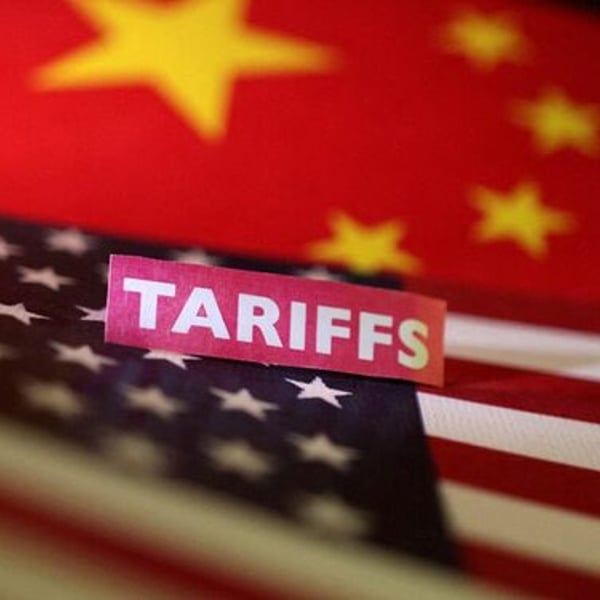
Senior U.S. and Chinese negotiators meet in Stockholm on Monday to tackle longstanding economic disputes at the centre of a trade war between the world’s top two economies, aiming to extend a truce keeping sharply higher tariffs at bay.

Reuters

China is facing an August 12 deadline to reach a durable tariff agreement with President Donald Trump‘s administration, after Beijing and Washington reached a preliminary deal in June to end weeks of escalating tit-for-tat tariffs.

Without an agreement, global supply chains could face renewed turmoil from duties exceeding 100%.

The Stockholm talks, led by U.S. Treasury Secretary Scott Bessent and Chinese Vice Premier He Lifeng, come right on the heels of Trump’s biggest trade deal yet, with the European Union accepting a 15% tariff on its goods exports to the U.S. and agreeing to make significant EU purchases of U.S. energy and military equipment.

That deal struck with European Commission President Ursula von der Leyen on Sunday in Scotland also calls for $600 billion in investments in the U.S. by the EU, Trump told reporters.

No similar breakthrough is expected in the U.S.-China talks, but trade analysts said that another 90-day extension of a tariff and export control truce struck in mid-May was likely.

An extension of that length would prevent further escalation and help create conditions for a potential meeting between Trump and Chinese President Xi Jinping in late October or early November.

Spokespersons for the White House and U.S. Trade Representative’s office did not immediately respond to requests for comment on a South China Morning Post report quoting unnamed sources as saying the two sides would refrain from introducing new tariffs or take other steps that could escalate the trade war for another 90 days.

Trump’s administration is poised to impose new sectoral tariffs that will impact China, including on semiconductors, pharmaceuticals, ship-to-shore cranes and other products.
“We’re very close to a deal with China. We really sort of made a deal with China, but we’ll see how that goes,” Trump told reporters before his meeting with von der Leyen, providing no further details.

Previous U.S.-China trade talks in Geneva and London in May and June focused on bringing U.S. and Chinese retaliatory tariffs down from triple-digit levels and restoring the flow of rare earth minerals halted by China and Nvidia’s H20 AI chips and other goods halted by the United States.

So far, the talks have not delved into broader economic issues. They include U.S. complaints that China’s state-led, export-driven model is flooding world markets with cheap goods, and Beijing’s complaints that U.S. national security export controls on tech goods seek to stunt Chinese growth.

“Stockholm will be the first meaningful round of U.S.-China trade talks,” said Bo Zhengyuan, Shanghai-based partner at China consultancy firm Plenum.

Trump has been successful in pressuring some other trading partners, including Japan, Vietnam and the Philippines, into deals accepting higher U.S. tariffs of 15% to 20%.

Analysts say the U.S.-China negotiations are far more complex and will require more time. China’s grip on the global market for rare earth minerals and magnets, used in everything from military hardware to car windshield wiper motors, has proved to be an effective leverage point on U.S. industries.

In the background of the talks is speculation about a possible meeting between Trump and Xi in late October.

Trump has said he will decide soon whether to visit China in a landmark trip to address trade and security tensions. A new flare-up of tariffs and export controls would likely derail any plans for a meeting with Xi.

“The Stockholm meeting is an opportunity to start laying the groundwork for a Trump visit to China,” said Wendy Cutler, vice president at the Asia Society Policy Institute.

Bessent has already said he wants to work out an extension of the August 12 deadline to prevent tariffs snapping back to 145% on the U.S. side and 125% on the Chinese side.

Still, China will likely request a reduction of multi-layered U.S. tariffs totaling 55% on most goods and further easing of U.S. high-tech export controls, analysts said. Beijing has argued that such purchases would help reduce the U.S. trade deficit with China, which reached $295.5 billion in 2024.

China is currently facing a 20% tariff related to the U.S. fentanyl crisis, a 10% reciprocal tariff, and 25% duties on most industrial goods imposed during Trump’s first term.

Bessent has also said he would discuss with He the need for China to rebalance its economy away from exports toward domestic consumer demand. The shift would require China to put an end to a protracted property crisis and boost social safety nets to encourage household spending.

Michael Froman, a former U.S. trade representative during Barack Obama‘s administration, said such a shift has been a goal of U.S. policymakers for two decades.

“Can we effectively use tariffs to get China to fundamentally change their economic strategy? That remains to be seen,” said Froman, now president of the Council on Foreign Relations think tank.

© Thomson Reuters 2025 All rights reserved.


Source link

Continue Reading

Fashion

Pop Closet: second-hand fashion store relocates to Pátio Siza Vieira in Lisbon, Portugal

Published

on


Published


November 14, 2025

Pop Closet, a second-hand clothing store opened eight years ago by António Branco, remains in Lisbon’s Colina do Chiado, but has now moved from Calçada do Sacramento, next to The Feeting Room, to Pátio Siza Vieira (further down), at 19 Rua Garrett (Shop A), next to Sienna. The new shop also features a more refined edit, focusing on luxury pieces from brands such as Acne Studios, Alexander McQueen, Balenciaga, Chanel, Celine, Comme des Garçons, Dior, Fendi, Gaultier, Gucci, Hermès, Loewe, Louis Vuitton, Margiela, Mugler, Off-White, Prada, Raf Simons, Saint Laurent, Valentino, and Vivienne Westwood among others. Prices range from €30 to €1,500.

Photo: Cátia Castel-Branco – @popclosetofficial / Instagram

Thanks to the extensive CV of its founder, who also works as a buyer, stylist, and fashion editor, particularly in the US and Brazil, Pop Closet has become a point of reference, despite the modest premises where it made its debut in the Portuguese capital.

The façade and interiors are defined by industrial finishes, in contrast to the century-old structural stone — salvaged from the fire that ravaged Chiado in 1988, starting at Armazéns Grandella and spreading through the area, destroying 18 historic buildings — and the restored wooden furniture that showcases second-hand clothing, eyewear, accessories, and footwear, as well as art and décor pieces.

@popclosetofficial / Instagram

The new Pop Closet also includes a space dedicated to art displayed on the walls, such as photographs by Cátia Castel-Branco, which are also for sale and will be replaced by works from other artists to foster a sense of dynamism and a changing atmosphere. There are even second-hand design pieces for the home — some recycled or part of collections from renowned brands such as Kartell.

“I want to have good items that anyone who comes in here feels they can wear, that aren’t specific to one type of customer. Above all, quality, beautiful and contemporary pieces,” António Branco told Time Out. He sources pieces in northern Europe or northern Portugal, from factories that offload leftover stock, in addition to those consigned by clients or bought directly by the shop, thus ensuring turnover.

This article is an automatic translation.

Copyright © 2025 FashionNetwork.com All rights reserved.


Source link

Continue Reading

Fashion

Due diligence law: the right and far right unite to dismantle it in the European Parliament

Published

on


Published


November 14, 2025

The right and the far right joined forces in the European Parliament on Thursday to unpick a law on major corporations’ social and environmental “due diligence” — a bombshell in Brussels.

Shutterstock

By 382 votes to 249, MEPs approved scaling back the text’s ambitions, limiting the number of companies covered, and removing some obligations. A weakened version of the text had been rejected by MEPs on October 22.

In a break with the traditional “pro-European” majority, an ad hoc alliance between the right (the EPP) and the far right sparked an outcry among the other groups.

The EPP “has torpedoed any moderate compromise,” lamented Social Democrat René Repasi. The vote serves as a warning to the pro-European camp, just as Parliament begins to tackle a series of measures to “simplify” business life.

The far right savoured a “great victory” on Thursday. “Another majority is possible” and “this is just the beginning”, declared the Patriots group, chaired by Jordan Bardella.

Adopted only eighteen months ago, this due diligence law is bearing the brunt of the European Union’s pro-business turn, buffeted by competition from China and tariffs in the US.

Its implementation had already been postponed by a year, from 2027 to 2028. But Brussels wants to go even further to lighten the administrative burden on companies across the continent.

Backed by penalties, the law adopted in 2024 required companies with over 1,000 employees to prevent and remedy human rights violations (child labour, forced labour, safety, etc.) and environmental damage throughout their value chains, including among their suppliers worldwide.

On Thursday, in line with the Member States, the European Parliament raised the thresholds for companies covered to more than 5,000 employees and over €1.5 billion in annual turnover.

Above all, MEPs scrapped the European civil liability regime, which served to harmonise companies’ obligations and their liability before the courts in the event of breaches.

Instead, parliamentarians opted to leave it to national legislation. They also abandoned the climate transition plans that companies were supposed to provide. A move that France, which has long boasted of having created the first national due diligence law, has pushed hard for since the beginning of the year, including through its president, Emmanuel Macron.

“Asphyxiation”

The law is now “completely empty”, laments centrist Pascal Canfin. This vote comes “during COP30” in Brazil and “represents a considerable setback for private-sector climate action”, he believes.

On the right, MEP François-Xavier Bellamy argues, by contrast, that this “simplification” will “save our businesses from regulatory asphyxiation”.

Following this vote, negotiations will begin with the Member States, with a view to the final adoption of the revised law.

“It is still possible to correct course”, says Jurei Yada of the E3G think tank, but the vote shows that “the far right is gaining influence” and that the pro-European majority is “crumbling”.

Environmental organisations, which had previously expressed concern about the future of the due diligence project, are also taking aim at the “industrial lobbies” opposed to this law.

The absence of European civil liability risks introducing “competition between the 27 Member States to see who has the most lax regime to try to attract companies”, warns Swann Bommier of the NGO Bloom.

In the name of fighting bureaucracy, German Chancellor Friedrich Merz and French President Emmanuel Macron had called for the law to be scrapped altogether.

But even if it is only slashed, the pill is hard to swallow for some of the parliamentarians who had celebrated its “historic” adoption in April 2024 after several years of tug-of-war within the European institutions themselves.

There was no shortage of superlatives at the time, including among Macronists, such as the current president of the centrist Renew group, Valérie Hayer.

However, the political balance has shifted in the chamber since the June 2024 elections, marked by the strengthening of the right and the breakthrough of the far right, which wants to roll back the Green Deal, the package of environmental measures adopted during the previous term.

FashionNetwork.com with AFP.

This article is an automatic translation.
Click here to read the original article.

Copyright © 2025 FashionNetwork.com All rights reserved.


Source link

Continue Reading

Fashion

Italy weighs one-off levy to bring private gold holdings into formal economy

Published

on


By

Reuters

Published


November 14, 2025

Italy is considering a one-off levy for households to declare gold held off the books, an amendment to the 2026 budget law showed, in a move that could potentially yield the state more than 2 billion euros ($2.3 billion).

Gold jewels are seen in a jewellery shop in downtown Rome, Italy, December 11, 2017 – REUTERS/Max Rossi

The proposal would allow individuals to pay a 12.5% tax to certify the market value of bullion, gold jewellery, and collectible coins for which purchase records are missing, the same rate as on government bonds. The certification has to be done by June 2026.

Under current rules, the lack of proof of purchase can lead to a 26% tax on the entire sale value, rather than just the actual capital gain.
This has discouraged people from selling their inherited gold on the official market and pushed some transactions into informal or undeclared channels, limiting market liquidity and tax revenues, lawmakers from the co-ruling League and Forza Italia party said.

Some estimates put privately held gold in Italy at 4,500–5,000 metric tons, worth roughly 500 billion euros at current prices.
Italy’s network of “Compro Oro” shops — businesses that buy and sell gold — has seen a sharp rise in activity as prices hit record highs. Sales of used gold jumped by around 25% in 2025, with more than 1.2 million transactions per month, driven by households cashing in old jewellery and coins, according to Metropolitan Magazine, an Italian publication.

Under the proposed measure, taxpayers opting in would declare their holdings at market value, pay the substitute tax in one or three annual instalments, and obtain a stepped-up fiscal value basis for future sales. The process would be overseen by authorised intermediaries and advisers, with strict anti–money-laundering checks.

Supporters say the measure could generate significant one-off revenues for the Treasury, while improving transparency in a market long characterised by opaque holdings and informal family transfers. Based on an assumption that 10% of privately held investment gold is certified, the draft estimates additional revenue of up to 2.08 billion euros.

The proposal also seeks to encourage the “legal circulation” of gold by removing what stakeholders see as a punitive regime for individuals unable to document purchases made years—or generations—ago. The amendment still needs to clear parliamentary scrutiny and government vetting.

© Thomson Reuters 2025 All rights reserved.


Source link

Continue Reading

Trending

Copyright © Miami Select.