Connect with us

Business

Trump’s TACO tariff parade: Here are all the times he talked a big game and didn’t back it up on trade

Published

on


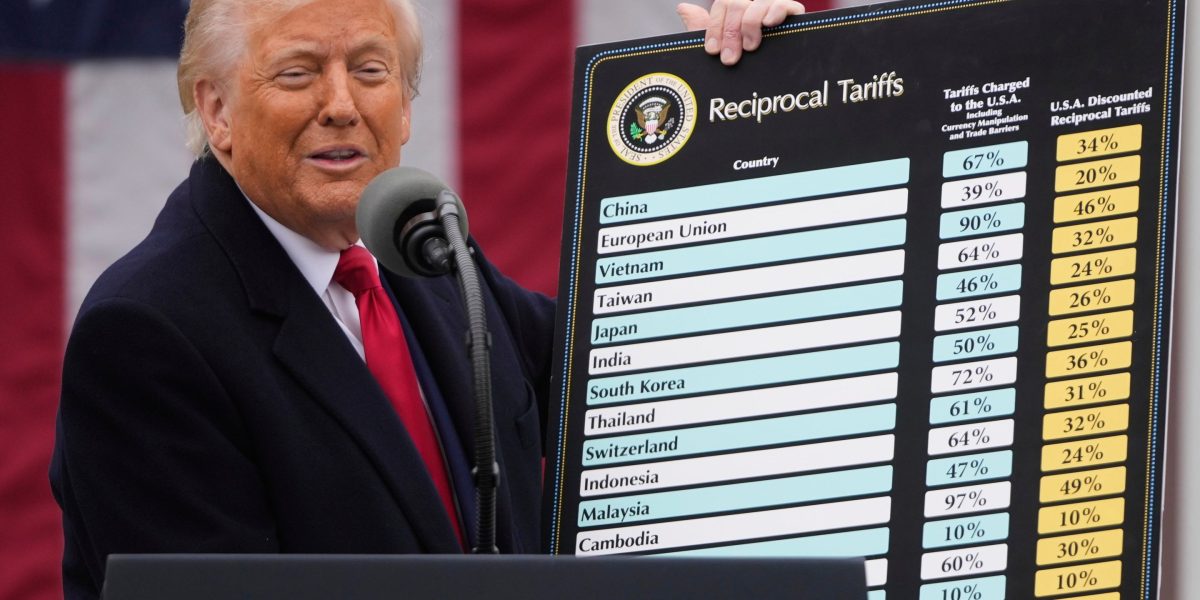
President Donald Trump made a lot of tariff threats and trade promises this year. Many materialized into a barrage of new import taxes that overturned decades of U.S. economic policy — but others have yet to be fulfilled as 2025 comes to a close.

Some of Trump’s unrealized threats reflect a broader approach from a president with a track record of using sky-high levies to pressure other countries into new trade dealsone-up retaliatory measures or even punish political critics. At the same time, they arrived as growing list of tariffs did go into effect — from Trump’s punishing new taxes on imported metals, to tit-for-tat levies with top U.S. trading partners like China — plunging consumers and businesses worldwide into uncertainty.

Here’s what Trump said when announcing some of his biggest (but still unrealized) tariff threats and promises this year, and where things stand today.

External Revenue Service

In his words:

What happened: The External Revenue Service has yet to be established as of the end of December. While administration officials continued to reiterate plans for launching the External Revenue Service during Trump’s first months back in office, the entity does not yet exist.

200% tariff on European wine, Champagne and spirits

In his words:

What happened: The EU’s planned levy on American whiskey — which it unveiled as part of broader retaliation in response to Trump’s new steel and aluminum tariffs — was postponed, with the latest delay reportedly running until at least February.

Trump’s 200% tariff threat on European alcohol never materialized. But spirits were not included in the EU-U.S. trade deal struck over the summer, which set a 15% rate on most European imports.

100% tariff on foreign-made films

In his words:

What happened: Despite Trump’s repeated threats, the U.S. has yet to impose a 100% tariff on foreign films. After his initial May promise to initiate the process, the White House said no final decision had been made. Also still unclear is how the U.S. would tax a movie made overseas.

Tariffs on pharmaceutical drugs

In his words:

What happened: The president did not sign an executive order imposing a 100% tariff on pharma products on Oct. 1 and, as of today, no levy has been put into place. But Trump previously suggested that steep levies on pharmaceutical drugs could arrive further down the road, telling CNBC in August that he would start by charging a “small tariff” and potentially raise the rate as high as 250%. Meanwhile, trade agreements with specific countries set their own rates or exemptions — with the U.K., for example, securing a 0% tariff on all British medicine exported to the U.S. for three years. The administration also announced deals with specific companies with promises of lower drug prices.

100% tariff on computer chips

In his words:

What happened: A sweeping 100% on computer chips has yet to go into effect. When announcing his plans to impose the levy back in August, Trump was not specific about the timing. And other details have remained scarce.

$2,000 tariff dividend

In his words:

What happened: Details about how, when and if a tariff dividend will reach Americans are still scarce. Budget experts have said that the math doesn’t add up. And Treasury Secretary Scott Bessent suggested that it might not mean checks from the government. Instead, Bessent told ABC in November, the rebate might take the form of tax cuts. White House National Economic Council Director Kevin Hassett also told CBS News that it’s up to Congress.


Source link

Continue Reading

Business

Down Arrow Button Icon

Published

on


The dollar is poised for its sharpest annual retreat in eight years and investors say more declines are coming if the next Federal Reserve chief opts for deeper interest-rate cuts as expected. 

The Bloomberg Dollar Spot Index has fallen about 8% this year so far. After tumbling in the wake of Donald Trump’s “Liberation Day” tariffs in April, the greenback came under sustained pressure as the president kicked off his aggressive campaign to get a dovish appointee installed as Fed chair next year.

“The biggest factor for the dollar in first quarter will be the Fed,” said Yusuke Miyairi, a foreign-exchange strategist at Nomura. “And it’s not just the meetings in January and March, but who will be the Fed Chair after Jerome Powell ends his term.”  

With at least two rate reductions priced in for next year, the US’s policy path diverges from some of its developed peers, further dimming the dollar’s appeal.

The euro has surged against the greenback as benign inflation and a coming wave of European defense spending keep rate-cut bets close to zero. In Canada, Sweden and Australia, meanwhile, rates traders are wagering on hikes. 

The dollar gauge rose as much as 0.2% Wednesday after Labor Department data showed applications for US unemployment benefits fell last week to one of the lowest levels this year. The greenback index was still on track to finish December down about 1%. 

This month, a brief period of bullish positioning on the dollar reverted to the more pessimistic stance that’s dominated since the April tariffs fueled concerns about the US economy, Commodity Futures Trading Commission data for the week ending Dec. 16 show.

For now, it’s all about the Fed and who steps into replace Jerome Powell, whose term as chair is set to end in May. 

Trump recently teased that he has a preferred candidate, but is in no hurry to make an announcement — while also musing that he might fire the central bank’s current leader.

National Economic Council Director Kevin Hassett has long been seen as the leading candidate, while Trump also expressed interest in former Fed governor Kevin Warsh. Fed governors Christopher Waller and Michelle Bowman and BlackRock’s Rick Rieder are also seen as being in the running. 

“Hassett would be more or less priced in since he has been the frontrunner for some time now, but Warsh or Waller would likely not be as quick to cut, which would be better for the dollar,” said Andrew Hazlett, a foreign-exchange trader at Monex Inc.


Source link

Continue Reading

Business

Gold and silver stumble at the end of best year since the 1970s

Published

on


Gold and silver fell on the last trading day of 2025, though both remained on track for the biggest annual gain in more than four decades as a banner year for precious metals draws to a close. 

Spot gold hovered around $4,320 an ounce, while silver slid toward $71. The two have seen exceptional volatility in thin post-holiday trading, plunging Monday before recovering Tuesday and dropping again Wednesday. The big swings prompted exchange operator CME Group to raise margin requirements twice. 

Both metals are still on track for their best year since 1979, supported by strong demand for haven assets amid mounting geopolitical risks, and by interest-rate cuts by the US Federal Reserve. The so-called debasement trade — triggered by fears of inflation and swelling debt burdens in developed economies — has helped supercharge the scorching rally.

In gold, the bigger market by far, those factors spurred a rush by investors into bullion-backed exchange-traded funds, while central banks extended a years-long buying spree.

Gold is up about 63% this year. In September, it eclipsed an inflation-adjusted peak set 45 years ago — a time when US currency pressures, spiking inflation and an unfolding recession pushed prices to $850. This time around, the record run saw prices smash through $4,000 in early October.

“In my career, it’s unprecedented,” said John Reade, a market veteran and chief strategist at the World Gold Council. “Unprecedented by the number of new all-time highs, and unprecedented in the performance of gold exceeding the expectations of so many people by so much.”

Silver has notched up a gain of more than 140% during the year, driven by speculative buying but also by industrial demand, with the metal used extensively in electronics, solar panels and electric cars. In October, it soared to a record as tariff concerns drove imports into the US, tightening the London market and triggering a historic squeeze.

The new peak was then passed the following month as US rate cuts and speculative fervor drove prices higher, and the rally topped out above $80 earlier this week — in part reflecting elevated buying in China.

Yet the latest move swiftly reversed, with the market closing down 9% on Monday then swinging the following two days. In response to the extreme volatility, CME Group again raised margins on precious-metal futures, meaning traders must put up more cash to keep their positions open. Some speculators may be forced to shrink or exit their trades — weighing on prices.

“The key driver today is the CME raising margins for the second time in just a few days,” said Ross Norman, chief executive officer of Metals Daily, a pricing and analysis website. The higher collateral requirements are “cooling the markets off,” he said.

Platinum, Palladium

The enthusiasm for gold and silver has extended into the wider precious-metals complex in 2025, with platinum breaking out of a years-long holding pattern to hit a new high.

The metal is on course for a third annual deficit, following disruptions in major producer South Africa, and supply will likely remain tight until there’s clarity on whether the Trump administration will impose tariffs — as well as on silver.

Prices for silver, platinum and palladium all sagged on Wednesday, though there’s little sign of enthusiasm waning.

“2025’s surprise was how safe-haven metals turned into momentum trades — silver in particular,” said Charu Chanana, chief market strategist at Saxo Markets in Singapore.

Silver traded down 6% at $71.44 an ounce as of 12:28 p.m. in New York. Gold slipped 0.4% to $4,322.04 an ounce, while the Bloomberg Dollar Spot Index was up 0.1%.


Source link

Continue Reading

Business

Copper records biggest annual gain since 2009 on supply bets

Published

on


Copper had its best year since 2009, fueled by near-term supply tightness and bets that demand for the metal key in electrification will outpace production. 

The red metal has notched a series of all-time highs in an end-of-year surge, rallying 42% on the London Metal Exchange this year. That makes it the best performer of the six industrial metals on the bourse. Prices dipped 1.1% Wednesday, the last trading day of 2025.

The latest gains also have been driven by traders rushing to ship copper to the US in anticipation of potential tariffs, creating tightness elsewhere. Trump’s plan to revisit the question of tariffs on primary copper in 2026 revived the arbitrage trade that rocked the market earlier in the year, tightening availability elsewhere even as underlying demand in key buyer China has softened. That price spread narrowed recently amid a power December rally on the LME.

“The expectation for future US import tariffs on refined copper has resulted in more than 650,000 tons of metal entering the country, creating tightness ex-US,” wrote Natalie Scott-Gray, senior metals analyst at StoneX Financial Ltd. She noted two-thirds of global visible stocks now are held within COMEX.

Beyond the tariff-driven flows, a deadly accident at the world’s second-largest copper mine in Indonesia, an underground flood in the Democratic Republic of Congo and a fatal rock blast at a mine in Chile have all added more strain to availability of the metal.

The near-term outlook for copper demand growth has been clouded by weakness in China, the world’s top consumer of the red metal. The country’s property market has been stuck in a yearslong downturn that’s dented the need for copper plumbing and wiring, while consumer spending has been sluggish, weighing on appetite for finished goods such as electronic appliances.

Still, robust momentum in global copper demand is expected over the long term. BloombergNEF estimates consumption could increase by more than a third by 2035 in its baseline scenario.

The drivers of this trend include the ongoing shift to cleaner energy sources such as solar panels and wind turbines, growing adoption of electric vehicles and the expansion of power grids.

Copper settled 1.1% lower at $12,558.50 a ton in London. Prices hit a record $12,960 on Monday. 

This story was originally featured on Fortune.com


Source link

Continue Reading

Trending

Copyright © Miami Select.