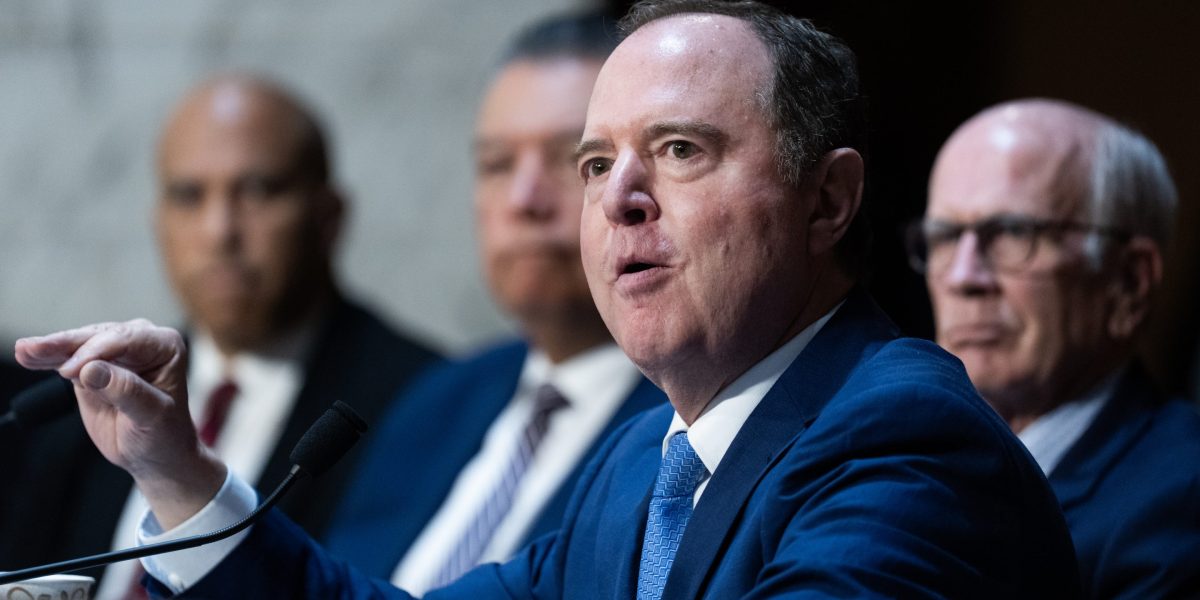
Prediction markets are facing new limits on Capitol Hill. The Senate passed a bill Thursday evening that would bar platforms from offering contracts tied to terrorism, assassination, an individual’s death, war or U.S. military operations–the first legislation targeting the burgeoning industry to clear either chamber of Congress.
Sens. Adam Schiff (D-Calif.) and John Curtis (R-Utah) introduced the bill, formally called the DEATH BETS Act, to prevent exchanges and clearinghouses overseen by the Commodity Futures Trading Commission from offering or processing those contracts. It would also ban contracts whose outcomes are reasonably expected to depend mainly on someone’s death, even if the wording does not mention death.
The bill passed the Senate by a voice vote and must still pass the House before heading to the president’s desk.
“They are offered with no regard for national security and in far too many cases, even basic morality,” Schiff said on the Senate floor. “These markets are operating in a wild West, desperately in need of regulation and guardrails.”
As platforms like Kalshi and Polymarket have grown in prominence over the past two years, they have offered contracts on seemingly anything, drawing scrutiny over bets tied to war, violence or human suffering. They have also raised concerns about insider trading, as users can trade without publicly revealing their identities, making it harder for outsiders to spot potential conflicts of interest.
Several cases have drawn politicians’ attention to these issues. One involved a Polymarket trader who made more than $400,000 betting on Nicolás Maduro’s removal from power before U.S. forces captured the Venezuelan leader in January. Kalshi also drew scrutiny over a market on whether Iranian Supreme Leader, Ali Khamenei, would leave office, which sparked a dispute after his killing when Kalshi declined to pay traders who had bet he would leave office, citing a rule that excluded death as a qualifying outcome.
In his speech, Schiff pointed to a Polymarket bet on whether NASA’s Artemis II mission would explode, raising concerns about wagers on astronauts’ lives. He also cited a bet on whether Russian forces would capture the Ukrainian city of Myrnohrad.
The companies’ leaders have previously pushed back on these criticisms. “We don’t list markets directly tied to death,” Kalshi CEO Tarek Mansour wrote on X in February. Speaking at a conference in March, Polymarket CEO Shayne Coplan called conflict-related markets a “complicated question” but defended their value as a source of useful information.
“Kalshi has never listed death markets,” a spokesperson for Kalshi told Fortune.
Polymarket declined to comment.
Other platforms, such as Novig, avoid these contracts altogether, limiting their offerings to sports markets and restricting trading to users 21 and older.
Pressure builds in Washington
The bill’s passage comes amid growing political scrutiny of prediction markets, particularly after Democrats won control of both chambers of Congress in this month’s midterm elections. Over the past week, several Democratic lawmakers have criticized the platforms on social media.
Sen. Elizabeth Warren (D-Mass.) pointed Wednesday to Kalshi’s decision to pause trading on contracts tied to President Donald Trump’s public remarks, which have drawn concerns about insider trading. “The CFTC needs to do more to stop insiders from cashing in,” she wrote on X.
Rep. Ro Khanna (D-Calif.) focused on younger users, calling Wednesday for an investigation and a ban on sports prediction markets. He criticized Kalshi for allowing 18-year-olds to bet on sports and said users under 21 had wagered $3.9 billion on the platform. “They call it a ‘prediction market.’ It’s gambling,” he wrote.
Though Democrats have been the most vocal, the scrutiny has crossed party lines. Besides cosponsoring the bill that passed Thursday, Curtis joined Warren last month in questioning Kalshi and Polymarket about potentially improper election-related trading. The Utah Republican has also backed separate legislation to ban sports and casino-style prediction contracts, citing concerns about young users’ exposure to gambling.
Sen. Ted Cruz (R-Texas) also announced plans to introduce legislation that would bar prediction market platforms from offering sports contracts without state or tribal approval, according to Bloomberg Law.
Update, Nov. 20, 2026: This article has been updated with a comment from Kalshi and Polymarket.