
Fashion
Samantha Ruth Prabhu launches new apparel brand Mile Collective


Fashion
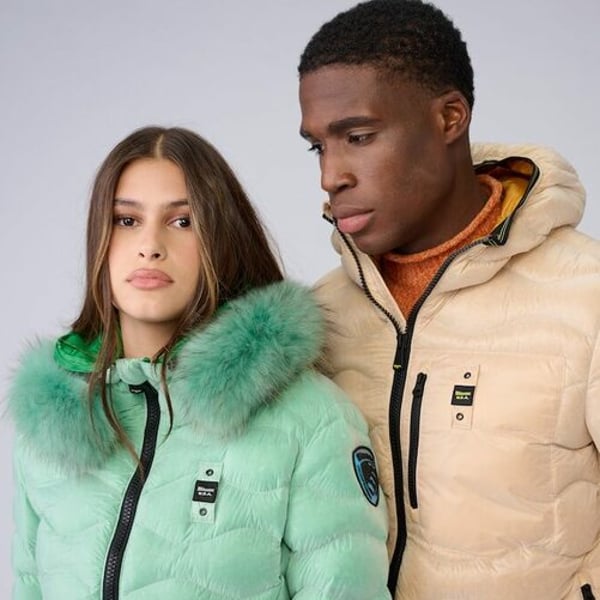
FGF Industry brand Blauer expands into Scandinavia and the Balkans, women’s and kid’s wear performs very well
Published
January 15, 2026
There has been positive momentum between the end of 2025 and the start of 2026 for Italian apparel group FGF Industry, headquartered in Montegalda. Under owner Enzo Fusco, the company has consistently delivered strong margins and revenues, and achieved a turnover increase of over 6 per cent, as he had forecast six months ago. “€80 million in apparel turnover which, with accessory licences- especially footwear- adding a further €14 million, took us to €94 million at the end of 2025,” the owner and founder of FGF Industry, Enzo Fusco, tells FashionNetwork.com.
At retail, Blauer opened a store in Bari in the second half of the year. The Trieste opening was moved to February, but in December another directly managed 120-square-metre Blauer mono-brand store opened on Brescia’s most prestigious street. “We want to get to a point where all mono-brand stores are directly managed. At the moment, four or five are not,” says Enzo Fusco about Blauer, which has around 10 directly operated stores, while there are five franchises. “With Trieste opening, and then Naples, in 2026 we will reach a minimum of 12 directly operated stores. As for the franchises, when the contracts expire, we either take them over 100 per cent or open new ones, because we now prefer direct management.”
After reopening markets in France, the Netherlands, and Belgium, and having begun distributing Blauer in Denmark and Sweden for the winter season (around a dozen clients with the first summer collection, ed.), Blauer’s international expansion continues, with the aim of increasing the brand’s foreign sales to at least 50% of the total, up from the current 30%. “For the winter season we already plan to reach 40% abroad. I predict that by the end of 2026 we could be talking about 45–50% of turnover generated outside Italy. With our regular customers, those who have been with us for many years, we have sell-through rates of 70–75% before the sales, and that’s a lot,” says Fusco.

The leading markets for the group after Italy are in the DACH region, especially Germany and Austria, which continued to grow last season, followed by Spain, Poland and the Czech Republic. “Portugal is also doing very well,” says Enzo Fusco, “however, now, having opened the Balkans, Turkey, France, Denmark, the Netherlands and Belgium, these countries will bring us an increase in 2026, raising the bar for the value of our exports relative to Italy. Within two or three seasons, I hope to generate more turnover abroad, always remembering that Italy is the nation that allowed Blauer to become what it is now. In our home market we are aiming for a more carefully controlled and more upmarket distribution.”
Enzo Fusco is very satisfied with the sales results of the childrenswear lines, up 20 per cent on the previous year. Womenswear accounted for 45% of sales in Autumn/Winter. “From the data I have, this year we may even bring it up to 48% of the total,” he stresses.

The 4,500-square-metre expansion project of FGF Industry’s headquarters is also well underway. “We plan to move in between May and June, because the building is already there- it’s the interiors that need to be finalised.” The old headquarters will also be renovated, while the company store, which faces the street in front of the plant in a recently renovated 800-square-metre warehouse, will be enhanced in the future- Fusco hopes within a year- by a Caffè Blauer.
Blauer is distributed to about 1,600 clients (around a hundred more than last year) between Italy and Europe, while Ten C can be found in 280 stores worldwide.
It is Ten C in particular (with its clothing and outerwear made entirely in Italy from fine Japanese fabrics) that has especially pleased Fusco. “Thanks to the new sales director, with Ten C we are off to a good start in South Korea, because the group that distributes us there has already opened two stores in shopping centres, and three more are set to open in 2026, bringing the total to 10 boutiques in two years. And we managed to open in the UK- two corners in Manchester and London. Thanks to Liam Gallagher, the lead singer of Oasis, who performed between 10 and 15 concerts in England wearing our jacket throughout. And it was his choice, it wasn’t arranged, unintentionally giving Ten C’s marketing an incredible boost.”

The collection presented at Pitti Uomo in January 2026 features no fewer than 350 references, offering a total look. There are 14 employees, including those who work in the stores. “The important thing is that we always have balance sheets in the black. I want to say that, because it’s no small thing, with EBITDA in 2025 standing at 22%. We think we’re working well,” concludes the entrepreneur from Veneto.
Finally, this year Blauer celebrates 25 years in Italy and the union of American heritage with the Italian vision of fashion, with an event curated by creative director Felice Limosani in the Salone d’Onore at Triennale Milano, entitled “Blauer– 25th Anniversary.” The installation is conceived as an immersive experience: a dialogue between photography, architecture, design, and sound design that transforms the hall into a visual orchestra, in which Blauer presents “Family Grammar,” a project that is not corporate but rather “a cultural installation that stages a shared language, where art, business and contemporary sensibility dialogue in harmony,” Limosani explains.
Founded in Boston in 1936, Blauer has become a benchmark for technical police and military uniforms, embodying the values of quality, performance, and durability. Thanks to the foresight of Enzo Fusco, Blauer entered Italy in 2001 without losing its identity. Under the leadership of the Fusco family- Enzo, Silvana, and the next generation, Federica Fusco D’Amore and Giuseppe D’Amore- the brand has become a point of reference for those seeking style, authenticity, and performance. A family story that believed in the brand’s potential and supported its growth through to the acquisition of a 50% stake via BWF (Blauer World Fashion).
This article is an automatic translation.
Click here to read the original article.
Copyright © 2026 FashionNetwork.com All rights reserved.
Published
January 15, 2026
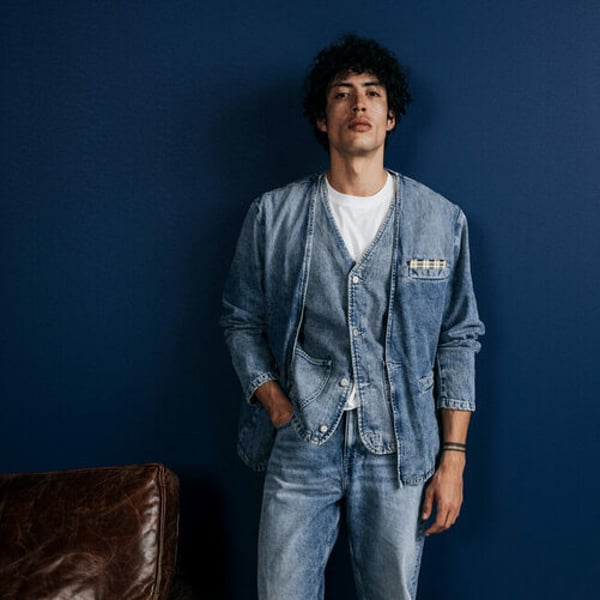
After its sales team wrapped up a very busy stint at Pitti Uomo, the Italian menswear trade show, on Thursday, Mustang will be at Who’s Next, the Paris fashion trade show at Porte de Versailles, from Saturday, with the ambition of continuing to build momentum in the French market.
The German denim label, founded in 1932, was for many years a major force in France before pulling back somewhat in the early 2010s following the closure of its local subsidiary. Since 2024, however, it has overhauled its strategy in the country. With best-sellers priced at €89.99, the label is now seeing the fruits of this restructuring.
“It took at least a year to put together the right team and recruit the right agents to cover the various regions. Then we took part in our first Who’s Next in early 2025, which brought us several dozen new customers,” notes Mauriz Kochendörfer, the brand’s international sales director since 2017. “As several historic players in the French market have disappeared, such as Kaporal, or are facing difficulties, we have a great opportunity for growth, with a positioning that meets consumer expectations.” The executive reports 120 stockists in the market by the end of 2025, up from around 50 before the relaunch, and says the company has doubled its business over the past two years.
For Mustang, which reported revenue of €110 million in 2024, the German-speaking markets of Germany, Austria, and Switzerland still account for 50% of its business. But the brand, which was one of the first Western labels to establish itself in countries of the former Soviet bloc, has also historically had substantial activity in Poland and Hungary. “However, France, Belgium, and the Netherlands are markets with very strong potential,” explains the executive. “We have also developed our business in the Scandinavian markets. Our organisation now covers 95% of European markets; we now need to energise growth.”

In France, Mustang also launched its first “True Heritage” campaign last October, based on a digital and influencer strategy, as well as collaborations with retailers such as the CCV multi-brand network and the Culture Denim store in Lille, to highlight its history and its work on denim silhouettes, which still account for 60% of its revenue. Alongside an accessible offering, in which straight and slim cuts still account for the largest volumes and which appeals to a number of multi-brand retailers, Mustang is strengthening its image as a denim specialist. The brand has also developed a capsule with Italian mill Candiani, with prices starting at €120.
At Who’s Next, the brand will showcase this diverse offering, highlighting its efforts to offer styles incorporating technical materials that provide greater comfort and warmth in winter for men, who account for 55% of sales, as well as for women, regarded as an important growth driver.
This article is an automatic translation.
Click here to read the original article.
Copyright © 2026 FashionNetwork.com All rights reserved.


TMZ Sports Streaming Live From Newsroom, Join The Conversation!

Gap goes Hollywood with new chief entertainment officer

Carnegie honors 7 State University System schools for outstanding community service
-

 Politics8 years ago
Congress rolls out ‘Better Deal,’ new economic agenda
-
Entertainment8 years ago
New Season 8 Walking Dead trailer flashes forward in time
-
Politics9 years ago
Poll: Virginia governor’s race in dead heat
-
Politics8 years ago
Illinois’ financial crisis could bring the state to a halt
-
Entertainment8 years ago
The final 6 ‘Game of Thrones’ episodes might feel like a full season
-
Entertainment8 years ago
Meet Superman’s grandfather in new trailer for Krypton
-
Business8 years ago
6 Stunning new co-working spaces around the globe
-
Tech8 years ago
Hulu hires Google marketing veteran Kelly Campbell as CMO