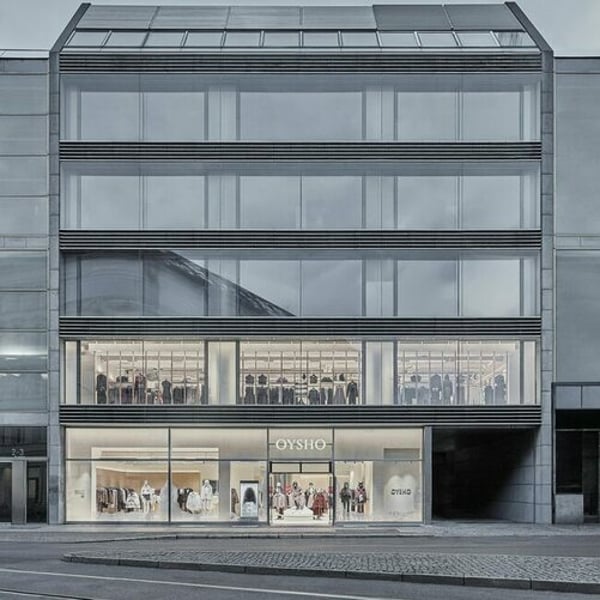
Inditex’s sports and leisure chain has made its debut in the German capital. Oysho has opened a new store at 2–3 Hackescher Markt, in the central Mitte district and just a few steps from the emblematic Alexanderplatz. The opening forms part of the brand’s global growth strategy, which has seen it enter the Netherlands for the first time and strengthen its presence in markets such as the United Kingdom and France in recent months.
Façade of the sports and leisure chain’s new store in the heart of Berlin. – Oysho
Covering almost 400 square metres across two floors, the store showcases a warm, light-filled design, in keeping with the brand’s hallmark technical and functional ethos. It occupies a listed building with a wide glass façade opening onto the square, creating a contemporary, minimalist atmosphere.
This new space offers a broad selection of Oysho’s collections, including its ski and après-ski capsule, outerwear and the Warm line, all available on the ground floor, while the first floor brings together athleisure, basics, tops and leggings. The store also features the chain’s Studio line, intended for activities such as Pilates, barre and yoga, and a dedicated running area equipped with accessories and fitting rooms.
To coincide with the opening, the brand has launched its Oysho Community in Germany, a free programme of sporting activities that includes a weekly running club setting off from the store, partnerships with local gyms via Partner Studios and a series of special seasonal sessions.
Founded in 2001 and headquartered in Tordera, the chain entered the German market in 2022 with the opening of a store of around 300 square metres at the Westfield Hamburg-Überseequartier shopping centre. With this Berlin opening, it now operates two company-owned stores in the country. Globally, as at the end of 2024, the brand had a network of 396 stores, including company-owned and franchised locations, as well as an online presence in around 220 markets.
China’s HongShan Capital Group (HSG) has sent a 2.5 billion euro ($2.91 billion) offer to private equity Permira to buy Italian luxury sneaker maker Golden Goose, with the aim of signing the deal by Christmas, daily la Repubblica reported on Friday.
Golden Goose is known for its luxury sneakers – goldengoose.com
Details still need to be defined but the offer gives the luxury group an enterprise value of 10 times the core profit expected by the end of the year, debt included, the newspaper said. Golden Goose’s revenues totalled 655 million euros in 2024, with an adjusted core profit of 227 million euros.
HSG has asked veteran fashion industry executive Marco Bizzarri to become Golden Goose’s future chairman, la Repubblica said, adding that the Chinese private equity aims to expand Golden Goose’s directly-managed stores, particularly in Asia, and plans to list the group in the medium-term.
Last year the Venice-based company, which sells sneakers for more than 500 euros a pair, shelved plans for an initial public offering on the Milan Bourse, citing market volatility caused by political uncertainty in Europe.
IKEA plans to source more products from factories in the United States, the Swedish furniture group’s top supply chain executive told Reuters, as President Donald Trump‘s tariffs drive up the cost of importing bookcases, mattresses and sofas.
IKEA logo is seen in this illustration taken, February 11, 2025 – REUTERS/Dado Ruvic/Illustration/File Photo
This marks a big shift for IKEA after the share of the company’s US-made products declined over the past decade. Inter IKEA, the brand franchiser, used to have a factory in Danville, Virginia, but shut it in 2019 and moved production back to Europe.
IKEA’s push to source products closer to where it sells them aims to support the retailer’s expansion in the US, its second-biggest market, and the wider region, where it has stores in Canada, Mexico, Chile, and Colombia, with plans to open in Costa Rica and Panama.
“We are designing our supply chain network to be much more resilient, robust, and responsive,” Susanne Waidzunas, Global Supply Manager at Inter IKEA said in an interview with Reuters, adding that the company’s stores in North and South America are very dependent on furniture being shipped in, with long lead times.
“The closer we can build, the faster we can react from a supply perspective, both when it goes up in demand but also when it goes down,” said Waidzunas. The plan to produce closer to US consumers predates this year’s tariff hikes and is part of a global initiative.
But the timing is now beneficial: IKEA prides itself on low prices but was forced to increase them on some products in the US to offset the tariff impact. The retailer’s sales have declined for two years running as it lowered prices to attract inflation-weary shoppers.
SBA Home, a Lithuanian supplier to IKEA, is ramping up its first US factory in Mocksville, North Carolina, a $70 million investment supported in part by Inter IKEA. The factory will make products for IKEA like top-selling KALLAX shelves.
Jurgita Radzevice, CEO of SBA Home, said manufacturing capacity at the largely automated factory, which is expected to produce 2 million pieces of furniture a year, is steadily increasing.
IKEA depends more on imports in the US than elsewhere. Just 15% of IKEA products sold in US stores are made in-country, down from 19% in 2014. In Europe, 70% of the products IKEA sells are made in the region, while the equivalent figure for Asia is 80%. Its top sourcing countries are China, Germany, Italy, Lithuania, and Poland.
Producing in the US is more expensive, Waidzunas said, but shipping products across the world is also more costly and more unpredictable now than before the COVID-19 pandemic. IKEA plans to buy more from existing US suppliers, which include Ohio-based Sauder Woodworking, and look for new suppliers particularly of bulky items, aiming, for example, to source most of its mattresses in the US.
London property giant Shaftesbury Capital has announced that “following the completion of a number of important initiatives Andrew Price, executive director will be stepping down from his role at the end of this year to pursue other opportunities”.
Andrew Price – Shaftesbury Capital
Price joined the business in 2001 and has “undertaken a number of significant investment, asset management and leadership roles”.
Following the Shaftesbury and Capco merger and the sale of the Fitzrovia portfolio he led the operations team “to achieve efficiencies across the portfolio and drive the enhancement of sustainability initiatives”.
CEO Ian Hawksworth said that he “made a significant contribution to the company over many years. He leaves with our thanks and best wishes for the future”.
There was no hint of where he’s off to next.
The news comes less than a month after the company said Michelle McGrath, also an executive director, would be stepping down from her role to pursue other opportunities. She too will leave at the end of the year.
Shaftesbury Capital was created in 2022 as two of London’s major landlords merged to form an entity that now controls huge swathes of Soho, the West End and Covent Garden. Its properties have been among the most buoyant in recent periods and in an update earlier this month it talked of being “busy and vibrant through this important trading period, with high occupancy, footfall and sales volumes”.