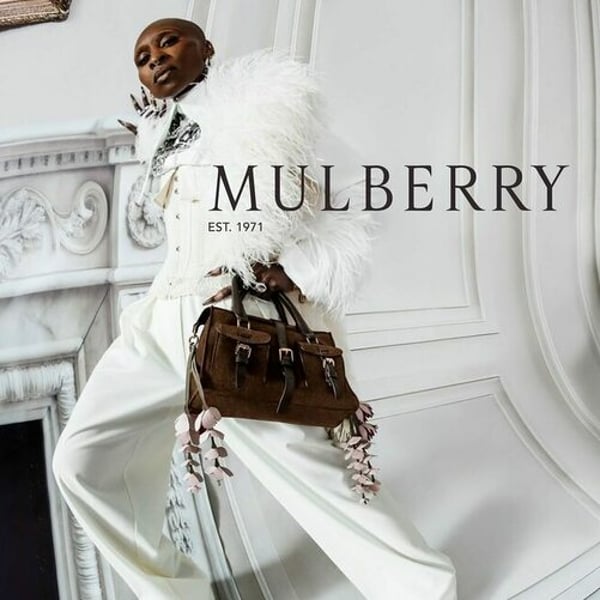
With a brand that’s as loved as Mulberry has been for years in the UK, it’s been painful to watch it going into decline in recent years. Each new trading update can bring disappointment. But recent ones have held out some hope. So what did the latest update on Wednesday tell us? Well, there was not only hope but some tangible good news, showing that the turnaround plan put in place around a year ago is paying off.
Mulberry
The company said it saw a “strong festive trading period” underpinned by its full-price sales mix and newness. And there was “positive customer response” to its “right product, at the right price” strategy. You may remember that in November 2024, its still-new CEO Andrea Baldo said it was aiming to sell most of its luxury handbags for less than £1,095 (that is, less than the price of the star Bayswater) to broaden the brand’s appeal and boost sales.
For Q3 (the 13 weeks to 27 December) that translated into total group sales (that is, physical retail, e-tail and wholesale) rising 5.3% with retail and digital sales rising 11% on a like-for-like basis.
In the UK, those two figures were a positive 3.5% and 6.5%, respectively, while in the US they were an even bigger 12.7% and 12.6%. In Europe excluding the UK, the rises were 14.9% and an impressive 27.2%. In Asia Pacific, the total sales rise was just 0.8% (due to the continued right-sizing of its store estate as part of its simplification strategy) but on a like-for-like basis, sales rose 12.1%.
During the period, the group delivered revenue growth across all markets, with “a successful focus on full-price sales in the lead up to and during the festive period, against a highly promotional wider retail market”. This resulted in the previously mentioned group like-for-like sales rise in digital and e-commerce of 11%, with retail full-price sales up 19%.
The company said that the “strength of this performance reflects the group’s ongoing delivery of its new strategy – focused on simplifying the business, refreshing the brand, and more fully leveraging customer insights”.
Success at home and abroad
Part of its new strategy had been about refocusing on the UK market and customer, and this appeared to have been successful as sales in its home market rose. Full-price was the lynchpin, and it also delivered a larger proportion of the sales mix online than the prior year, “amid a backdrop of more challenging growth in the broader retail market”. This tells it that “the product is resonating positively with the UK consumer”.
As for the rest of the world, those figures for the US, Europe and Asia Pacific show that the strategy is working elsewhere too. The strength of the Apac like-for-like rise was a reflection of strong trading during the Double 11 shopping festival in November 2025.
The company added that it’s seen customers responding enthusiastically to its “differentiated product range, at a time when we have been realigning Mulberry’s identity as a British lifestyle brand, and reinvigorating its cultural relevance. Mulberry has successfully re-engaged their existing customer base as well engaging new shoppers across both retail and digital, reinforcing the core offering and signalling the Back to the Mulberry Spirit strategy is working”.
It’s something that’s also being seen at larger peer Burberry and in the case of both companies is a sign that focusing on Britishness and brand heritage doesn’t have to mean products and campaigns that are traditional, even boring.
In fact, both firms have been adding new products and reworking existing ones, using heritage materials, and promoting them via campaigns where creativity is to the fore.
CEO Andrea Baldo said that “there remains plenty more to be done” but the early results are “encouraging” and the business is also maintaining “disciplined cost control, while at the same time growing full-price sales by having products that resonate at the right price”.
He also said the response to its Christmas campaign “has been in line with expectation, with particularly strong demand for the Roxanne, the Hackney and the continued resurgence of the Bayswater”.
Japanese activewear brand Asics has unveiled its new global brand campaign ‘Move Your Body, Move Your Mind’ that tunes into the motivation that tends to kickstart New Year fitness ambitions.
Asics
Accompanied by a reimagined version of The Beach Boys’ timeless hit ‘Good Vibrations’ the campaign reinforces Asics’ “75-year commitment to the transformative power of movement for physical and mental wellbeing”.
The campaign launches with running and tennis-focused films highlighting how a run or match can positively lift our mood and transform the world around us.
The campaign launches across digital, social, broadcast, and retail channels in key markets worldwide and will be supported by community activations “that encourage people to experience the uplifting power of movement firsthand”.
And if we needed any further motivation, Asics’ commitment to movement for body and mind is backed by extensive research, including studies showing that even 15 minutes of exercise may lift our mental state.
Gary Raucher, Global head of Marketing at the brand, said: “For over 75 years, Asics has been committed to helping more people move so they can feel better. It’s the reason we were founded and why we’re called Asics – an acronym for Anima Sana In Corpore Sano, or Sound Mind in a Sound Body. This campaign brings our founding principle to life in a way that inspires everyone to experience the uplifting power of movement, because when you move your body, you move your mind.”
As anticipated by FashionNetwork.com, Diesel, part of the OTB Group, has confirmed the appointment of Andrea Rigogliosi as the brand’s new CEO. Rigogliosi will report directly to Ubaldo Minelli, CEO of the OTB Group.
Andrea Rigogliosi
“Diesel is a magical brand that I founded, and it has always been a unique force in the fashion landscape. Under Glenn Martens‘s creative direction, it has been transformed, rediscovering its most authentic DNA and making the brand fresher, more contemporary, and increasingly loved by younger audiences. Today, Diesel can be considered the only alternative to the luxury world, able to embody values such as inclusivity and a democratic spirit, which are particularly meaningful at a complex time for the entire fashion industry. Recently, I have closely followed the brand’s development alongside a team of managers as we navigated a challenging market phase. I am very happy about Andrea’s arrival; together with the team, I am certain he will further enhance Diesel’s potential at a crucial moment in its evolution,” said Renzo Rosso, founder of Diesel and chairman of the OTB Group.
Andrea Rigogliosi has strong international leadership experience in the luxury, fashion, and retail sectors, having held senior strategic and commercial roles across Europe.
Prior to joining Diesel, Rigogliosi was global head of retail and commercial at Miu Miu– Prada Group, leading global business growth and the expansion of its distribution network. Rigogliosi has held key positions within the LVMH Group, including president, Europe, at Fendi and general manager for France & Monaco and for Italy at Christian Dior Couture. Early in his career, he held management positions at the Poltrona Frau Group and L’Oréal Luxury Products. The executive holds a degree in International Business Administration from Bocconi University in Milan.
This article is an automatic translation. Click here to read the original article.
LVMH is doubling down on China, having opened several major flagships in the country in December. Encouraged by early indicators of a luxury sales rebound, the group is weighing further expansion to capitalise on China’s economic recovery.
The new Louis Vuitton store’s façade is treated as an elegant, sparkling, and translucent “garment” rather than a mere shell – Louis Vuitton
Following the success of its ship-shaped flagship in Shanghai opened mid-2025, the key LVMH brand has pivoted its strategic focus toward ‘hyper-physical’ immersive retail environments, deep-rooted cultural synergy, and the scaling of high-impact regional flagships. With the opening of its new emblematic building in the vibrant heart of Sanlitun, Beijing, Louis Vuitton has set another global benchmark for luxury retail and architecture.
Architecture and fashion dialogue
As Louis Vuitton’s long-standing architectural partner, Jun Aoki envisioned a space that harmoniously balances local cultural heritage with a sense of global openness. The initial inspiration for the façade was the Taihu Stone, which is central to traditional Chinese garden design.
“Beijing is a city of ‘transplanted’ nature, where the mountain’s spirit lives within the scholar’s rock,” architect Aoki Jun told FashionNetwork.com. “We envisioned this store as a stone found in such a garden, shaped by the four ancient principles of traditional Chinese scholar’s rock appreciation: the slenderness of Shòu(瘦) establishing the store’s upright and poised character; the rhythmic wrinkles of Zhòu(皱)imbuing the walls with a rugged, rock-like texture; the hollowed depth of Lòu(漏)creating intriguing pathways and framed vistas; and the luminous transparency of Tòu(透)ensuring the essential light and openness for a commercial space. It is more than a structure; it is a condensed landscape.”
The design also takes its inspiration from a Nicolas Ghesquière dress presented during a Louis Vuitton spring/ summer show in 2016, illustrating the fertile dialogue between architecture and fashion at the maison. The façade is treated as an elegant, sparkling, and translucent “garment” rather than a mere shell.
An immersive experience with gastronomy
The excellence of the building continues inside, where the retail space extends over four levels. It offers the entirety of the Louis Vuitton universe, including men’s and women’s leather goods, ready-to-wear, jewellery, shoes, perfumes, beauty, accessories, and the new Maison collection. Four private lounges are dedicated to the exclusive experience of Very Important Clients.
The LV Café embodies the maison’s desire to offer guests a complete and immersive lifestyle experience, intertwining design, culture, and gastronomy – Louis Vuitton
The interior architecture, conceived by the maison’s Architecture Studio, focused on sequencing spaces and creating superimposed voids to generate surprising vertical perspectives and total immersion in natural light. The customer’s journey is thus a constant mix of viewing the brand’s extensive product offer and contemplating the façade’s delicate lace.
Summiting the building is the very first Louis Vuitton Café in Beijing. This space, set to become a new urban meeting point and a place of openness to the city, is completed with a private dining room and a remarkable 250 square metres of outdoor spaces, including a rooftop event bar. The Café embodies the maison’s desire to offer guests a complete and immersive lifestyle experience, intertwining design, culture, and gastronomy.
Pivot to emotional retail
The era of pure acquisition has been superseded by a new focus in modern luxury, according to Bain & Company senior partner Bruno Lannes. He states that intangible experiences and deep emotional connections now hold the primary power to drive growth. As a result, physical retail requires a fundamental transformation: brands must concentrate resources on fewer, grander flagships that serve as sanctuaries for delivering powerful emotion, sensory immersion, and tailored personal engagement, rather than just being points of sale.
This philosophy is powerfully manifested in the architecture of Louis Vuitton’s new Beijing building. “Beijing represents a fascinating ‘centrality’- it accepts the world’s influences yet organises them into a logic that is purely its own,” said Aoki Jun. “As brands like Louis Vuitton move toward a holistic lifestyle offering, they must protect the ‘vibration’ of the destinations they inhabit.”
Betting on a market resurgence, Louis Vuitton is preparing for a bold new chapter in 2026. This vision was reinforced by LVMH CEO Bernard Arnault’s frequent presence in China in 2025, where he championed a strategy of cultural synergy. By scouting local craftsmanship and integrating Chinese heritage into its design DNA, the brand has transformed its flagships into emotive landscapes that offer more than just products-they offer a deep, immersive connection to the local soul.
Moving beyond its role as a traditional luxury supplier, Louis Vuitton is emerging as a pioneer of a comprehensive lifestyle offering. By weaving its heritage of travel into the realms of dining and cultural dialogue, the brand is embarking on a transformative second chapter in China.