Louis Vuitton Foundation to stage major Calder retrospective
Published
December 16, 2025
The Fondation Louis Vuitton will stage a novel Alexander Calder centennial retrospective in 2026, the latest in a series by the Paris art institute focused on leading artists of 20th and 21st centuries.
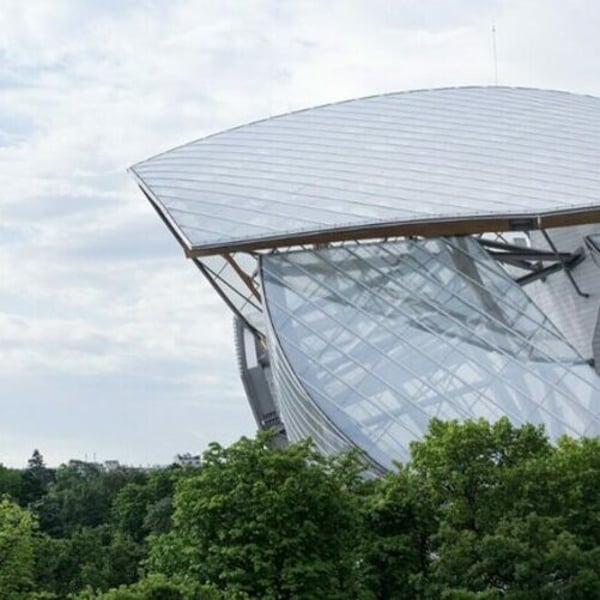
The striking silhouette of the Fondation Louis Vuitton in France – Fondation Louis Vuitton – Facebook
Previous monographic exhibitions at the Fondation Louis Vuitton have included Jean-Michel Basquiat, Joan Mitchell, Charlotte Perriand, Mark Rothko, David Hockney, and Gerhard Richter, its current show.
For Calder, a legendary artist known for his giant mobiles, sprawling mechanical kinetic sculptures moved by power and wind, the foundation will dedicate the entirety of its show space. And also, for the first time, the adjacent lawn, in a dialogue between Calder’s volumes, planes, and movements and those of the foundation’s famous sailboat silhouette.
The announcement by the Fondation Louis Vuitton on Tuesday, comes 11 days after the death of Frank Gehry, the master architect who designed its building. The art show will celebrate the centenary of Alexander Calder’s arrival in France in 1926 and the 50th anniversary of his death with a retrospective covering all aspects of his work. The son and grandson of two sculptors, Calder was born in Philadelphia in 1898 and died in New York in 1976.
Entitled ‘Calder: Rêver en équilibre,’ or ‘Calder: Dreaming in Balance,’ the exhibition covers half a century of creation, from the late 1920s and the first performances of the Calder Circus that captivated the Parisian avant-garde, to his monumental sculptures that redefined the idea of public art in the 1960s and 1970s.
The exhibition, one of the most important to date devoted to Calder, was conceived in close collaboration with the Calder Foundation, which is the main lender. It will also benefit from loans from international institutions and leading private collectors, bringing together nearly 300 works: mobiles and stabiles- to borrow Calder’s terminology for kinetic and static abstractions- as well as wire portraits, wooden sculptures, paintings, drawings, and even jewellery.
Works by his friends Jean Arp, Barbara Hepworth, Jean Hélion, and Piet Mondrian, as well as Paul Klee and Pablo Picasso, help to situate Calder’s radical inventiveness within the avant-garde movement. Thirty-four photographs taken by some of the most important photographers of the 20th century (Henri Cartier-Bresson, André Kertész, Gordon Parks, Man Ray, Irving Penn, and Agnès Varda) show an artist walking the tightrope between art and life.
After studying at the Art Students League in New York, Calder moved to Paris in 1926. In the Montparnasse district, the artist quickly became part of what was then the world’s leading artistic centre. There he presented unique forms, figurative and refined wire sculptures that attracted critical acclaim, and a miniature circus. Thanks to an exceptional loan from the Whitney Museum of American Art, the first in 15 years, Calder’s Circus is returning to Paris, the city where it was created. At the centre of this new kind of show, Calder manipulates acrobats, clowns, and miniature horsemen. Fernand Léger, Jean Hélion, Le Corbusier, Jean Arp, Joan Miró, and Piet Mondrian are among his spectators.
Calder’s visit to Mondrian’s studio in 1930 marked the abstract turning point in his work, first in painting, then in sculpture. Marcel Duchamp proposed the name “Mobiles” for the abstract and kinetic compositions that the artist presented in 1932 at the Galerie Vignon in Paris. Initially driven mechanically, then moved by slight breezes, these mobiles borrowed “their life from the vague life of the atmosphere,” as Jean-Paul Sartre wrote in 1946.
Calder returned to France after WW2 and set up a studio in the hamlet of Saché, in the Loire Valley in 1953. One of his sculptures still stands in the village’s square.
Like his swaying interconnected mobile art, the exhibition is a joint curation that includes input from Suzanne Pagé, artistic director of the Fondation Louis Vuitton; guest curators Dieter Buchhart and Anna Karina Hofbauer, assisted by Valentin Neuroth and Claire Deuticke; and Olivier Michelon, associate curator, assisted by Léna Lévy.