
Fashion
Levi’s expands Wear Longer program to Paris and London
Published
October 5, 2026
From customisation to repair: since October 1, visitors to the Levi’s flagship store on the Champs-Élysées have been able to discover the brand’s latest initiative to help them repair their jeans.
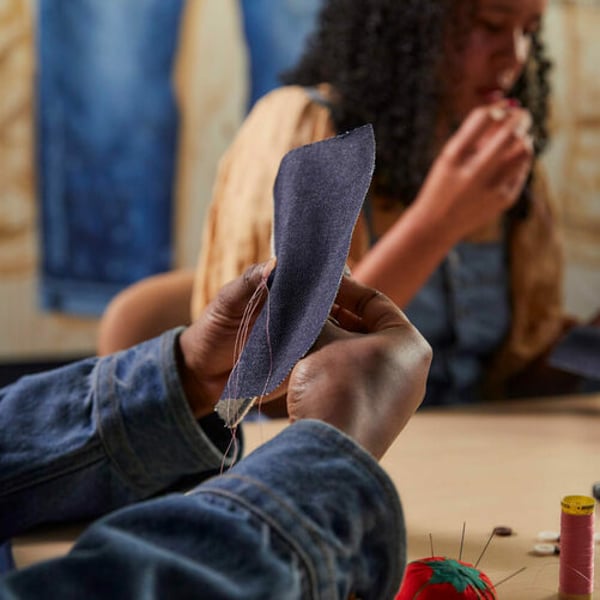
The global denim giant has decided to roll out its ‘Wear Longer’ project – which aims to promote repair – in the French capital and in London.
For years, the brand has run customisation workshops in its largest stores and in certain department stores. But given the sustainability imperative, Levi’s has opted for this awareness-raising campaign.
Launched last January in the US market, the scheme served as the first large-scale test. In the US, the brand claims to have reached nearly 90,000 young people through in-school lessons and local workshops. In Europe, this launch is also a way to connect with part of its Gen Z customer base. According to the San Francisco-based brand, 43 per cent of young people surveyed in Europe say they are interested in repair, whilst acknowledging that they do not have the basic skills. By combining video tutorials, translated content and workshops led by volunteer staff, the company is therefore focusing on education.
“The Wear Longer Project was created to equip young people with practical repair skills, rather than to boost sales or measure customer loyalty,” acknowledges Alexis Bechtol, director of community affairs at Levi Strauss & Co.
“Stores provide a way to roll out the programme by offering an engaging setting for certain workshops, but the aim of the project is to help young people acquire new skills.”
Several fashion brands have made repair a key part of their ethos, or even their business model. The Swedish denim brand Nudie Jeans has made free lifetime alterations a central feature of its model. In the outdoor sector, Patagonia has been running its Worn Wear programme for several years, whilst Arc’teryx is developing ReBird spaces in its key stores. Among high-street retailers, Uniqlo has incorporated areas dedicated to embroidery in several of its stores.
For its Paris operations, Levi’s has partnered with the service provider United Repair Centre (URC). Based in Amsterdam and London, this B Corp-certified organisation opened a Paris workshop in the spring and handles the items entrusted to it. The project aims to link these awareness-raising workshops with the repair services offered in a number of Parisian stores, before gradually expanding across France by the end of the year.

For Levi’s, the initiative also helps address recurring consumer criticism about the perceived decline in the durability of modern jeans compared to vintage styles.
“The Wear Longer Project is not a substitute for our responsibility to manufacture quality products,” argues Paul Dillinger, general manager of design innovation at Levi Strauss & Co.
“It complements this responsibility by giving young people the practical skills to repair, maintain and personalise the clothes they already own. In my view, the project is about empowering young people to forge a connection with their clothes through repair and personalisation. Encouraging people to look after and repair what they own has never been at odds with our business. We have always been convinced that there is value in making products that people want to keep in circulation, whether it’s a new pair of jeans or the trucker jacket worn by their grandparents.”
Prioritising repair is also an immediately available, responsible lever, at a time when the ubiquity of stretch fabrics and synthetic fibres complicates end-of-life recycling.
“The repair aspect is the simplest, insofar as blended textiles can be repaired,” explains the executive.
“Recycling is more complex, as the technology to recycle fibre blends does not yet exist at scale. For the time being, the best approach is therefore to continue repairing items for as long as possible.”
Nevertheless, repair faces well-known financial constraints. According to a behavioural study conducted by Ifop for the eco-organisation Refashion, the cost of the intervention is the main deterrent for 71 per cent of consumers, who consider it too high compared with the original purchase price. For a pair of jeans sold for around €100, the decision becomes difficult when the cost of repair ranges between €15 and €30. Whilst the ‘Bonus Réparation’ scheme aims to reduce this cost in France, whether people actually go ahead with repairs still largely depends on the sentimental value they attach to the garment.
Whilst promoting the care of its denim garments, the American group is, however, more circumspect about the introduction of European regulatory requirements, such as environmental labelling or the Digital Product Passport (DPP).
“We are closely monitoring the development of the Digital Product Passport as the regulatory framework evolves,” notes Bechtol, cautiously. “As the requirements become clearer, we will assess the best way to incorporate them.”
For now, by focusing on imparting practical skills – either through its own teams or by working with schools – Levi’s is opting for awareness-raising without actually undertaking a comprehensive overhaul of its business model. The denim giant is, however, banking on the idea that self-repair can both help it bolster its sustainability commitments and maintain close relationships with its customers. Whilst Levi’s notes that its initiative has reached people in every US state since January, it remains to be seen whether such an approach will take root at scale across Europe.
Copyright © 2026 FashionNetwork.com All rights reserved.