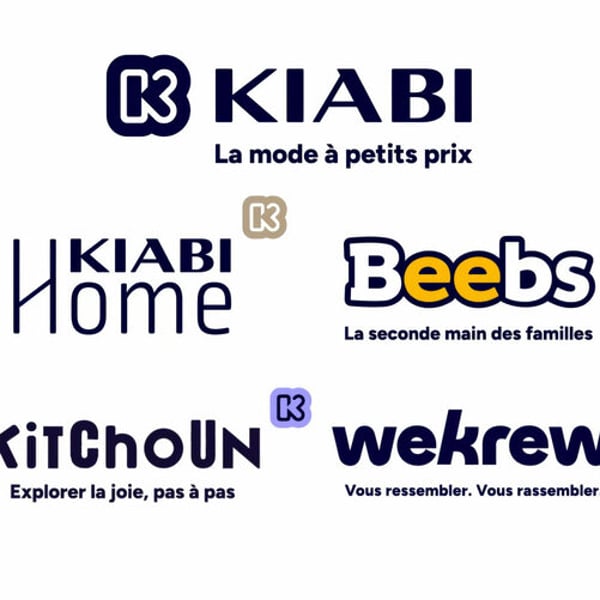
To move beyond its identity as a retail brand and make it easier to identify the labels that now span the different facets of its offering, the Kiabi group has unveiled a new logo: a stylised “K” that will appear across the logos of all its entities.
Kiabi
This “K”, framed by a thick white outline, appears in the top right-hand corner of the Kiabi Home logo, as well as on the logos for Beebs, dedicated to second-hand, and Kitchoun, the brand for shoes for babies from birth to nine months.
“This new adventure represents our transition from a fashion retailer to an ecosystem of brands and services, centred on a strong promise: to always do more for families,” the group said on social media.
“More than just a symbol, [this new logo] embodies our evolution, our new identity and our ambition. It reflects the quality, style and accessibility that define Kiabi’s DNA, upheld every day by our teams around the world.”
As FashionNetwork.com recently noted, Kiabi is now at the helm of a growing portfolio of brands in the French apparel market. With revenue of €2.5 billion in 2024, Kiabi currently has a network of 647 stores and 10,000 employees across 83 countries.
The family fashion brand recently used Circular Fashion Week, held in Lille on 4 and 5 December, to formalise its membership of the Dutch Denim Deal coalition, which aims to scale up the recycling of jeans into new garments.
This article is an automatic translation. Click here to read the original article.
On the occasion of the Contrastes programme, presented from December 1 to 31, 2025 at the Opéra national de Paris, Alainpaul unveils its first collaboration with choreographers Imre and Marne van Opstal. Their new piece, Drift Wood, offers an ideal canvas for exploring the relationship between body, material, and narrative, a space where costumes become integral to movement.
Alain Paul collaborates with Imre and Marne van Opstal – Benoîte Fanton
Inspired by the image of driftwood, shaped by time and carried by the currents, Alainpaul’s costumes give physical form to the tension at the heart of the piece: that which both opposes and binds conscious humanity to instinctive nature. Poised between fragility and resistance, the silhouettes move like a second skin, moulding to the dancers’ movements. This focus on texture and construction renders, in visual terms, the contradictions that course through Drift Wood, where bodies oscillate between self-control and impulse.
“A moment of fulfilment”
Conceived as a poetic diorama, the piece unfolds within a landscape shaped by the elements: sound, image, and movement interweave to explore vulnerability, connection, and ambiguity. In this floating world, the costumes play a central role. Rooted in Alainpaul’s signature sculptural clarity and fluidity, they amplify the emotional language imagined by the Van Opstal duo. For the house, this collaboration marks a powerful return to the stage, where clothing reconnects with its primary origin: gesture.
Drift Wood will be performed at the Paris Opera in December as part of the Contrastes programme. – Benoîte Fanton
“Collaborating with Imre and Marne, as well as with the Opéra national de Paris’s exceptional atelier, was an immense honour,” said Alain Paul, the house’s founder. “These are the first Alainpaul costumes created for a contemporary ballet, and we are deeply grateful for the trust placed in us for Drift Wood. We have forged a genuine dialogue between movement and the construction of the costumes. Having grown up in the world of dance, this project represents a moment of fulfilment and a profound way of uniting my two worlds.”
Alainpaul, a brand inspired by choreography
This creation forms part of Contrastes, a programme that brings together three choreographic worlds: two major works by Trisha Brown, the entry into the repertoire of David Dawson’s Anima Animus, and Drift Wood, the Van Opstals’ first piece for the Paris Opera. Together, these works explore the tensions and oppositions running through dance today, from minimalist radicalism to sculptural power.
Alain Paul’s work has always been influenced by choreography. – Benoîte Fanton
Founded on a choreographic approach to clothing, the house Alainpaul has, from the outset, drawn on the vocabulary of choreographers such as Pina Bausch and Merce Cunningham. Its pieces, with their experimental lines and sculptural silhouettes, reinterpret the dancer’s wardrobe within a timeless, urban aesthetic. With Drift Wood, this ambition takes on a new dimension: that of a garment fully animated by movement.
This article is an automatic translation. Click here to read the original article.
Omnichannel rules! Expect hybrid shopping “to define Christmas spending this year” as 87% of UK consumers plan to shop both online and in-store for gifts this year.
Image: CACI
That’s according to data specialists CACI, who flip the data to show that just 7% intend to shop exclusively in-store, and only 6% plan to do all their shopping online.
Generational and gender differences, of course, come into play, revealing further nuances with 19% of male Gen Zers saying they intend to shop entirely online, compared with just 1% of females in the same age group.
At the other end of the spectrum, 13% of male and 7% of female Baby Boomers expect to purchase all their gifts in-store, “showing that physical retail remains more prominent among older shoppers”, although not in the numbers we might expect.
The report highlights that last year’s retail performance “further supports the advantage of having a strong multichannel presence” as brands that enabled both physical and digital buying behaviour, with seamless integration, personalisation, and strong app and online experiences, “had some of the biggest gains”.
CACI took Korean beauty retailer PureSeoul as an example: “Known for combining digital reach with selective in-person experiences, the… brand more than doubled its sales in December 2024 compared with the same month the year before (up 118%)”.
Meanwhile clothing/lifestyle giant Uniqlo reported a 22% year-on-year omnichannel increase in December 2024 sales.
Alex McCulloch, Director at CACI, said: “If we look at the data from last Christmas, and what we’re hearing from consumers now, it’s clear that the brands set to win this season are the ones that recognise the need for a true multichannel approach.
“Not just because it’s practical, but because physical stores help build loyalty that carries over to online. That loyalty is being reinforced even earlier, as more retailers turn their stores into experiential spaces – some operating almost like ‘clubhouses’ that create connection and community long before a purchase is made.”
OpenAI and Disney announced on Thursday that they have entered into a three-year licensing agreement that will enable the use of Disney’s characters on Sora, a platform for videos created with generative artificial intelligence (AI), a strong signal for the AI content ecosystem.
Disney and OpenAI announced their agreement on Thursday – Sora
Under the partnership, Disney will take a $1 billion equity stake in OpenAI and receive warrants enabling it to acquire additional shares in the company behind ChatGPT at a later date.
Launched at the end of September, Sora positions itself as a social network where only AI-generated videos can be published. The platform runs on OpenAI’s generative video model, Sora 2, successor to the original Sora model, whose generic name has been adopted for the app.
From the outset, Sora featured unauthorised content using brands, the likenesses of public figures, and visual worlds inspired by existing programmes, cartoons, films, and series. Many videos included characters directly inspired by those of Pixar, a Disney subsidiary, as well as several cartoons owned by the entertainment giant, such as ‘Family Guy.’
A few days later, Sam Altman indicated that OpenAI intended to offer rights holders greater control over the use of materials that are theoretically protected by intellectual property rights.
Under the collaboration unveiled on Thursday, Sora users will now be able to create videos drawing on a catalogue of more than 200 characters from the Disney, Marvel, Pixar, and Star Wars universes, according to a joint press release. However, these are limited to animated characters, masked characters or creatures, and do not include real human actors.
“Technological innovation has continually shaped the evolution of entertainment, bringing with it new ways to create and share great stories with the world,” said Robert A. Iger, CEO of The Walt Disney Company, in the release. “Rapid advances in artificial intelligence mark an important moment for our industry, and through this collaboration with OpenAI, we will thoughtfully and responsibly extend the reach of our stories through generative AI, while respecting and protecting creators and their works.”
The tie-up between the two groups goes beyond Sora, as Disney will become a “major customer” of OpenAI. The Burbank, California-based company will give its employees access to ChatGPT and use OpenAI’s models to “create new products, tools and experiences.”
For Sam Altman, also quoted in the press release, this agreement “shows that AI companies and content publishers can work together responsibly to promote innovation.” Sora and ChatGPT Images are expected to begin producing fan-inspired videos featuring Disney’s multi-brand licensed characters in early 2026.
With AFP
This article is an automatic translation. Click here to read the original article.