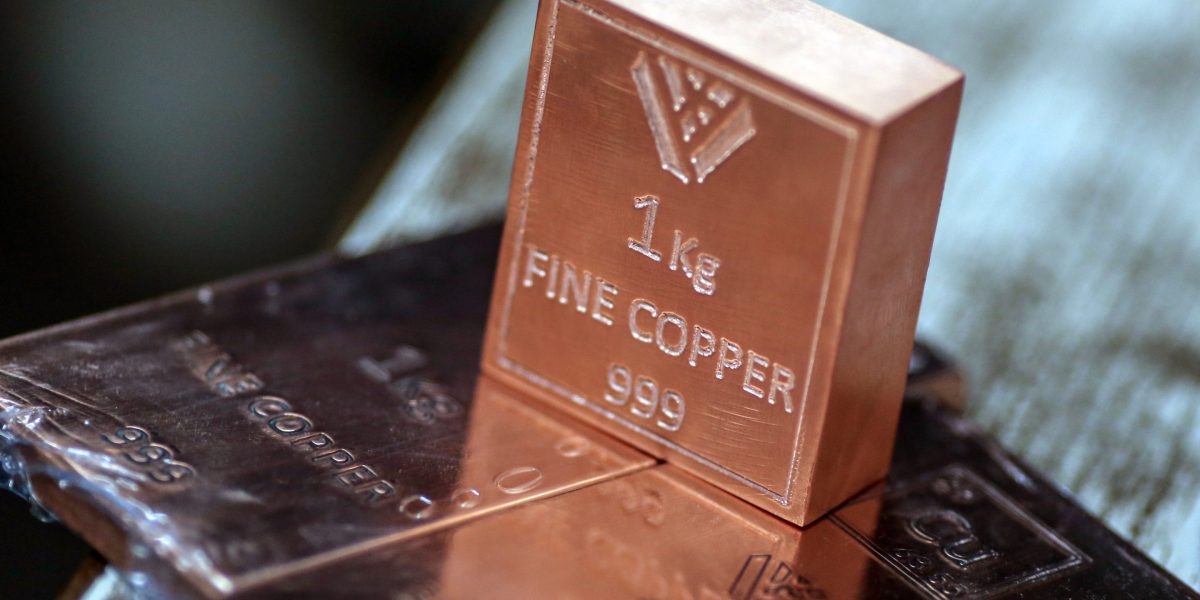
Copper has long been an economic bellwether as the metal is widely used across industries, but soaring demand is making it a strategic bottleneck that threatens growth, according to S&P Global.
In a report published Thursday, researchers estimated demand for the metal will jump 50% from current levels to 42 million metric tons by 2040, while supply will shrink in the coming years.
The result will be a shortfall of 10 million tons that represents a “systemic risk for global industries, technological advancement and economic growth,” the report said.
Meanwhile, copper prices have surged to more than $13,000 per metric ton from just over $8,000 in April 2025, as President Donald Trump’s global tariffs and mining disruptions weighed on supplies. Prices for precious metals like gold, silver, palladium, and platinum, which also have industrial uses, have shot up in recently months as well.
The report highlights four key drivers of copper demand: core economic sectors, the transition to electrification, data centers powering the AI boom, and high-tech weapons.
A fifth potential driver is humanoid robots, S&P Global said, citing projections of 1 billion to 10 billion of them in operation by 2040.
“The future is not just copper-intensive, it is copper-enabled. Every new building, every line of digital code, every renewable megawatt, every new car, every advanced weapon system depends on the metal,” Aurian De La Noue, executive director for critical minerals and energy transition consulting at S&P Global Energy, said in a statement.
“Multilateral cooperation and regional diversification will be crucial to ensure a more resilient global copper system—one commensurate with copper’s role as the linchpin of electrification, digitalization, and security in the age of AI.”
Increased mining is necessary to alleviate the supply pressure, but it takes 17 years, on average, for a new mine to yield fresh copper after it’s first discovered. That’s as several headwinds weigh on production, including geology, engineering, logistics, regulatory, and environmental issues.
The concentration of copper mining and processing represent risks too, according to S&P Global. For example, just six countries account for roughly two-thirds of mining production, and China alone commands about 40% of global smelting capacity.
Beijing already leverages its dominance in rare earth minerals—which are also critical in a range of technologies—as a geopolitical tool in disputes with rivals like the U.S. and Japan.
The report warned copper’s reliance on a handful of countries makes global supplies and prices vulnerable to disruptions, policy shocks, and trade barriers.
“Several countries have deemed copper a ‘critical metal’ over the past half decade, including, in 2025, the United States. And with good reason,” said study co-chair Carlos Pascual, senior vice president at S&P Global Energy for geopolitics and international affairs.
“Copper is the connective artery linking physical machinery, digital intelligence, mobility, infrastructure, communication, and security systems,” Pascual said. “The future availability of copper has become a matter of strategic importance.”