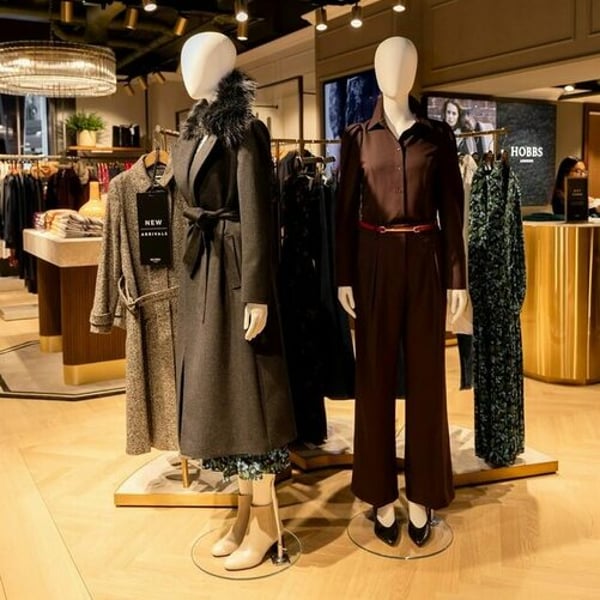
TFG Brands (London) Limited is growing fast following its purchase of White Stuff last year. But while still loss-making, the company that already owned Hobbs, Whistles and Phase Eight, isn’t only relying on acquisitions to expand.
Hobbs
It has filed its accounts for the year to late March 2025 and said that turnover jumped to £377.5 million from £323.5 million. Adjusted EBITDA was up to £51 million from £33.8 million (excluding White Stuff the latest figure was £41.3 million) and operating profit rose to £23.2 million from £20.1 million.
But as mentioned, the company remained loss-making after tax with a loss this time of £5.9 million, slightly wider than the £5.7 million deficit of the previous year. That loss after tax was impacted by £18.9 million of interest charges on parent company loans. The same issue had caused the loss in the previous year.
The company talked of ongoing challenges economically on a global scale but also said that it achieved what it believes is a strong set of financial results for its FY25 period. Obviously, the White Stuff buy significantly boosted it following its purchase in October 2024, contributing £81 million of turnover and £4.5 million of profit for the year. Its impact for FY26 should be much greater as it will be a full year.
There were other plus points too as, in line with its strategic objectives, TFG’s direct channel mix grew to 69% from 56%. It also opened four new standalone stores in the US.
Hobbs
The gross margin for the year improved to 70.5% from 69.4% reflecting the impact of the higher direct channel mix despite the promotional environment.
That said, while there was growth in the own channels mix, the sales performance overall was impacted by underperformance in the concession channel where sales dropped 14.7% year on year. This reflected border macroeconomic challenges as consumer shopping habits remained muted
But physical stores have a significant role to play in its business and it’s continuing to invest in the estate. During the year (including its own stores and concessions) it acquired 169 new ones via the White Stuff business and opened a further 78. It also closed 103 as it right-sized the business and focused on profitability and as of the end of the period in question, the group had a store portfolio of 699, up from 555 a year earlier.
Brand focus
Overall, it’s clear that the company is heading in the right direction, although looking at the individual brands that it owned before the White Stuff acquisition, we can see some strong variations in performance.
At womenswear retailer Hobbs, turnover dropped to £117.5 million from £123.9 million but adjusted EB ITDA rose to £23.9 million from £18.6 million. Operating profit increased to £16.7 million from £13.9 million and profit after tax rose to £12.4 million from £9.8 million.
The gross margin for the year improved to 72.9% from 67.4% and this is what contributed to the higher EBITDA.
Those improvements also came despite the fact that the latest financial year was a 52-week period compared to 53 weeks for the previous year.
The direct channel mix grew to 73.9% from 62.4% at Hobbs but it saw weakness in concession channels, as mentioned for the company as a whole. Sales there were down 12.8%, which is why the overall turnover for the brand dropped.
But the company has clearly been focusing on its strongest-performing locations and while it opens six new stores during the year it closed 18. This meant its total number of stores and concessions by the end of the period was 123 down from 135.
Phase Eight
Phase Eight looked less strong with turnover down to £82.5 million from £91.7 million and adjusted EBITDA rising a little to £2.6 million from £2.2 million. The company made an operating loss of £0.5 million, which admittedly was smaller than the loss of £1.3 million a year earlier and profit after tax more than doubled, but only to £0.9 million from £0.4 million.
The womenswear brand delivered what the company called a “steady” performance. Again, its direct channel mix grew, this time to 62.4% from 52.5%, and the international mix increased to 12% from 5%. There was growth in own channels, particularly online, but again concessions were the weak spot with a sales drop of 15%.
The brand also implemented a new merchandising system during the year to “unlock future operating efficiencies” but it had an impact on current year trading as the supply of products was affected during the transition period. That contributed to the 10% drop in turnover, as did the fact that the company opened nine new stores but closed 18 as it moved to what it said was a “higher-quality, more profitable” core business. Its total store numbers at the end of the year were 128, down from 137.
The gross margin improved to 66.5% from 63.5% and distribution costs fell. But that couldn’t counteract the impact of lower turnover when it came to profitability.
As for contemporary brand Whistles, we don’t yet know about its performance as the accounts have been filed but are not yet available on the Companies House website. We’ll keep you updated about those when they are available.
Founded in Aquitaine, France over a century ago, Rondinaud has set its sights on Northern European markets and also plans to establish a presence in Germany, Spain, and Italy.
Rondinaud
It is a challenge the fifteen-employee company intends to meet, bolstered by its Protected Geographical Indication (PGI) status and by a reputation that has carried it as far as New York’s MoMA. The Museum of Modern Art’s shop stocks the traditional, glue-free charentaise made by the century-old La Rochefoucauld firm.
“From securing PGI status to our presence in the United States, these marks of recognition are a tremendous source of pride and a testament to the value of our fifteen employees and our expertise,” says Olivier Rondinaud. “Our ambition now is to make this charentaise, a true ambassador for Charente, a staple of comfort and style in European homes.”
The company’s European ambitions are underpinned by a retail network that currently comprises around 500 points of sale, divided between its own boutiques and multi-brand retailers, alongside an online portal presenting its full product range.
If Ateliers Rondinaud say they are targeting Northern Europe, it is unsurprisingly for the climate. “Seasonality and the culture of ‘cocooning’ are a perfect fit for the qualities of the wool-felt charentaise (around 38 tonnes of felt used per year),” the company notes.
Rondinaud
With production now reaching 450 to 500 pairs per day, the company says it sold more than 90,000 pairs in 2024 and expects to post a turnover of €1.9 million in the 2025 financial year.
This article is an automatic translation. Click here to read the original article.
The house of Dior on Monday named an eclectic trio- Anya Taylor-Joy, Jisoo, and Willow Smith- to be the new faces of its hit perfume Addict.
Anya Taylor-Joy for Dior Perfumes – Dior
Since her global explosion into superstardom with the cult TV series The Queen’s Gambit, Anya Taylor-Joy has become a significant on-screen star and important red-carpet presence.
Jisoo is the K-pop phenomenon who draws immense crowds worldwide. She rose to prominence as a member of the South Korean girl group Blackpink, which debuted under YG Entertainment in August 2016, and became one of the best-selling girl groups of all time.
Jisoo for Dior Perfumes – Dior
Willow Smith is an early-blooming singer with a soul voice and a prolific artist.
This trio, the Paris based house stated in a release, “embodies a new generation of Dior stars with their contrasting styles of beauty and their bold, unique characters. Today, they make headlines by joining the legendary world of Dior Perfumes.”
Each representing the three new Dior Addict fragrances, Peachy Glow, Rosy Glow, and Purple Glow, created by Francis Kurkdjian.
Willow Smith for Dior – Dior
“The three stars express the radiant facets of carefree youth on a quest for deliciously spontaneous olfactory pleasure,” Dior added.
The Paris based fashion, luxury, scent, and beauty house hailed their appointments as “the perfect occasion for them to bring to life an incredible Dior Addict revolution in glowing images bursting with energy, where perfumes dialogue with the iconic Dior Addict Lip Glow Oil created by Peter Philips.”
Boucheron has inked a strategic joint venture with the Al Tayer Group in the United Arab Emirates, granting the local group control of its operations in the Gulf State.
A Boucheron store on Rodeo Drive in Los Angeles, US
The deal, which is effective this December, marks an important step in Boucheron’s regional development and celebrates the Maison’s 20th anniversary in the UAE.
“The United Arab Emirates holds a special place in Boucheron’s heart. For 20 years, we have had the privilege of serving clients whose discernment and passion for High Jewelry inspire us every day. This joint venture with Al Tayer Group- a partner whose expertise and vision we deeply respect- marks a strategic turning point. Together, we will strengthen our relationship with our clients, enhance the Boucheron experience, and write a new chapter of shared success,” said Boucheron CEO Hélène Poulit-Duquesne.
Long before Boucheron opened its first boutique in the region, discerning Emirati clients were already making the journey to the brand’s historic flagship at 26 Place Vendôme in Paris. Subsequently, Boucheron opened its first boutique at Mall of the Emirates in Dubai in 2005, before expanding its footprint with boutiques at Galleria Mall in Abu Dhabi in 2013 and The Dubai Mall in 2017. There are currently over 90 Boucheron boutiques worldwide. Since 2000, the brand belongs to the global luxury group Kering.
“For decades, Al Tayer Group has championed the growth of exceptional luxury houses and Boucheron stands among the most storied and innovative of them. This partnership represents far more than a business venture, it is a meeting of shared values, a commitment to excellence, and a vision for elevating the luxury landscape in our region. As we embark on this new chapter together, we look forward to deepening Boucheron’s presence in the UAE, delivering an experience worthy of our clients’ expectations, and shaping the future of luxury retail through innovation, trust, and enduring partnership,” said Khalid Al Tayer, Al Tayer Insignia’s managing director Ounass’ CEO.
Privately-held Al Tayer is a diversified company with interests in automobile sales and service, luxury and lifestyle retail, perfumes and cosmetics distribution, engineering, and real estate. It operates over 200 stores throughout the Gulf and represents many major league European luxury labels- Bulgari, Saint Laurent, Prada, and Zegna. It has been the partner of Giorgio Armani in the region for over two decades and operates 22 of the late designer’s stores.
The joint statement underlined that the partnership would continue to share Boucheron’s universe of creativity, craftsmanship, and innovation with an enriched product assortment, including Fine Jewelry and High Jewelry creations. The deal also reflects Boucheron’s confidence in the Middle Eastern market.
Boucheron was founded in 1858 by Frédéric Boucheron and has been built up by four generations of his direct descendants. A visionary designer and the first jeweller among his great contemporaries to open a boutique on Place Vendôme, Boucheron created a maison that still epitomises the finest in jewellery, high jewellery, and watchmaking to this day.