Connect with us

Fashion

Historic perfume house Satinine returns with single-brand boutique in Milan
Published

on


Published


December 12, 2025

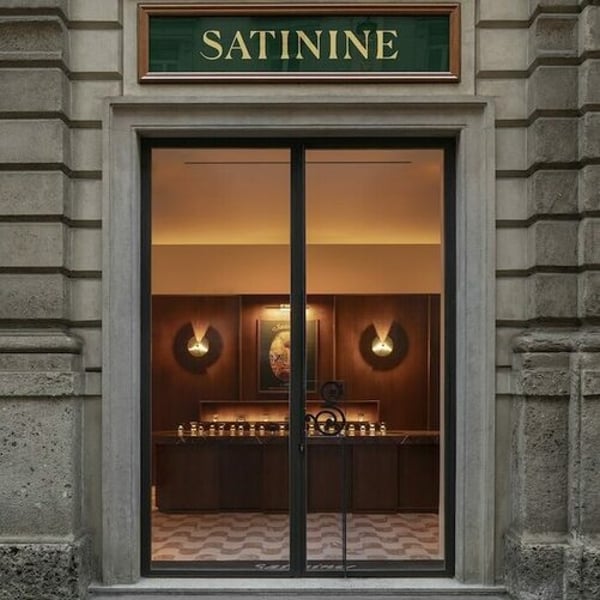
Founded in 1883 in Milan, Satinine is a perfumery laboratory that blends art and science in the creation of fragrances deeply rooted in Italy’s botanical heritage. Today, the Milanese brand has announced its return to its home city with the opening of a 70-square-metre boutique at Via Giuseppe Mengoni 4, just a short walk from Piazza Duomo.

Satinine returns to Milan – ©Tiziano Ercoli e Riccardo Giancola

Satinine’s founder was Lorenzo Usellini, a native of Arona on Lake Maggiore, who moved to Milan to handle the import and distribution of toiletries. After the First World War, Usellini began composing fragrances, and the “Satinine Officina Odoraria” was born—an enterprise that grew thanks to the artistic and creative input of his three sons in a family with a pronounced artistic streak; one of Usellini’s sons would go on to become a respected painter.

“Each essence is the result of a sophisticated balance between nature and science, memory and innovation, art and formula,” Usellini said of his creations.

In the 1930s, Satinine created perfumes that gained international popularity, most notably “Orchidea Nera” (a women’s fragrance) and “Caccia alla Volpe” (a men’s fragrance), presented in precious flacons that became icons of the Italian olfactory landscape, produced by Vetrerie Bormioli. The company’s name combines “Satin”—the fabric, a symbol of tactile elegance, lustre and sensuality—with the suffix “-ine”, which evokes the company’s precision and chemical/botanical leaning.

“Today we have a trove of 150 items from Satinine’s past to draw inspiration from, including perfume bottles and other materials, which stand out in a display case inside our store,” Galletti, the entrepreneur and fragrance enthusiast who relaunched this historic brand by co-founding Profumieri Milano S.r.l. with Ridgely Cinquegrana, former president of Loewe, tells FashionNetwork.com.

“I worked with him in the past in London on the development of Fornasetti Profumi,” Galletti added. “We stayed in touch, and he was keen to realise a project that would be meaningful in the perfumery world. We didn’t want to launch a brand with no history. As someone who knows the history of perfume, I decided to invest in the relaunch of Satinine.”

Satinine in Milan
Satinine in Milan – E.P. – FashionNetwork.com

“Historic perfumery was wiped out in the 1950s by the advent of fragrances from designer brands,” Galletti continued. “Satinine too began focusing on licensing and, over time, produced fragrances for brands such as Ferrari, Bottega Veneta and Borsalino. Milan had hundreds of perfumeries—single-brand houses with in-house production—and they were swept away by a public that wanted designer-label scents. The only ones to hold firm were the French, who continued to champion their historic production. In doing so, we lost an immensely important cultural heritage,” says the entrepreneur. “In 2005, Satinine went bankrupt; it was acquired by a Rome-based company, but essentially disappeared from the market. In 2024, we at Profumieri Milano reacquired it.”

The company has also opened a laboratory with in-house production, where it manufactures for other brands—mainly bespoke products for designers or hotel chains—while Satinine has now also debuted in home fragrances. Its perfumes retail between €120 and €180.

Satinine in Milan
Satinine in Milan – E.P. – FashionNetwork.com

Satinine’s new Milan shop, called Officina, is designed by Mara Bragagnolo and reinterprets the city’s architectural and perfumery traditions through a contemporary lens, drawing inspiration from the entrance halls of historic buildings as places of welcome and intimacy. Organised into distinct spaces—the porter’s lodge, the sensory room and the curatorial area—the shop creates a journey intended to transform the discovery of fragrances into a shared ritual.

The interiors combine modernist rigour and textural warmth through local materials such as Lombard terracotta, glazed ceramic and cathedral glass, in dialogue with oak panelling, Cardinal marble and satin-finished steel details. Each element is bespoke, crafted by local artisans, while soft lighting, curated by Martina Frattura, envelops the space with a “satin” glow.

Satinine in Milan
Satinine in Milan – ©Tiziano Ercoli e Riccardo Giancola

Amid this atmosphere, the shop’s official opening saw the debut of a new collection of ten Satinine fragrances developed in the in-house laboratory, using natural ingredients from Italian cultivars, with the stated aim of championing independent auteur perfumery, distinct from the conventions of the French school. Also new is the brand’s perfume bottle, designed by Franz Degano, whose design draws on the elegance of the 1930s.

Satinine’s retail ambitions now include international openings. “We would love to open in London, but we also like the idea of having a shop in Japan or South Korea,” concluded Galletti.

This article is an automatic translation.
Click here to read the original article.

Copyright © 2025 FashionNetwork.com All rights reserved.


Source link

Continue Reading

Fashion

River Island to close over 30 stores before the end of the January sales

Published

on


Published


December 12, 2025

River Island’s store closure programme will move into high gear within weeks as 33 stores will close by the end of January under the chain’s court-approved restructuring plan.

Photo: Sandra Halliday

The plan should also see it starting to pay reduced rents for 71 of its current 200+ chain. That could include up to three years of rent cuts or even no rents being paid for some River Island stores.

Its restructuring plan was approved earlier this year amid dire warnings that the business might collapse if the restructuring process didn’t go through.

Only this month the fashion retailer’s newly-filed accounts showed that River Island Holdings Limited made a loss before tax of £124.3 million in 2024, much wider than the £32.2 million loss of the year before. That came as turnover fell to £690.1 million from £701.5 million.

At the hearing for its restructuring plan in August, its legal team told the court that external pressures meant it hadn’t been able to reverse the downward trend.

The stores that will close within weeks are: Aylesbury, Bangor Bloomfield, Barnstaple, Beckton, Brighton, Burton-Upon-Trent, Cumbernauld, Didcot, Edinburgh, Falkirk, Gloucester, Great Yarmouth, Grimsby, Hanley, Hartlepool, Hereford, Kilmarnock, Kirkcaldy, Leeds Birstall Park, Lisburn, Northwich, Norwich, Oxford, Perth, Poole, Rochdale, St Helens, Surrey Quays, Sutton Coldfield, Taunton, Workington, and Wrexham.

Copyright © 2025 FashionNetwork.com All rights reserved.


Source link

Continue Reading

Fashion

UK festive spend to rise only in line with inflation, but young shoppers to spend more

Published

on


Published


December 12, 2025

​UK spend will increase this festive season but won’t beat inflation according to the latest PwC forecast that predicts seasonal spend of £24.6 billion.

Photo: Pixabay

That would be a 3.5% year on year rise, which is close to the current inflation rate (3.6%) but still slightly behind. So in real terms, spending will be static.

Shoppers are expected to spend £461 per head (up from £449 in 2024), with the top priorities being food & drink, Christmas dinner, and health & beauty.

And importantly, plenty of 18 to 24-year-olds plan to spend more than last year.

The latest Festive Predictions Survey showed 15% of shoppers planning to increase their spending compared with last Christmas, but with an almost equal number (14%) saying they’ll spend less. This is a slightly more pessimistic outlook than this time last year, when 20% of consumers said they’d spend more on festivities and 16% spend less. 

As mentioned, younger shoppers should be key as they’re set to spend more on the festive period this year than other age groups, with 32% of 18 to 24-year-olds set to spend more. And as in previous years, they’re forecast to be the biggest spenders per head with an estimated £541. 

The 25 to 34 age group will be next with a spend of £476 each and just over one in five (21%) saying they’ll increase their festive spend. 

When it comes to more cautious consumers, they’re mainly found in older age groups with 18% of the 35 to 44 age group and 14% of those aged 45 to 54 keeping a close eye on their spending, The 45 to 54-year-olds are also the group forecast to spend the least per head, at £436. 

Among the consumers planning to spend less there’s a mix of reasons ranging from those who actually have less cash available to those who just feel less confident about their finances. 

PwC also said that in a reversal of what happened around Black Friday, women are forecast to spend more than men, with a £471 outlay per head forecast. Men are projected to spend £452 per head.   

Fashion and beauty spend to rise

It added that “there are winners and losers amongst the categories shoppers say they will be buying”.  

Health & beauty is among the winners with 18% saying they’ll spend more on such products, making it the third-most-prioritised category, overtaking both adult and children’s clothing and electricals & technology. Health & beauty has become particularly important for younger shoppers. 

That said, fashion is the fourth-highest priority for consumer spend this Christmas, with 17% planning to spend more on adult clothing this year. 

As for when and where consumers have shopped or will be shopping, 46% say they finished their shopping before the beginning of December, partly to be organised but also to take advantage of pre-Christmas discounts.

Young shoppers are most likely to be in this group with 25% of 18 to 24-year-olds and 23% of 25 to 34-year-olds saying they did their shopping earlier than usual. More than half of 25 to 44-year-olds finished most of their shopping by the start of December. 

But many consumers are still shopping in December with 47% doing it in the early or middle days of the month. Only 8% are leaving it until the week before Christmas. 

Women continue to be more organised than men, with the majority of women (54%) having bought most of their gifts by the start of December, and only 4% leaving it until the week before Christmas. Some 12% of men plan to do most of their shopping the week before Christmas.  

Most consumers plan to do their spending for the festive season online with 55% of purchases happening online for home delivery. Together with click & collect (9%), that leaves only a little over a third of shopping taking place in physical stores (36%). 

The combined 64% of Christmas presents bought online is an increase on the last two years, and the highest proportion spent online since the end of the pandemic. 

Copyright © 2025 FashionNetwork.com All rights reserved.


Source link

Continue Reading

Fashion

Rec (Ecollant) to open its first polyamide recycling facility this spring

Published

on


Published


December 12, 2025

Auxerre-based Ecollant has developed a process that recycles 100% of the polyamide found in tights. As it prepares an industrial demonstrator for 2026, the Burgundy-based company is now extending its recycling capabilities to sportswear, lingerie, and swimwear. In line with this shift, it is adopting a new name: Rec.

Ecollant

Founded by Laurent Trognon and Frédéric Austrui, the company’s process recovers from textiles a nylon with properties identical to virgin polyamide. “There are plenty of people capable of recycling it. What sets us apart is our ability to achieve the level of purity required to produce robust yarns that can be used on an industrial scale,” said operations director Agathe Rouzaud.

On the strength of its process, Rec has now secured a 1,800 square-metre site in Joigny, where the initial phase will employ 17 people and produce 100 tonnes of nylon per year. A second site is already planned for around 2030, this time employing about 30 people and producing some 20,000 tonnes of material.

“We already have 100 tonnes of products to recycle in stock,” explains Frédéric Austrui, who notes that Rec has already secured its feedstock via collection specialists and hotel chains. The initial focus was tights, which are rich in polyamide. But the company is now broadening its collection scope, working on products composed of at least 70% nylon.

In tights, polyamide is often wound around elastane threads, giving the product its flexibility.
In tights, polyamide is often wound around elastane threads, giving the product its flexibility. – Ecollant

Some consumers have already come across materials recycled by Rec, which tested them through Divine, a brand of tights and stockings. Also via the Révélation brand of socks and parkas, notably sold at Galeries Lafayette and Printemps. The success, which surprised even its founders, quickly brought in around one million euros to finance an industrial project that now intends to focus solely on supplying manufacturers and brands, some of which have already committed to purchasing Rec’s recycled nylon.

In 2024, polyamide (or nylon) accounted for 5% of fibres produced worldwide, at around seven million tonnes, making it the second most-produced synthetic fibre, far behind polyester. That same year, only 2% of the nylon produced came from recycling, with long-standing technical obstacles hampering recovery.

“When we set out to recycle nylon, we were told it was impossible,” recalls Laurent Trognon, referring to a previous venture with Frédéric Austrui: Divine tights and stockings for mass retail. “We were confronted with the issue of the waste generated, while our yarn supplier was steadily increasing prices. So we decided to create our own industrial operation.”

Ecollant presentation film

Rec is not limiting itself to clothing. While polyamide is widely used in technical apparel and sport, the material is used mainly in the automotive industry, and also finds its way into electronics and industrial equipment. These are all areas in which the Burgundy-based company has already begun to secure outlets.

This article is an automatic translation.
Click here to read the original article.

Copyright © 2025 FashionNetwork.com All rights reserved.


Source link

Continue Reading

Trending

Copyright © Miami Select.