Fashion
Historic perfume house Satinine returns with single-brand boutique in Milan
Published
December 12, 2025
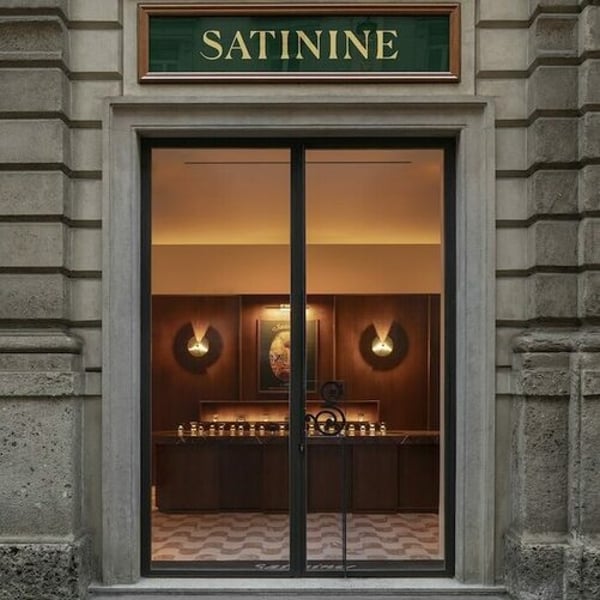
Founded in 1883 in Milan, Satinine is a perfumery laboratory that blends art and science in the creation of fragrances deeply rooted in Italy’s botanical heritage. Today, the Milanese brand has announced its return to its home city with the opening of a 70-square-metre boutique at Via Giuseppe Mengoni 4, just a short walk from Piazza Duomo.
Satinine’s founder was Lorenzo Usellini, a native of Arona on Lake Maggiore, who moved to Milan to handle the import and distribution of toiletries. After the First World War, Usellini began composing fragrances, and the “Satinine Officina Odoraria” was born—an enterprise that grew thanks to the artistic and creative input of his three sons in a family with a pronounced artistic streak; one of Usellini’s sons would go on to become a respected painter.
“Each essence is the result of a sophisticated balance between nature and science, memory and innovation, art and formula,” Usellini said of his creations.
In the 1930s, Satinine created perfumes that gained international popularity, most notably “Orchidea Nera” (a women’s fragrance) and “Caccia alla Volpe” (a men’s fragrance), presented in precious flacons that became icons of the Italian olfactory landscape, produced by Vetrerie Bormioli. The company’s name combines “Satin”—the fabric, a symbol of tactile elegance, lustre and sensuality—with the suffix “-ine”, which evokes the company’s precision and chemical/botanical leaning.
“Today we have a trove of 150 items from Satinine’s past to draw inspiration from, including perfume bottles and other materials, which stand out in a display case inside our store,” Galletti, the entrepreneur and fragrance enthusiast who relaunched this historic brand by co-founding Profumieri Milano S.r.l. with Ridgely Cinquegrana, former president of Loewe, tells FashionNetwork.com.
“I worked with him in the past in London on the development of Fornasetti Profumi,” Galletti added. “We stayed in touch, and he was keen to realise a project that would be meaningful in the perfumery world. We didn’t want to launch a brand with no history. As someone who knows the history of perfume, I decided to invest in the relaunch of Satinine.”


“Historic perfumery was wiped out in the 1950s by the advent of fragrances from designer brands,” Galletti continued. “Satinine too began focusing on licensing and, over time, produced fragrances for brands such as Ferrari, Bottega Veneta and Borsalino. Milan had hundreds of perfumeries—single-brand houses with in-house production—and they were swept away by a public that wanted designer-label scents. The only ones to hold firm were the French, who continued to champion their historic production. In doing so, we lost an immensely important cultural heritage,” says the entrepreneur. “In 2005, Satinine went bankrupt; it was acquired by a Rome-based company, but essentially disappeared from the market. In 2024, we at Profumieri Milano reacquired it.”
The company has also opened a laboratory with in-house production, where it manufactures for other brands—mainly bespoke products for designers or hotel chains—while Satinine has now also debuted in home fragrances. Its perfumes retail between €120 and €180.

Satinine’s new Milan shop, called Officina, is designed by Mara Bragagnolo and reinterprets the city’s architectural and perfumery traditions through a contemporary lens, drawing inspiration from the entrance halls of historic buildings as places of welcome and intimacy. Organised into distinct spaces—the porter’s lodge, the sensory room and the curatorial area—the shop creates a journey intended to transform the discovery of fragrances into a shared ritual.
The interiors combine modernist rigour and textural warmth through local materials such as Lombard terracotta, glazed ceramic and cathedral glass, in dialogue with oak panelling, Cardinal marble and satin-finished steel details. Each element is bespoke, crafted by local artisans, while soft lighting, curated by Martina Frattura, envelops the space with a “satin” glow.


Amid this atmosphere, the shop’s official opening saw the debut of a new collection of ten Satinine fragrances developed in the in-house laboratory, using natural ingredients from Italian cultivars, with the stated aim of championing independent auteur perfumery, distinct from the conventions of the French school. Also new is the brand’s perfume bottle, designed by Franz Degano, whose design draws on the elegance of the 1930s.
Satinine’s retail ambitions now include international openings. “We would love to open in London, but we also like the idea of having a shop in Japan or South Korea,” concluded Galletti.
This article is an automatic translation.
Click here to read the original article.
Copyright © 2025 FashionNetwork.com All rights reserved.