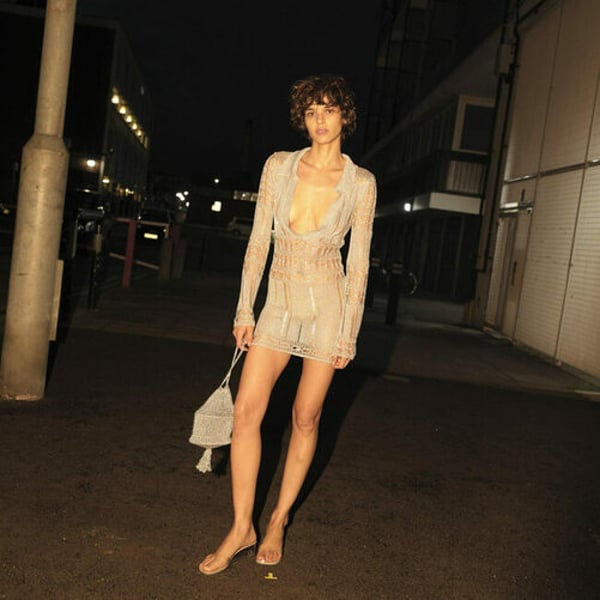
Alongside the main emerging designer competitions, like the Andam Prize, the LVMH Prize and the Hyères Festival, countless initiatives are flourishing as the fashion industry searches for hidden gems. A growing number of labels, often in association with fashion academies, have launched their own emerging designer competition, looking for young stylists or talented artisans that could potentially join their creative teams. A way to deal with the dearth of apprentices in the manual craftsmanship trades, and to inject fresh creative energy into a label.
Chinese designer Kexin Zhang will join Louis Vuitton’s leather goods department – Louis Vuitton
Among the most recent initiatives, French luxury group Kering has selected the winners of its new competition for sustainable jewellery design, the ‘Kering Generation Award X Jewellery’, staged in partnership with CIBJO (the international association for the fine and costume jewellery, goldsmithing and precious gems trades) and the Poli.Design department of Milan’s Politecnico University. Kering invited 22 start-ups and students to create a piece of jewellery from scraps. The competition’s first edition, whose theme was ‘second chance, first choice’, was held on June 7 in Las Vegas, during the JCK World Jewellery Show.
The winner in the ‘student’ category was Korean designer Lee Min Seo from Seoul’s Hongik University, who makes jewellery using leather offcuts from the manufacture of janggu, a traditional Korean percussion instrument. Her reward will be an internship at one of Kering’s jewellery brands, Boucheron, Pomellato, Dodo, or Qeelin. The winner among the start-ups was Chinese brand Ianyan, whose jewellery creations are made from imperfect and/or cracked stones. The two winners will also be mentored by experts from Politecnico’s faculty in Milan.
At the end of 2023, Louis Vuitton launched, in partnership with 30 schools around the world, the ‘Accessories Design Graduates Initiative’, a competition recognising innovation and creativity in leather goods and accessories design. Chinese designer Kexin Zhang, trained at the Academy of Fine Arts in Tianjin (TAFA) and the Royal Academy of Fine Arts in Antwerp, where she specialised in jewellery design, has recently won the competition’s second edition, thanks to “her sense of detail and exceptional expertise.”
Zhang will join Louis Vuitton’s leather goods and accessories design departments to create new products, said Louis Vuitton. Working alongside the luxury label’s staff, she will design leather goods, accessories and jewellery items, taking part in a comprehensive introduction programme, and she will undoubtedly meet Johnny Coca, head of women’s leather goods at LVMH’s flagship label.
In March, Parisian label Ami presented the fourth AMI x IFM Entrepreneurship Award to Matho, a brand specialising in knitwear designed as an extension of the body, founded by Léa Mathonière Fallot. Matho won €20,000 in prize money and a mentorship. The jury also awarded the Coup de cœur prize to Telmet, an experiential brand led by Léo Ciavarella and César Noyer which combines fashion design and audiovisual creations. Telmet received a €10,000 cash prize. For Ami Paris, the award is a way to give concrete support to emerging designers.
Other labels are hiring emerging designers for special projects, for example one-off collaborations. They see in this approach the opportunity to refresh their offering without losing their brand identity, while creating commercial buzz. In return, they offer visibility to young talents who are often unknown to the public, giving them the chance to design ad hoc capsule collections. This was the case with AZ Factory, for example, as it sought to give continuity to the Alber Elbaz brand after the eponymous designer’s death.
A look created by Anglo-Indian designer Supriya Lele for Mango as part of the Spanish label’s young designers programme – Mango
Spanish fast-fashion label Mango has recently launched the ‘Mango Collective’ project, “to celebrate the creativity and innovation of emerging brands.” As its first guest stylist, Mango has chosen Anglo-Indian designer Supriya Lele, a finalist at the 2020 LVMH Prize, who has already made a name for herself in London, where she set up her label in 2017. “The goal is to launch one collaboration a year, featuring a collection jointly created with a guest brand or designer, with the idea of building a creative community,” said Mango.
Focus on artisanal and manual craftsmanship
Artisanal skills and handcrafting talent are also very much in demand, as shown by the plethora of initiatives being organised in this field. Loewe, LVMH’s Spanish leather goods label, was one of the first houses to create a craftsmanship award, in 2016, under the aegis of its then creative director Jonathan Anderson. At the end of May, Japanese sculptor Kunimasa Aoki was crowned as the winner of the 2025 Loewe Foundation Craft Prize.
In 2017, French footwear brand J.M. Weston established, through its corporate foundation, the ‘J.M. Weston Foundation Awards’, aimed at promoting an international exchange between young French and Japanese artisans. “The objective is to allow young shoemakers to work for a period of four weeks at the best workshops in both countries,” said J.M. Weston, adding that the winners must complete during this time “an exceptional project working with the support of local master craftsmen who will be training them in their methods.”
Each year, J.M. Weston awards four scholarships through this programme, two for French apprentices and two for Japanese ones. The selection of this year’s two Japanese winners is under way, and they will visit the J.M. Weston factory in Limoges, France, in September. The two French winners have already been picked, and are expected to travel to Japan in October, where they will be working at the Scotch Grain factory in Tokyo. The closing ceremony, with the presentation of the completed projects and the awards, will take place in Japan on October 31.
In 2023, Marseilles-based label Sessun launched an international competition for designers under 35 years of age operating in the field of interior design. For the competition’s third edition, Sessun awarded first prize to Sarah El Yousefy and Nina Ouchinsky. Their project will be realised and presented at Galeries Lafayette Haussmann in Paris in September. Second prize went to Gala Vernhes-Chazeau, and third prize to Constant Clesse and Clément Pasquier. Setting up designer competitions allows labels to boost their brand image while supporting the creative generations of tomorrow.
Long regarded as a core pillar of corporate strategy, DE&I (diversity, equity and inclusion) is now going through a turbulent period. Under intensifying political, economic and social pressures, it has reached a pivotal moment. The sixth White Paper from the International Association of Department Stores (IADS) examines whether inclusion remains a fundamental priority or risks being pushed into the background.
Inclusion in the United States is under strain amid pressure from the presidential administration – Shutterstock
The 2025 edition looks at DE&I at a time when commitments are being put to the test. The year 2024 saw heightened scrutiny of inclusion programmes. In January 2025, the signing of a controversial US presidential executive order entitled “Ending Radical and Costly Government Diversity, Equity and Inclusion Programs and Preferences” prompted immediate reactions from major North American companies fearing legal reprisals, according to IADS.
The myth that inclusion penalises businesses
The 2025 report draws on a set of concrete observations from an analysis of the practices of leading retailers worldwide. It highlights four dimensions in which DE&I, when embedded in day-to-day operations, serves as a measurable driver of performance. Firstly, organisations with diverse leadership teams report stronger decision-making and greater strategic agility.
Secondly, companies that value inclusion see improved employee retention, thereby reducing turnover costs in a historically volatile sector. Thirdly, inclusion fosters more effective communication within teams, which reduces operational errors and strengthens cohesion.
DE&I is a legacy of civil rights struggles
Finally, retailers note that some of the most relevant ideas come directly from frontline teams who, thanks to their diverse experiences, contribute significantly to innovation and to adapting to varied customer expectations. These findings show that DE&I is not only an ethical value, but also a concrete driver of organisational effectiveness.
Despite conservative rhetoric, inclusion and diversity are an asset for companies, says IADS – Shutterstock
The report also notes that DE&I forms part of a longer legacy, rooted in the civil rights movement and in the historic demands of retail frontline teams for fair treatment and safer working conditions. However, contemporary expectations, often unclear or poorly defined, have given rise to what some stakeholders describe as “DE&I fatigue”, fuelled by doubts about the sincerity of commitments rather than by clear strategic thinking.
Inclusion, between intention and ‘strategic advantage’
The White Paper further points out that DE&I cannot be one-size-fits-all: priorities vary by region — from gender parity, ethnicity and disability to socio-economic background and national integration — and expectations regarding language and transparency differ considerably. For international groups, tailoring local approaches while upholding universal principles of equity is a major operational challenge.
Finally, IADS sets out the conditions that enable inclusion to take root for the long term: listening to employees, setting clear behavioural expectations, fostering collaboration between stores and headquarters, and ensuring fairness in recruitment and development processes. Beyond intention, these capabilities help retailers turn DE&I into a tangible strategic advantage, strengthening resilience, engagement and relevance in a constantly evolving environment.
Founded in 1928, IADS coordinates exchanges between department stores worldwide and publishes an annual White Paper on a key industry issue. Previous publications have focused on the Covid-19 pandemic, digital transformation, sustainability, retail media and the role of middle management.
Lululemon founder Chip Wilson is trying to excise private equity firm Advent from the apparel maker’s board as part of an ongoing proxy fight, Semafor reported on Monday, citing people familiar with the matter.
Lululemon
Wilson had launched a proxy fight in late December by nominating three independent directors to the company’s board.
Wilson is one of Lululemon’s largest independent shareholders, with a 4.27% stake as of December 2025, according to data compiled by LSEG.
While Wilson has said he does not want a board seat, he is making it clear that he will not consider any settlement with Lululemon unless two legacy directors, including chair David Mussafer, resign, Semafor reported.
The yogawear maker founder’s frustrations have been compounded by Advent’s spotty record in the consumer space, according to the Semafor report.
Lululemon also faces activist pressure from Elliott Management, which took a $1 billion stake in the company earlier in December and has been working closely with former Ralph Lauren executive Jane Nielsen for a potential CEO role.
Reuters could not immediately verify the report. Lululemon and Advent did not immediately respond to requests for comment.
Men’s Fashion Week kicks off in Paris on Tuesday and will feature six days of trend-setting catwalk shows, a farewell at Hermes and tributes to late Italian fashion icon Valentino.
The first day of the Fall/Winter 2026 edition will be dominated by the latest mega-production from Louis Vuitton‘s celebrity menswear designer Pharrell Williams, as well as mourning for one of the industry’s biggest names.
Williams will unveil his collection at the brand’s glitzy gallery space in western Paris under the shadow of the death of Italy’s Valentino Garavani, who passed away Monday at the age of 93.
The giant in the world of haute couture died at his home in Rome, just four months after the death of fellow Italian great Giorgio Armani.
In a sign of industrial renewal, however, French designer Jeanne Friot will take her first steps on the daunting Paris calendar on Monday, with the young stylist telling AFP it was a “quite an unusual joy and stress” to take part.
French designer Veronique Nichanian will meanwhile present her last collection for Hermes on Saturday after 37 years at the helm.
The 71-year-old Parisian — one of the few women designing in menswear — will leave behind a brand in tremendous financial shape with an image of timeless, refined masculinity that she has helped shape.
Her successor, London designer Grace Wales Bonner, who is of English and Jamaican heritage, represents a generational and stylistic shift for the classic family-run French house.
Many fashionistas will be casting an eye on the Christian Louboutin show on day two where Jaden Smith — son of US rapper-actor Will Smith — will present his debut collection.
The model and musician, 27, was unveiled as the creative director of the famed French brand last September by founder Louboutin, who appears to be preparing to hand over the reins to the Gen Z trendsetter.
The choice is seen as a bold bet on relatively inexperienced youth by the veteran maker of red-soled stilettos, whose ready-to-wear menswear and accessories are estimated by analysts to account for about a quarter of his sales.
On Wednesday, much-hyped Dior designer Jonathan Anderson will unveil his second Homme collection, having made his debut in June last year with a widely praised show of unisex styling.
But the 41-year-old’s womenswear collection in September didn’t convince everyone, and some observers expect him to put a more decisive mark on Dior and cement the new identity he’s begun sketching out.
“There’s a lot of anticipation,” Alice Feillard, men’s buying director at Paris department store Galeries Lafayette, told AFP.
The luxury fashion industry has undergone a wave of changes over the last 12 months at a time of weak international growth following the bumper buying frenzy of the post-Covid period.
Slowing demand from China, US tariffs on imports and uncertainty about the global economy have all weighed on sales of European brands.
New faces such as Anderson, Matthieu Blazy at Chanel, Demna at Gucci or Sarah Burton at Givenchy represent the elevation of a new stable of couturiers who look set to dominate the major houses over the next decade.
Elsewhere over the week, Japanese brands from Yohji Yamamoto and Issey Miyake to Mihara Yasuhiro will be out in force.
LVMH-owned Kenzo, will hold a presentation instead of a runway show on Tuesday inside the vast Parisian house of late founder Kenzo Takada in the French capital’s trendy 11th district.
The four-storey modernist building, which features a Japanese garden, will host a day-long gathering of design, food and music curated by chief creative Nigo.
US designer Willy Chavarria, who is one of a handful unafraid to express political views, also returns for his third season in Paris and might have something to say about Donald Trump‘s presidency on Friday.