Connect with us

Business

GM’s $1 billion tariff hit is evidence of American companies, consumers eating import tax costs

Published

on


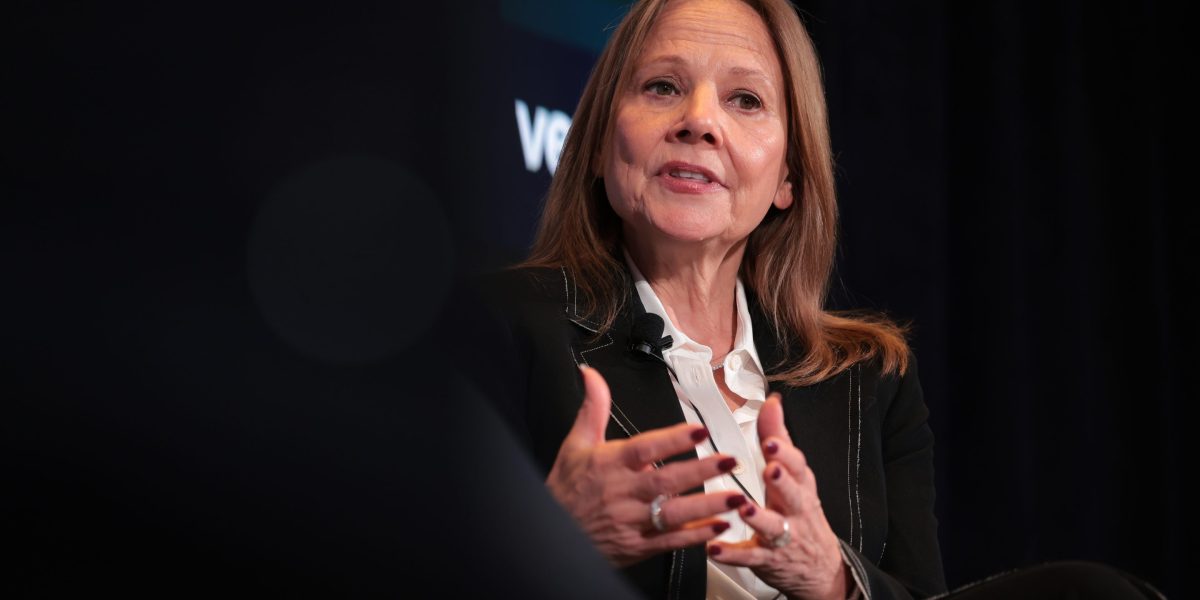
General Motors is the latest U.S. auto giant to say tariffs have taken a chunk from their earnings. The company beat earnings expectations on Tuesday, but reported a decline in second-quarter profits, including a $1.1 billion hit as a result of hefty import taxes.

GM reported a 2% dip in sales to $47 billion, as well as $1.9 billion in quarterly profits, compared to $2.9 billion in the same period last year.

Anticipating the impact of President Donald Trump’s auto tariff policy—which outlined a 25% levy for many imported vehicles—GM withdrew its annual guidance last quarter, predicting an up to $5 billion pummelling from the levies. The company announced last month plans to invest $4 billion in domestic manufacturing plants in order to offset the cost of imports, as well as increase production capacity. Still, GM’s reliance on compact cars made in South Korea has made it vulnerable to the levies.

“In addition to our strong underlying operating performance, we are positioning the business for a profitable, long-term future as we adapt to new trade and tax policies, and a rapidly evolving tech landscape,” CEO Mary Barra wrote in a letter to shareholders on Tuesday.

GM’s rival Stellantis, which owns Jeep and Ram Trucks among other brands, announced on Monday $2.7 billion in net losses for the first half of the year as North American sales continued to slump. Those struggles were exacerbated by the “early effects of U.S. tariffs,” according to Stellantis, which had a more than $350 million negative impact on the company.

America is eating tariff costs

The auto companies’ tariff hit reinforced concerns—and emerging evidence—that Americans are the ones footing the bill for Trump’s sweeping tariff policy. 

Despite the U.S. Treasury collecting a record-setting $100 billion in customs duties so far this year, there has not been a meaningful reduction in the price of imported goods indicating exporters absorbing increased costs on their ends, according to a Deutsche Bank analyst note published on Monday. Instead, import prices have remained steady through June.

“The top-down macroevidence seems clear: Americans are mostly paying for the tariffs,” Deutsche Bank analyst George Saravelos said in the note.

Saravelos posited that because the Consumer Price Index has so far indicated only modest levels of inflation, “it follows that American importers are mostly absorbing the tariffs into their profit margins.”

The phenomenon is exemplified by Stellantis and GM eating billions in tariff costs.

Auto tariffs are no exception

Bernstein senior analyst Daniel Roeska said auto companies have started to exhaust their strategy of absorbing tariff costs into their own margins as car prices are poised to skyrocket later this year.

“There are only two people who can pay for [tariffs]: either the shareholders or the consumer,” Roeska told Fortune. “And in the end, there’s going to be some sharing between those two halves. And so our view has been and continues to be that prices for cars are going to push up in the second half.”

There’s already indications American consumers will be the next to take the tariff punch. Car companies are beginning to roll back discounts and incentives implemented months earlier to boost sales, as evidenced by Ford Motors switching away from its employee discount plan for prospective buyers in favor of a $0 down and 0% interest or financing plan. While GM’s plan to move some manufacturing to the U.S. will help the company save on tariff and transport costs, it will also incur steeper labor costs. The strategic move is a good one, according to Roeska, but it illustrates that companies will largely encounter trade offs when it comes to managing the inevitable impacts of tariffs.

“There’s not much you can do,” Roeska said. “If the policy is to put tariffs on cars, then that will increase the cost of cars, and ultimately, that will likely increase the price of cars.”


Source link

Continue Reading

Business

Hollywood reels from shocking Reiner murders as police weigh charges for their son

Published

on


Los Angeles police are set to present a case to prosecutors Tuesday following Nick Reiner’s arrest in the killings of his parents, Rob Reiner and Michele Singer Reiner, which stunned their communities in Hollywood and Democratic politics, where both were widely beloved.

Prosecutors are set to decide whether and how to charge 32-year-old Nick Reiner, who is being held in jail without bail. He was arrested several hours after his parents were found dead in their home in the upscale Brentwood neighborhood of Los Angeles on Sunday, police said.

Rob Reiner was the Emmy-winning star of the sitcom “All in the Family” who went on to direct films including “When Harry Met Sally…” and ”The Princess Bride” He was an outspoken liberal activist for decades. Michele Singer Reiner was a photographer, movie producer and advocate for LGBTQ+ rights. They had been married for 36 years.

Representatives for the Reiner family did not respond to requests for comment, and it wasn’t clear if Nick Reiner had an attorney who could speak on his behalf. Police haven’t said anything about a motive for the killings.

Investigators believe Rob and Michelle Singer Reiner died from stab wounds, a law enforcement official told The Associated Press. The official, who was briefed on the investigation, could not publicly discuss the details and spoke to the AP on condition of anonymity.

The killings were especially shocking given the warm comic legacy of the family. Rob Reiner was the son of comedy legend Carl Reiner, who died in 2020 at age 98.

Kathy Bates, who won an Oscar as the star of Rob Reiner’s 1990 film “Misery,” was among those paying tribute to the couple.

“I loved Rob,” Bates said in a statement. “He was brilliant and kind, a man who made films of every genre to challenge himself as an artist. He also fought courageously for his political beliefs. He changed the course of my life. Michele was a gifted photographer.”

Bill Clinton called the couple “good, generous people who made everyone who knew them better.”

“Hillary and I are heartbroken by the tragic deaths of our friends Rob and Michele Reiner,” he said in a statement. “They inspired and uplifted millions through their work in film and television.”

Three months ago, Nick Reiner was photographed with his parents and siblings at the premiere of his father’s film “Spinal Tap 2: The End Continues.”

He had spoken publicly of his struggles with addiction, cycling in and out of treatment facilities with bouts of homelessness in between through his teen years. Rob and Nick Reiner explored — and seemed to improve — their relationship through the making of the 2016 film, “Being Charlie.”

Nick Reiner co-wrote and Rob Reiner directed the film about the struggles of an addicted son and a famous father. It was not autobiographical but included several elements of their lives.

“It forced us to understand ourselves better than we had,” Rob Reiner told the AP in 2016. “I told Nick while we were making it, I said, ‘You know it doesn’t matter, whatever happens to this thing, we won already.’”

Rob Reiner was long one of the most prolific directors in Hollywood, and his work included some of the most memorable and endlessly watchable movies of the 1980s and ’90s, including “This is Spinal Tap” and “A Few Good Men.”

He met Michele Singer Reiner on the set of “When Harry Met Sally…,” and their meeting would inspire the film’s shift to a happy ending, with stars Billy Crystal — one of Reiner’s closest friends for decades — and Meg Ryan ending up together on New Year’s Eve.

The Reiners were outspoken advocates for liberal causes and major Democratic donors.

President Donald Trump on Monday blamed Rob Reiner’s outspoken opposition to the president for the actor-director’s killing, delivering the unsubstantiated claim in a social media post that seemed intent on decrying his opponents even in the face of a tragedy.

___

Balsamo reported from Washington. Associated Press Entertainment Writer Andrew Dalton in Los Angeles contributed.


Source link

Continue Reading

Business

Valerie Health raises $30 million Series A to scale “AI front offices” for physicians

Published

on


The intersection of AI and healthcare has been getting massive attention from investors—and rightfully so, says Peter Shalek. 

“I think this is truly a once-in-a-lifetime moment,” said Shalek, cofounder and CEO of Valerie Health. “Software, at its best, takes complexity away from the end user that benefits their customers. It creates new experiences, and that hasn’t happened in the last 30 years… Over the next ten years, the experience of going to the doctor will change.” 

To meet the moment, Shalek—who co-founded digital mental health startup Joyable, which was sold to AbleTo—teamed up with Nitin Joshi, cofounder of Uber Health and Stripe engineering leader to start Valerie Health in 2023. Valerie, Shalek says, is “an AI front office” for independent doctors’ offices. 

“All the space that sits between the patient and provider, we’re taking that over and automating as much as possible,” Shalek said. “We automate referrals, we automate faxes, we automate scheduling. But over time, we’re building out a comprehensive platform that can really manage the entire workflow from front to back.”

Valerie Health—named with Shalek and Joshi’s children’s initials—has raised its $30 million Series A, led by Redpoint Ventures, Fortune has exclusively learned. General Catalyst, Primary Ventures, BoxGroup, and Karman Ventures participated in the round, along with 406 Ventures and Waybury Capital. Angels included executives from One Medical, Oscar, Main Street Health, and DoorDash. Valerie has now raised $39 million.  

“The future of healthcare is personalized and proactive,” said Meera Clark, partner at Redpoint Ventures. “Think about the ability to shift an appointment time or get that next appointment on the books—imagine a system has context to reach out to me and schedule based on my preferences, knows my healthcare needs, and knows my risk profile, what I might need to be screening for. You really need a foundation in place to be that proactive and personalized, and Valerie is laying that foundation.”

To Shalek, this isn’t just about a tech-enabled future, it’s the hope for better healthcare overall.

“We live in the U.S., with the best medical care in the world,” said Shalek. “We have incredible therapeutics, incredible diagnostics, incredible surgical capabilities—and yet, we have very mediocre average healthcare. The gap is about getting patients the right care that they need. It’s about democratizing healthcare, not just care for the healthiest and wealthiest people, which is too often what happens.”

See you tomorrow,

Allie Garfinkle
X:
@agarfinks
Email:alexandra.garfinkle@fortune.com
Submit a deal for the Term Sheet newsletter here.

Allie Garfinkle curated the deals section of today’s newsletter.Subscribe here.

Venture Deals

Link Cell Therapies, South San Francisco, Calif.-based oncology cell therapy company, launched from stealth with $60 million in Series A funding. Johnson & Johnson Innovation led the round, and was joined by Samsara BioCapital, Sheatree Capital, and Wing Venture Capital

AIR, an AI-powered credit intelligence startup, raised $6.1 million in seed funding. The round was co-led by Work-Bench Ventures and Lerer Hippeau.

Auxira Health, Columbia, Md.-based virtual cardiology company, raised $7.8 million in seed funding. Route 66 Ventures and Abundant Venture Partners led the round, and were joined by DigiTx Partners, American Heart Association Ventures, Ensemble Innovation Ventures, and City Light Capital.

– Soverli, a Zurich, Switzerland-based smartphone cybersecurity company, raised $2.6 million in pre-seed funding. Founderful led the round and was joined by the ETH Zurich Foundation and Venture Kick.

Private Equity

Godspeed Capital agreed to make a strategic investment in NextPoint Group, a Herndon, Va-based technology solutions provider for the intelligence and defense communities. Financial terms weren’t disclosed.

IPOs

Wealthfront, a Palo Alto, Calif.-based financial platform, is going public today with an offering of 34.6 million shares priced at $14 a share. 

Funds + Funds of Funds

Lightspeed Venture Partners, a Menlo Park, Calif.-based multi-stage venture capital firm, raised $9 billion in capital across six vehicles. 

Dragoneer Investment Group, a San Francisco-based investment firm, raised $4.3 billion for its seventh venture capital fund. 

Exits

Freshworks agreed to acquire FireHydrant, a New York-based AI-enabled incident management startup. Financial terms weren’t disclosed.

NVIDIA agreed to acquire SchedMD, a Lehi, Utah-based developer of open-source workload management system Slurm.

Fortune AIQ: The year in AI–and what’s ahead

Businesses took big steps forward on the AI journey in 2025, from hiring Chief AI Officers to experimenting with AI agents. The lessons learned—both good and bad–combined with the technology’s latest innovations will make 2026 another decisive year. Explore all of Fortune AIQ, and read the latest playbook below: 

The 3 trends that dominated companies’ AI rollouts in 2025.

2025 was the year of agentic AI. How did we do?

AI coding tools exploded in 2025. The first security exploits show what could go wrong.

The big AI New Year’s resolution for businesses in 2026: ROI.

Businesses face a confusing patchwork of AI policy and rules. Is clarity on the horizon?


Source link

Continue Reading

Business

America’s $38 trillion national debt will exacerbate generational imbalance, says think tank

Published

on


The United States’ current borrowing trajectory will place an “undue burden on future generations,” an economic think tank has warned, with younger generations facing a higher interest rate environment, slower economic growth, and stalling wage increases.

The latest research from the American Action Forum chimes with concerns across both the public and private sectors. Everyone from JPMorganChase CEO Jamie Dimon to Fed chairman Jerome Powell is nervously eyeing the nation’s $38 trillion debt burden. The government has paid $10 billion a week to service the debt for the first few months of the 2026 fiscal year.

Economists are concerned that, at some point, the growth of the American economy will become so disconnected from the borrowing of its government that bond buyers will demand higher premiums on their loans. The worry is that the central bank will intervene by increasing the money supply—kick-starting an inflationary cycle—but that ultimately the government may have to cut back on spending.

Bridgewater Associates founder Ray Dalio has described this scenario as an economic “heart attack,” with government investment squeezed out by the need for the country to maintain its debt obligations.

Younger people will face the sharpest end of that outcome, warned Jordan Haring, director of fiscal policy at the American Action Forum. Haring, formerly a senior policy analyst at the Committee for a Responsible Federal Budget (CRFB) wrote in a note this week: “The United States’ high debt load exacerbates generational imbalances. These imbalances will ultimately burden younger and future generations with higher interest payments, slower economic growth, slower income growth, and a greater burden to bear for future tax or spending changes.”

She continued: “Without significant policy changes to reduce debt growth, future generations will inherit a budget where significant resources are locked into servicing past borrowing.”

“As interest costs rise, the federal government will have less money available for education, infrastructure, or scientific research—areas that directly support long-term prosperity. Future taxpayers will face higher tax burdens or reduced government services simply to cover the costs created by previous budget deficits.”

Haring pointed to the discrepancies in budgets between education and health services, for example. Already the gap is large: In 2025, the Department for Education requested $82.4 billion for its budget, while in 2024 Medicaid spending totalled more than $900 billion, per the Medicaid and CHIP Payment and Access Commission.

With an ageing population, it is likely that spending on social care will increase over the coming decades. Lower birth rates will mean fewer entrants into the ranks of the economically active to maintain the revenues gathered by the government.

While the accuracy of the conservative think tank’s research has been criticised in the past, Haring’s stance has been echoed by the likes of BlackRock’s Larry Fink.

Last year, Fink urged corporate leaders and politicians to pursue “an organized, high-level effort” to rethink the retirement system. In a letter to BlackRock investors, Fink wrote: “The federal government has prioritized maintaining entitlement benefits for people my age (I’m 71) even though it might mean that Social Security will struggle to meet its full obligations when younger workers retire.”

He added: “It’s no wonder younger generations, Millennials and Gen Z, are so economically anxious. They believe my generation—the baby boomers—have focused on their own financial well-being to the detriment of who comes next. And in the case of retirement, they’re right.”

The Great Wealth Transfer option

With a shift in economic activity from one generation to the next also comes with new flows of wealth, and this is something governments around the world will be looking to leverage, according to experts.

Studies have found that over the next 20 to 30 years as much as $124 trillion will be passed down from older generations to their younger counterparts, though UBS puts the figure of the “Great Wealth Transfer” at $80 trillion. Baby boomers—people born between 1946 and 1964—are the wealthiest generation in history, and as these individuals begin passing on their assets, sums will go immediately to their Gen X, millennial, and Gen Z successors, and some cash will go to spouses.

“The change in wealth comes at a time when many governments around the world have high debt and deficits. It seems unrealistic to suppose that governments will just sit idly by as this wealth moves around. We would expect governments to attempt to mobilize that wealth to help fund their debt, but in doing so that denies private sector investment access to some of those funds.”


Source link

Continue Reading

Trending

Copyright © Miami Select.