Connect with us

Business

Halliburton: Oil markets are “softer” and will remain weak for all of 2025

Published

on


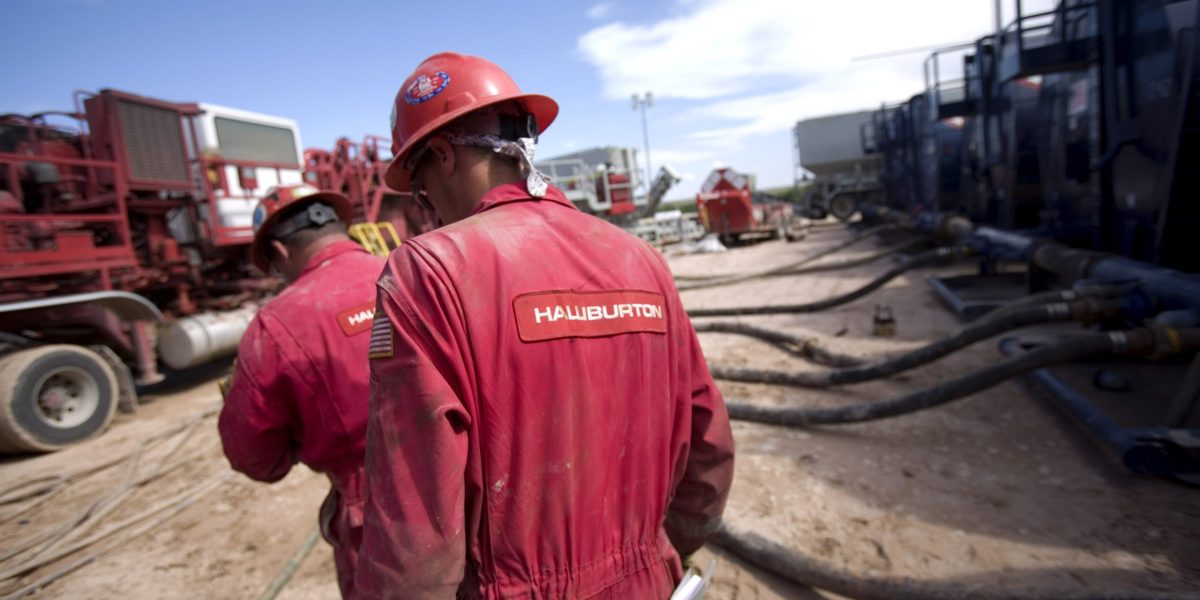
A combination of weaker oil prices, widespread spending cuts, and ramped-up OPEC crude oil volumes created a softer-than-expected industry environment that will continue at least through the rest of 2025, the CEOs of oilfield services leaders Halliburton and SLB said.

Global economic volatility, including ongoing tariff uncertainty, is leading oil and gas producers to plan more conservatively for the rest of the year than anticipated, they said, although though the longer-term oil and gas outlook remains bullish. The U.S. and Mexico are showing particular weakness even as shale oil and gas technologies developed in the U.S. over the past 20 years spread worldwide from Argentina to Australia, said Halliburton chairman and CEO Jeff Miller during the July 22 earnings call.

“To put it plainly, what I see tells me the oilfield services market will be softer than I previously expected over the short to medium term,” Miller said, arguing that oil producers and countries are cutting back spending more dramatically than current oil prices would normally necessitate. The U.S. oil pricing benchmark is about $66 per barrel, and it would need to rise well above $70 to be considered relatively healthy for the industry.

What that means for Halliburton and SLB is focusing more on technology and some of their service specialties while retiring some equipment and well completions—or fracking—fleets.

“We’ll clearly stack some fleets just because we’re not going to work at uneconomic levels,” Miller said. “It’s strategic for us, and it takes some equipment out of the market as well. But, from our perspective, working at uneconomic levels literally burns up equipment, creates HSE (health, safety, and environment) risk, and all sorts of things that we just don’t want to do.”

On the other hand, Halliburton (194 in the Fortune 500) is growing market share with its new autonomous and electrified fracking fleets, called Zeus IQ, and has partnered with Chevron (No. 16 in the Fortune 500) and others. Halliburton first developed early hydraulic fracturing, or fracking, techniques more than 75 years ago under founder Erle P. Halliburton.

For all of 2025, Halliburton now estimates its North American revenues will decline by more than 10%.

Halliburton reported second-quarter revenues that fell nearly 6% from $5.83 billion to $5.51 billion year over year. Net income plunged 33% from $709 million down to $472 million.

The biggest oilfield services company in the world, SLB (479 in the Fortune Global 500), formerly Schlumberger, also saw its quarterly revenues dip 6% year on year to $8.55 billion. Net income of $1.01 billion fell by 9%.

Oilfield outlook

OPEC and its allies have surprised much of the energy industry since this spring by unwinding years of voluntary production cuts more rapidly than anticipated to gain back market share. Dumping those new barrels on a saturated global marketplace Is adding to the weaker oil price environment, leading U.S. oil and gas producers and others to cut back spending and, in many cases, oil and gas volumes.

Adding to the weakness is the oilfield services sector becoming a victim of its own success. Efficiently gains now allow producers to extract more oil and gas per location without requiring as many drilling rigs and fracking fleets.

In mid-July, SLB closed its nearly $8 billion acquisition of ChampionX. The merger gives SLB a stronger footprint in artificial lift and production chemicals. Such services keep the oil and gas wells flowing optimally long after they are drilled and put into operation, which CEO Olivier Le Peuch said helps SLB avoid some of the industry’s inherent cyclicality. Even as drilling activity slows down, the existing wells still need just as much servicing and maintenance.

In fact, the number of drilling rigs active in the U.S. has fallen by 7% in the past 12 months, down to 544 active rigs, according to research firm Enverus, and the decline is expected to continue. Nearly half of all the active rigs are in the still-booming Permian Basin in West Texas and southeastern New Mexico.

“As we have seen more recently, the short-cycle markets have been more reactive to the persistent slightly lower commodity price than anticipated,” Le Peuch said. “Yet, all in, we are seeing this as a resilient market going forward.”


Source link

Continue Reading

Business

Gen Z’s pursuit of the #RichTok lifestyle sends them to social media for investing advice

Published

on


Gen Z loves #RichTok — and they love being rich. Mash them together and you get a generation that overwhelmingly turns to social media for investing advice as they seek the most elusive thing of all for the young: financial independence.

Social media ranked the top reason 55% of Gen Z and 44% of millennial investors say they got into investing, according to a survey of 300,000 investors over five years by the Oliver Wyman Forum. 

In their search for alternative pathways toward financial security, personal finance influencers are providing solutions. Videos describing how to invest $1,000 in the stock market or explaining “the stock market tea” in terms of the Kardashians or The Real Housewives franchise get hundreds of thousands of views across platforms. 

Vivian Tu, better known as Your Rich BFF, has 2.7 million TikTok and 3.8 million Instagram followers and gives advice on investing, financial planning,and tax loopholes.

“Suddenly, you have someone who doesn’t look like your dad’s financial advisor. You have somebody who looks like I could be anybody’s college best friend,” Tu previously told Fortune. “I want to entertain my audience and turn finance into funance and just make talking about money more accessible for the next generation of rich BFFs.”

Creator Rebecca Ma, who goes by Becca Bloom online, has 8.2 million followers on Instagram and TikTok. She shares her daily routine, feeding her cat caviar for breakfast and showcasing her endless luxury clothing hauls. Each one gets millions of views and likes. 

The popularity of these videos shows a common desire for extreme financial success. The Oliver Wyman Forum survey found in 2022, 18% of people said they felt pressure to make money to feel successful. By 2025, that number had climbed to 33%, and this feeling more than doubled among low-income earners and boomers nearing retirement. 

Economic uncertainty is driving Gen Z to invest early  

More than half of Gen Z started to learn about investing before entering the workforce, compared to only 20% of Baby Boomers, according to a World Economic Forum survey from 2024. Nearly a third started investing in college or early adulthood, twice the rate of millennials who invested at that age. 

Early investing is part of a strategy towards financial independence, which is now the

fastest-growing unmet financial need, according to the survey. Economic nihilism is growing within Gen Z as they face a stagnant job market and are pessimistic about the future of safety net programs like Social Security. 

“There’s this genuine interest to learn. Isaid Natalya Guseva, head of financial markets and resilience initiatives at WEF, which has surveyed investor habits every two years since 2022. She sees Gen Z’s lust for financial literacy as “driven by various things,” but overwhelmingly a sense from them that they can’t rely on things like governments and pensions as much as prior generations did. She also points to more access to information and diversified products to invest in as a draw for Gen Z.

Across all age groups, financial independence is the top skill people wished that they had learned more about earlier, according to WEF. Gen Z has taken this very seriously and is set on making as much money as possible.  

“Gen Z and young people in general have many financial goals, and we see many of them are actually quite medium to long term,” Guseva said. “Only about a tenth or fewer of our investors say they want to beat the market or speculate.”

Young people prefer AI over traditional advising

Nearly half of people consult AI when investing, compared to just over a third in 2023, according to the Oliver Wyman survey. Investors using AI typically use it as a sounding board rather than letting it independently invest their money. Compared to traditional financial advising, AI provides a judgment-free environment to learn, respondents said, and makes them feel more understood than human advisors. 

“We also see that younger generations, especially Gen Z, say that they would trust an institution more if it had an AI chat bot. ” Guseva said. “Many are using AI to learn about investing” 

With increased pressure, Gen Z is making riskier investments. While Oliver Wyman Forum found that Gen X and Baby Boomers’ investment portfolios tend to have more traditional compositions with higher levels of diversification and risk-hedging, cryptocurrency makes up more than one third of 71% of Gen Z investors’ portfolios, according to WEF.

“We see that more people know how to access crypto than stock, CTFs, and bonds, and more people feel like they can understand crypto than stocks, CTFs and bonds,” Guseva said. “What that shows to us is that what crypto has done is had a really great marketing campaign and awareness campaign. To us, it’s a lesson on, how do you meet people where they are?” 

Gen Z’s pivot toward higher-risk, high-reward assets like cryptocurrency isn’t just a trend. Their financial habits rank second among the areas where they feel most misjudged, the survey found, and their rejection of slow and steady wealth accumulation is a sign that they’re done with conventional wisdom that doesn’t fit their vision of the future. 


Source link

Continue Reading

Business

Stocks: ‘Dedollarization’ is dead—investors discount Trump’s drama as they pile into U.S. assets

Published

on


There is a conflict between Wall Street analysts right now over the right strategy for dealing with U.S. dollar-denominated assets. Some, like Pimco chief investment officer Dan Ivascyn, have recommended investors diversify out of U.S. equities because the Trump administration is so unpredictable. And analysts at ING have been pushing a “sell America” argument for a while now, noting that the 9% decline in the value of the dollar over the last 12 months has imposed a harsh haircut on anyone who bought U.S. assets in that period.

But yesterday we got some data showing that the tide may be turning against the “sell America” crowd.

First, the S&P 500 ticked up 0.26% yesterday and futures were up 0.36% this morning. One day’s trading is not significant on its own, of course. But it means that the S&P is up 1.45% year to date—a pretty decent pace of growth over such a short stretch.

More significantly, The U.S. government released its most recent numbers for Treasury International Capital Data (covering November) and they revealed that net foreign inflows into U.S. assets of all kinds were $212 billion.

That’s a lot, according to ING’s Chris Turner.

“The main takeaway is that foreigners continue to pour money into U.S. asset markets. The TIC release is a volatile data set, but looking at the rolling 12-month average, in November the net foreign purchase of US assets was around $100 billion per month – compared to around $25 billion in the summer of 2024,” he told clients this morning.

Cathie Wood adjusts her ‘rolling recession’ theory

There are several other factors giving traders good vibes about the U.S.

Ark Invest’s Cathie Wood announced in a new commentary that her “rolling recession” theory (that various sectors of the economy have suffered recessions even though the economy as a whole has held up) may be coming to an end. The U.S. “has evolved into a coiled spring that could bounce back powerfully during the next few years,” she said.

Wood is an idiosyncratic investor but she has a fervent fanbase buoyed by the performance of her ARK Innovation ETF, which is up 45% over the last 12 months, per Yahoo Finance:

Tech bulls are enthusiastic about Q4 earnings

Her bullishness looks tepid compared to Wedbush’s Dan Ives, who told clients to ignore all the people who have hating on tech stocks recently.

“We believe tech stocks will have a very strong 4Q earnings season led by Big Tech as the cloud stalwarts Microsoft, Alphabet, and Amazon had very robust AI enterprise demand in the quarter based on our field checks,” he said. “We believe … the Street is still underestimating how big this AI spending trajectory is and we expect 4Q tech earnings to be another validation moment with a doubling down on aggressive initial cap-ex numbers into 2026. Our bullish view is that investors are still not fully appreciating the tidal wave of growth on the horizon from the $3 trillion of spending over the next 3 years coming from enterprise and government.”

There’s a price gauge showing he may be right: The price of copper is up 33% over the last 12 months (based on the Comex continuous contract). President Trump’s copper tariffs didn’t help, of course, but the underlying issue is that tech companies building AI data centers need as much copper as they can get—so the copper price looks like an indicator of robust tech activity.

Trump: much smoke, less fire

Lastly, investors are becoming inured to Trump’s political dramas as they learn that much smoke often means little fire. Trump may have apprehended Venezuelan dictator Nicolás Maduro but he left the remainder of his regime in place. He may have threatened to bomb Iran again, but then he didn’t. His administration may be criminally investigating U.S. Federal Reserve Chairman Jerome Powell, but after Powell came out against him with guns blazing in a video on Sunday Wall Street was reassured that Fed independence wasn’t going away in the short term. Even Trump’s threat to invade Greenland looks like it might end up in the Pentagon’s “Easier said than done” file.

‘De-dollarisation is going to take some time’

ING’s Turner isn’t giving up on his theory that the world is slowly moving away from the dollar, yet. But his note this morning admitted that the greenback isn’t dead yet. The dollar has gained nearly a full percentage point in value on the DXY index of foreign currencies since the start of the year.

“The dollar is drifting higher this week on probably what is best described as a macro move. U.S. data has come in on the firmer side, e.g. retail sales and jobless claims, while the Fed’s Beige Book presented a view of a gently expanding economy and no immediate threat to the jobs market,” he told clients.

“We would again conclude that de-dollarisation is going to take some time and that if the dollar is to come lower this year, it will be driven by lower U.S. [interest] rates and increased foreign hedging of U.S. assets.”

Here’s a snapshot of the markets ahead of the opening bell in New York this morning:

  • S&P 500 futures were up 0.36% this morning. The last session closed up 0.26%.
  • STOXX Europe 600 was flat in early trading.
  • The U.K.’s FTSE 100 was flat in early trading. 
  • Japan’s Nikkei 225 was down 0.32%.
  • China’s CSI 300 was down 0.41%. 
  • The South Korea KOSPI was up 0.9%. 
  • India’s NIFTY 50 was up 0.16%. 
  • Bitcoin was down to $95.5K.


Source link

Continue Reading

Business

Jamie Dimon says his success is down to ‘details, no bullsh**ting, or meetings after meetings’

Published

on


Jamie Dimon’s ethos on running a company is pretty simple: Be relentless, and don’t overlook the details. When organizations get too comfortable and begin ignoring the fine print, he said, is when complacency sets in, and a business begins to decay.

With more than 300,000 employees worldwide, the CEO of America’s largest bank can’t be across every issue in the company—which is why he believes this diligence needs to be instilled at every level.

Speaking at the U.S. Chamber of Commerce yesterday, Dimon was asked how he had made JP better than “every other bank in the world,” a take which its CEO immediately disagreed with: “a lot of people do things better,” he began.

That reflection is “one of the reasons we sometimes do better a little bit,” Dimon added, explaining: “I’m relentless: Details, facts, analysis, no bulllshitting, no meetings after meetings, share all the information—put it on the table, put the dead cats on the table—go through system by system by system, get out on the road, visit other companies, they all do things better than you.”

The overall message is to “learn, learn, learn”, a mantra the Wall Street veteran has advised for everyone from Gen Z’s entering the job market to those in leadership.

“Big companies slow down, they become complacent, they become bureaucratic … arrogant,” Dimon added, all of which eventually leads to “stasis and death.” “Huge, wonderful companies” have failed because of this pitfall, Dimon said, and as such “nothing is too small to care about.”

Watchers of the 69-year-old’s career will not be surprised by his energetic leadership advice. Last April, Dimon wrote in his letter to shareholders that he runs the bank with a military tactic in mind named the ‘OODA loop,’ which stands for observe, orient, decide, act.

JP without Jamie

Under Dimon’s stewardship, JP has scored many wins: Its share price is up 21% over the past year, it is continually leading in AI adoption according to Evident AI’s barometer, and its CEO has the ear of everyone from lawmakers to President Trump.

However, Dimon shocked investors last year when he changed his oft-repeated response to the question of when he may be leaving the top job at JPMorgan Chase. For many years, Dimon would joke that his retirement was five years away. In May last year, that changed. “It’s not five years anymore,” he said.

Speculation has since been rife about which of JPM’s executive team would step in to fill the significant shoes of Dimon. But this week the executive’s tone changed again.

When a “five more years” anecdote was repeated back to Dimon this week, the CEO responded “at least,” suggesting his departure is anything but imminent. “I love what I do, it’s up to the board how long I do it,” he added.

Dimon’s success at JPM, which has included handling politicians and policymakers, led many to question whether one day he might make a move to Capitol Hill. The bank executive completely shut down the notion of a presidential run, as well as the role of Fed chairman (which will be vacated by Jerome Powell this spring).

“Fed chairman, I’d put in the absolutely, positively, no way, no chance, no way, no how for any reason,” Dimon doubled down this week. Since Trump’s return to the White House, the role of Fed chairman has become significantly less attractive, acting as a target for the Oval Office to level criticism and lobbying for the base rate to move one way or another.

But Treasury Secretary Dimon would “consider,” he added: “If a president calls you up asks you to do something, you should consider it. So I would take the call, consider it, and think about why and what they want, but what they want and how they want to operate would be important to me.

“I like my job, I’ve been my own boss for pretty much 25 years, and I like it that way.”


Source link

Continue Reading

Trending

Copyright © Miami Select.