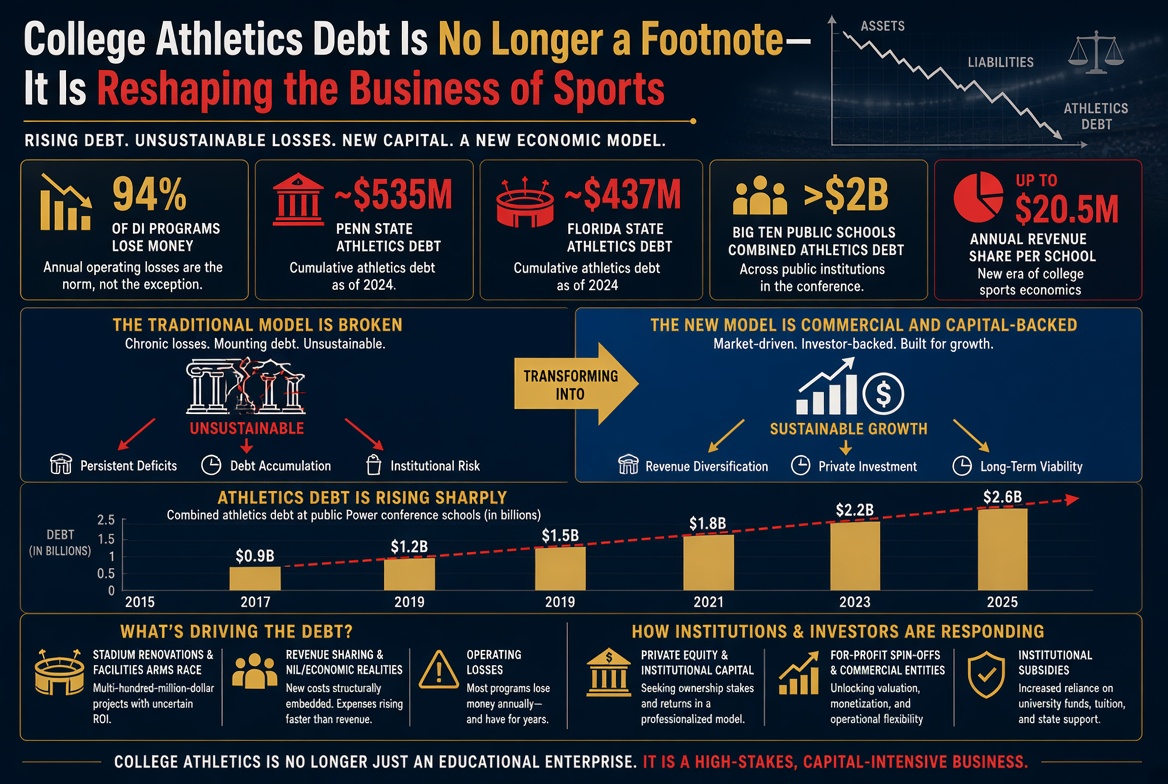
College athletics has always been a business dressed up as amateurism. But the numbers now coming out of major athletic departments make that point impossible to ignore. Penn State, Florida State, and Rutgers carry enormous athletic-related debt, and their situations show how stadium projects, operating losses, and rising costs are changing how college sports departments function.
This is not simply a story about reckless schools. It is a story about a system that has priced itself into a corner.
Debt Is Common, But Not Always a Crisis
Most major Division I athletic departments carry some level of debt. They borrow for stadiums, practice facilities, premium seating, video boards, locker rooms, and football complexes. The question is not whether debt exists. The question is whether the department can generate enough revenue to pay for it while still running the rest of the athletic program.
Long-term facility debt differs from an annual operating deficit. A school can borrow hundreds of millions for a stadium and still be financially stable if ticket sales, donations, sponsorships, media rights, and conference distributions cover the payments. That is the model Penn State and Florida State are trying to make work.
How Revenue Bonds Work
Most large college-stadium projects are financed with revenue bonds: tax-exempt or taxable debt issued through a university-affiliated athletics association or a state financing authority. Unlike general-obligation bonds backed by taxpayers, revenue bonds are repaid from specifically pledged athletics revenues—conference distributions, ticket sales, concessions, sponsorships, advertising, game guarantees, and booster contributions.
The bonds carry a schedule of semiannual interest payments and annual principal payments, often stretching 20 to 30 years. At Florida State, the 2024 athletics revenue bonds carry an average interest rate of 4.8%, mature between 2028 and 2053, and require annual principal payments beginning in 2025.
The key financial test is debt-service coverage: whether pledged revenues comfortably exceed the annual principal-and-interest bill. FSU’s bond documents projected maximum annual debt service of $36.3 million in fiscal 2027, with pledged revenues providing projected coverage of 3.54 times—well above the state system’s 1.20-times minimum requirement.
That coverage matters because the bonds generally hold a senior, or “gross,” claim on pledged revenue. In plain English: debt service is paid before those dollars can be used for ordinary athletics expenses. If revenues fall short, the department must draw on cash reserves or cut operating costs to protect the bond payment.
Boosters Are Part of the Repayment Plan
Booster organizations are no longer just fundraising arms; at schools such as Florida State, they are part of the bond collateral. The Seminole Boosters’ annual membership fees, capital gifts, and project-specific donations are pledged revenues that help secure and repay FSU’s stadium debt.
FSU’s financing was deliberately split into two pieces: a smaller, front-loaded portion intended to be repaid quickly from stadium-project donations over five years, and a much larger 30-year, level-debt-service portion repaid from recurring athletics and booster revenues.
That structure explains why fundraising is now so central to college sports. Donors are not merely supporting facilities; their gifts can directly reduce borrowing needs, accelerate repayment, and make the long-term bond package more creditworthy. FSU had secured $60.3 million toward an $85.6 million premium-seating contribution target as of March 2024.
The trade-off is real. Money pledged to bond repayment is money not available for coaching staffs, Olympic sports, facility maintenance, NIL collectives, or revenue-sharing obligations. Boosters may still be giving generously—but increasingly, part of that generosity is being spoken for before it reaches the operating budget.
Penn State Bets Big on Beaver Stadium
Penn State closed fiscal 2025 with $534.7 million in athletics-related debt, according to its NCAA financial disclosure. That figure jumped from $163.1 million the previous year, largely because of the roughly $700 million Beaver Stadium revitalization project.
Penn State has said Intercollegiate Athletics will finance and pay for the project entirely, with no tuition or educational-budget dollars. The repayment plan relies on fundraising, concessions, naming opportunities, sponsorships and ticket sales—especially new premium seating.
The risk is obvious. Penn State’s facility debt service, leases and rental costs reached $24.2 million in fiscal 2025. That money cannot be spent on Olympic sports, maintenance, recruiting, or roster costs.
Florida State Faces a Tighter Margin
Florida State reported $437 million in athletics-related debt in fiscal 2025, up roughly $200 million from the prior year. Much of that is connected to the Doak Campbell Stadium renovation and a new football operations center.
FSU officials have described the borrowing as planned infrastructure spending, not a sign that the department is collapsing. There is truth to that. But debt still limits flexibility, especially in college football, where coaching changes, buyouts, and roster costs have become brutally expensive.
If Florida State decides to move on from football coach Mike Norvell, reports have estimated the cost could reach $68 million. That is a difficult number for any athletic department to absorb, particularly one already carrying more than $400 million in debt.
Rutgers Shows the Cost of Chronic Losses
Rutgers is the clearest example of what happens when operating losses become routine. The school projected a record $78 million athletics deficit in fiscal 2025, even after receiving $15.8 million in student fees, $7 million from the university and $8 million in state support.
Since joining the Big Ten, Rutgers has accumulated roughly $516.9 million in cumulative athletics shortfalls. In fiscal 2025 alone, the department reported $193.8 million in expenses against $146.6 million in total operating revenue.
That is not a stadium-bond story. That is a structural revenue problem.
The Real Cost Comes Later
Debt does not stop an athletic department from functioning. It functions every day. Teams travel, coaches get paid, athletes compete, and stadiums open.
But debt changes priorities. It forces administrators to protect revenue streams, chase premium seating, lean harder on donors, and think twice before spending on anything that does not produce a return. In today’s college sports economy, that includes revenue sharing, NIL support, and roster construction.
The schools that survive this era will not be the ones with the newest buildings. They will be the ones that can pay for them.