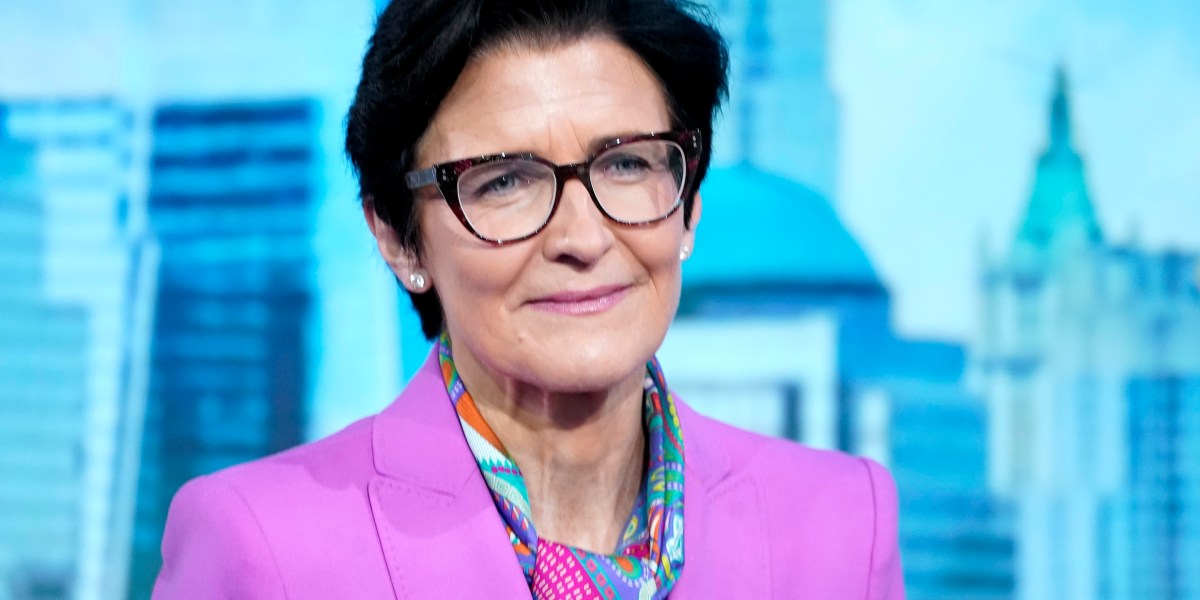
A Fortune Most Powerful Woman, Posnett is one of the bank’s top dealmakers, also serving as vice chair of the Firmwide Client Franchise Committee and is a member of the Management Committee. She was previously the global head of the Technology, Media and Telecommunications, among several other executive roles, including Head of Investment Banking Services and OneGS. She talked to Fortune about how she sees the current business environment and the most significant developments in 2026, in terms of AI, the IPO market and M&A activity. Goldman has been the No. 1 M&A advisory globally for the last 20 years, including in 2025 — and Posnett has been one of the star contributors, advising companies including Amazon, Uber, eBay, Etsy, and X.
- Heading into Davos, how would you describe the current environment?
As the global business community converges at Davos, we are seeing powerful catalysts driving M&A and capital markets activity. The foundational drivers that accelerated business activity in the second half of 2025 have continued to improve and remain strong heading into 2026. A constructive macro backdrop — including AI serving as a growth catalyst across sectors and geographies — is fueling CEO and board confidence, and our clients are looking to drive strategic and financing activity focused on scale, growth and innovation. As AI moves from theoretical catalyst to an industrial driver, it is creating a new set of priorities for the boardroom that are top of mind for every client we serve heading into 2026.
- What were the most significant AI developments in 2025, and what should we expect in 2026?
2025 was a breakout year for AI where we exited the era of AI experimentation and entered the era of AI industrialization. We witnessed major technical and structural breakthroughs across models, agents, infrastructure and governance. It was only a year ago, in January 2025, when DeepSeek launched its DeepSeek-R1 reasoning model challenging the “moats” of closed-source models by proving that world-class reasoning could be achieved with fully open-source models and radical cost efficiency. That same month, Stargate – a historic $500 billion public-private joint venture including OpenAI, SoftBank and Oracle – signaled the start of the “gigawatt era” of AI infrastructure. Just two months later in March 2025, xAI’s acquisition of X signaled a new strategy where social platforms could function as massive real-time data engines for model training. By year end, we saw massive, near-simultaneous escalation in model capabilities with the launches of OpenAI’s GPT-5.1 Pro, Google’s Gemini 3, and Anthropic’s Claude 4.5, all improving deep thinking and reasoning, pushing the boundaries of multimodality, and setting the standard for autonomous agentic workflows.
In the enterprise, the conversation has matured from “What is AI?” just a few years ago to “How fast can we deploy?” We have moved past the pilot phase into a period of deep structural transformation. For companies around the world, AI is fundamentally reshaping how work gets done. AI is no longer just a feature; it is the foundation of a new kind of productivity and operating leverage. Forward-leaning companies are no longer just using AI for automation; they are building agentic workflows that act as a force multiplier for their most valuable asset: human capital. We are starting to see the first real, measurable returns on investment as firms move from ‘AI-assisted’ tasks to ‘AI-led’ processes, fundamentally shifting the cost and speed of execution across organizations.
Of course, all this progress is not without regulatory and policy complexities. As AI reaches consumer, enterprise and sovereign scale, we are seeing a divergence in global policy that boards must navigate with care. In the United States, recent Executive Orders — such as the January 2025 ‘Removing Barriers’ order and the subsequent ‘Genesis Mission’ — have signaled a decisive shift toward prioritizing American AI dominance by rolling back prior reporting requirements and accelerating infrastructure buildouts. Contrast this with the European Union, where the EU AI Act is now in full effect, imposing strict guardrails on ‘high-risk’ systems and general-purpose models. Meanwhile, the UK has adopted a “pro-innovation” hybrid model: on the one hand, promoting “safety as a service”, while also investing billions into national compute and ‘AI Growth Zones’ to bridge the gap between innovation and public trust. For our clients, the challenge is no longer just regulatory compliance; it is strategic planning and arbitrage – deciding where to build, where to deploy, who to partner with, what to buy and how to maintain a global edge across a fragmented regulatory landscape.
As we enter 2026, the pace of innovation isn’t just accelerating; it is forcing a total rethink of business processes and capital allocation for every global enterprise.
- Given the expectation and anticipation for IPOs this year, what is your outlook for the market and how will it be characterized?
We are entering an IPO “mega-cycle” that we expect will be defined by unprecedented deal volume and IPO sizes. Unlike the dot-com wave of the late 1990s, which saw hundreds of small-cap listings, or even the 2020-2021 surge driven by a significant number of billion-dollar IPOs, this next IPO cycle will have greater volume and the largest deals the market has ever seen. It will be characterized by the public debut of institutionally mature titans, as well as totally disruptive, fast moving and capital consumptive innovators. Over the last decade, some companies have stayed private longer and raised unprecedented amounts of private capital, allowing a cohort of businesses to reach valuations and operational scale previously unseen in the private markets. We are no longer talking about “unicorns” — we are talking about global companies with the gravity and scale of Fortune 500 incumbents at the time they go public. For investors, the reopening of the IPO window will enable an opportunity to invest in the most transformative and fastest growing companies in the world and a generational re-weighting of the public indices.
In 2018, the five largest public tech companies were collectively valued at $3.3 trillion, led by Apple at ~$1 trillion. Today, the five largest public tech companies are valued at $18.3 trillion, more than five and half times larger. Even more significant, the 10 largest private tech companies in 2018 were valued at $300 billion. Today, the 10 largest private tech companies are valued at $3 trillion, more than 10 times larger. These are iconic, generational companies with unprecedented private market caps some of which have unprecedented capital needs which should lead to an unprecedented IPO market.
Each of these companies will have their own objectives on IPO timing, size and structure which will influence if, how and when they come to the market, but the potential across the board is significant. During the last IPO wave, Goldman Sachs was at the center of IPO innovation by leading the first direct listings and auction IPOs, and we expect more innovation with this upcoming wave. The current confluence of a constructive macro backdrop and groundbreaking technological advancements is doing more than just reopening the window; it is creating a generational opportunity for investors to participate in the companies that will define the next century of global business.
- M&A activity exploded in 2025, are the markers there for another boom year?
As we enter 2026, the global M&A market has transitioned from a year of recovery ($5.1 trillion of M&A volume in 2025, up 44% YoY) to one that is bold and strategic. While the second half of 2025 was defined by a “thawing” — driven by a constructive regulatory environment, fed easing cycle and normalizing valuations — the year ahead will be defined by ambition.
We have entered an era of broad, bold and ambitious strategic dealmaking: transformative, high-conviction transactions where industry leaders are no longer just consolidating for scale, but also moving aggressively to acquire the strategic assets, AI capabilities and digital infrastructure that will define the next decade. CEO and board confidence have reached a multi-year high, underpinned by the realization that in an AI-industrialized economy, standing still is the greatest risk of all. The quality and pace of strategic discussions that we are having with our clients signals that the world’s most influential companies — across sectors and regions — are ready to deploy their balance sheets and public currencies to redraw the competitive map.
AI is no longer an isolated tech trend; it is a horizontal disrupter, broadening the appetite for strategic M&A across every sector of the economy. While the dialogue in boardrooms has moved from theoretical ‘AI pilots’ to large-scale capital deployment, the speed of technology is currently outpacing traditional governance frameworks. Boards and management teams are being asked to make multi-billion dollar, high-stakes decisions in a landscape where historical benchmarks often no longer apply. In this environment, M&A has become a tool for strategic leapfrogging — allowing companies to move both defensively to protect their core and offensively to secure the critical infrastructure and talent needed for non-linear growth. Success in 2026 will be defined by strategic conviction: the ability to turn this unprecedented complexity into a clear, actionable strategy and competitive advantage.
As AI continues to reshape corporate M&A strategy, we are also seeing financial sponsors return to the center of the M&A stage. Sponsor M&A activity accelerated sharply in 2025 — with M&A volumes surging over 50% as the bid-ask spread between buyers and sellers started to narrow, financing markets became more constructive and innovative deal structures enabled private equity firms to pursue larger, more complex transactions. With $1 trillion of global sponsor dry powder and over $4 trillion of unmonetized sponsor portfolio companies, the pressure for capital return to LPs has continued to escalate. Financial sponsors are entering 2026 with a dual-focus: executing take-privates and strategic carveouts to deploy fresh capital, while simultaneously utilizing reopened monetization paths – from IPOs to secondary sales to strategic sales — to satisfy demand for liquidity. With monetization paths reopening and valuation gaps narrowing, sponsors are entering 2026 with greater flexibility, reinforced by a healthier macroeconomic backdrop and improving liquidity conditions.
This Q&A is based on an email conversation with Kim Posnett. This piece has been edited for length and clarity.







 Politics8 years ago