Fashion
‘Ce Qui Se Trame’ exhibition: a Franco-Indian partnership at the heart of textiles and crafts
Published
December 4, 2025
From December 5 to January 7, 2026, the Mobilier National will present the exhibition “Ce Qui Se Trame – Histoires Tissées Entre l’Inde et la France”, a project devoted to artistic and technical exchanges between France and India through textiles.
The event brings together several major players: 19M, the Métiers d’art cluster founded by Maison Chanel, the French Embassy in India via the Villa Swagatam programme, and designer Christian Louboutin, who oversees the artistic direction and scenography, drawing on his experience of India.
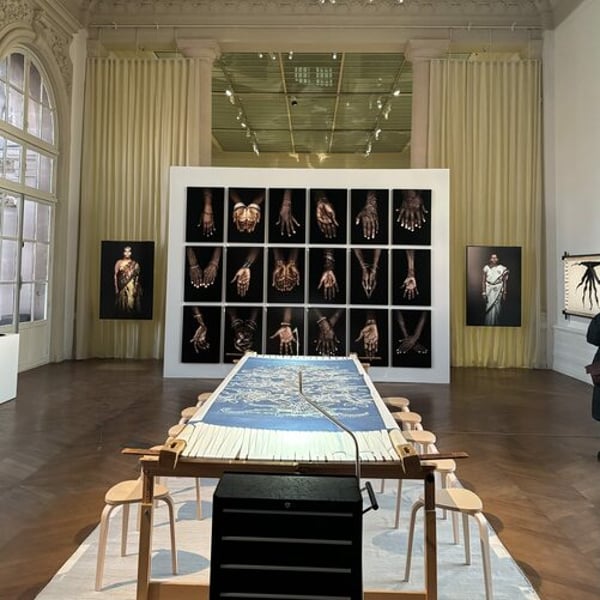
Guest curator Mayank Mansingh Kaul is responsible for the conceptual narrative, the organisation of the sections and the selection of works. To coincide with the exhibition, Lesage Intérieurs, a resident house at 19M specialising in embroidery and textile decoration, is organising a participatory workshop from December 4 to 7 focused on creating an embroidered Indigo Tree of Life. Conceived as a collective project, it will enable visitors to discover embroidery techniques while contributing to a shared artwork inspired by historical exchanges between India and Europe.
The exhibition is organised around seven successive spaces: L’Antichambre, Toiles blanches, Modes indiennes, Le fil d’or, Le chic à l’indienne, Sculpter les corps and, finally, Un langage universel.
The exhibition opens with L’Antichambre, a space showcasing artistic and commercial exchanges between India and France. It is a reproduction of an 18th-century French apartment, entirely lined with an Indian textile. Louboutin will use this setting to immerse visitors in history through a traditional 18th-century motif, created especially for the exhibition by artisans from the House of Kandadu. They worked entirely by hand, using age-old techniques such as block printing and natural dyes. The exterior of this room takes its inspiration from Indian nomadic tents. It is covered in Toile de Jouy, a French fabric that originally grew out of Indian printing techniques.
The next section, Toiles Blanches, returns to the essentials: fibres and threads. Shown without colour, they evoke the different meanings of white in Indian and French cultures. On display are hand-spun and hand-woven Indian cotton muslins, which transformed women’s fashion in France in the 17th and 18th centuries, as well as French embroidery, embellishments and handmade lace.
With Modes Indiennes, the exhibition looks back at the arrival in France, from the 17th century onward, of hand-painted and hand-printed cotton fabrics. These fabrics, first called palampores or chintz, later inspired the creation of “indiennes”, a type of textile that became very popular in France. Their floral and botanical motifs blend the styles of both cultures. The works on display show how these fabrics were used in clothing and interiors of the time, and also explain the origin of the French paisley motif, inspired by Kashmir shawls.
In Le Fil d’Or, visitors discover brocades, precious fabrics hand-woven from silk and metallic threads. Lyon was long the principal French centre for these textiles, and the invention of the Jacquard loom in the 19th century transformed their production worldwide. The exhibition shows the influence of this innovation on Indian textiles, particularly in Varanasi, through works that combine tradition and contemporary creation.
Le Chic à l’Indienne begins at the foot of the gallery staircase, with a colourful textile installation inspired by the sari. This traditional garment, over two thousand years old, is reinterpreted here by the Indian brand Raw Mango, known for modernising the sari while working with numerous artisans. This section explores the interplay between French haute couture and Indian fashion, and shows how textiles can shape the body. The large panels in the room come from The Flowers We Grew project, created by the Chanakya School of Craft with artist Rithika Merchant.
In Sculpter Les Corps, the exhibition focuses on artists who use textile craftsmanship within a contemporary practice. The works show how textiles can become sculptural and address social and political issues. The techniques used are varied, and artists from India and France explore the body, texture, volume and drape. Works by Mrinalini Mukherjee, Simone Pheulpin, Sheila Hicks, the Ateliers Chanakya collective and Jeanne Vicerial are on display.


Finally, the exhibition closes with Un Langage Universel, a salon inspired by India and entirely covered in denim. This fabric, developed in Nîmes in the 19th century using indigo from India, is now produced predominantly there. This space invites visitors to reflect on the enduring links between India and France. It includes the After Paris tapestry by Indian artist Viswanadhan, woven at the Gobelins, and a reminder of Le Corbusier’s work in India, notably in Chandigarh.
This article is an automatic translation.
Click here to read the original article.
Copyright © 2025 FashionNetwork.com All rights reserved.