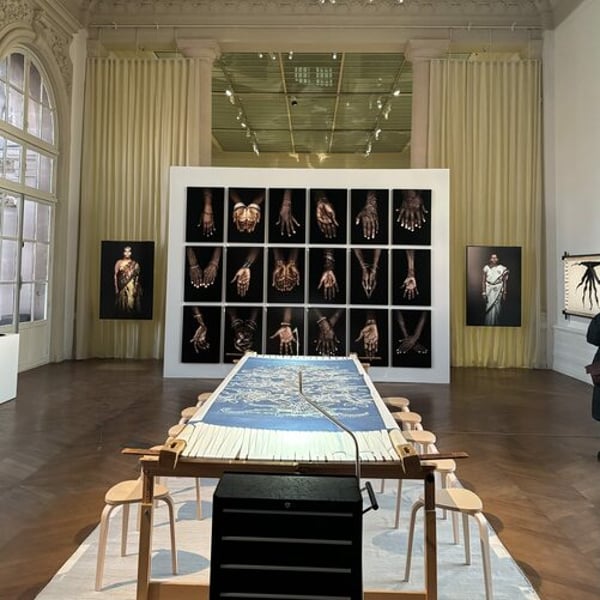
From December 5 to January 7, 2026, the Mobilier National will present the exhibition “Ce Qui Se Trame – Histoires Tissées Entre l’Inde et la France”, a project devoted to artistic and technical exchanges between France and India through textiles.
The event brings together several major players: 19M, the Métiers d’art cluster founded by Maison Chanel, the French Embassy in India via the Villa Swagatam programme, and designer Christian Louboutin, who oversees the artistic direction and scenography, drawing on his experience of India.
DR
Guest curator Mayank Mansingh Kaul is responsible for the conceptual narrative, the organisation of the sections and the selection of works. To coincide with the exhibition, Lesage Intérieurs, a resident house at 19M specialising in embroidery and textile decoration, is organising a participatory workshop from December 4 to 7 focused on creating an embroidered Indigo Tree of Life. Conceived as a collective project, it will enable visitors to discover embroidery techniques while contributing to a shared artwork inspired by historical exchanges between India and Europe.
The exhibition is organised around seven successive spaces: L’Antichambre, Toiles blanches, Modes indiennes, Le fil d’or, Le chic à l’indienne, Sculpter les corps and, finally, Un langage universel.
The exhibition opens with L’Antichambre, a space showcasing artistic and commercial exchanges between India and France. It is a reproduction of an 18th-century French apartment, entirely lined with an Indian textile. Louboutin will use this setting to immerse visitors in history through a traditional 18th-century motif, created especially for the exhibition by artisans from the House of Kandadu. They worked entirely by hand, using age-old techniques such as block printing and natural dyes. The exterior of this room takes its inspiration from Indian nomadic tents. It is covered in Toile de Jouy, a French fabric that originally grew out of Indian printing techniques.
The next section, Toiles Blanches, returns to the essentials: fibres and threads. Shown without colour, they evoke the different meanings of white in Indian and French cultures. On display are hand-spun and hand-woven Indian cotton muslins, which transformed women’s fashion in France in the 17th and 18th centuries, as well as French embroidery, embellishments and handmade lace.
With Modes Indiennes, the exhibition looks back at the arrival in France, from the 17th century onward, of hand-painted and hand-printed cotton fabrics. These fabrics, first called palampores or chintz, later inspired the creation of “indiennes”, a type of textile that became very popular in France. Their floral and botanical motifs blend the styles of both cultures. The works on display show how these fabrics were used in clothing and interiors of the time, and also explain the origin of the French paisley motif, inspired by Kashmir shawls.
In Le Fil d’Or, visitors discover brocades, precious fabrics hand-woven from silk and metallic threads. Lyon was long the principal French centre for these textiles, and the invention of the Jacquard loom in the 19th century transformed their production worldwide. The exhibition shows the influence of this innovation on Indian textiles, particularly in Varanasi, through works that combine tradition and contemporary creation.
Le Chic à l’Indienne begins at the foot of the gallery staircase, with a colourful textile installation inspired by the sari. This traditional garment, over two thousand years old, is reinterpreted here by the Indian brand Raw Mango, known for modernising the sari while working with numerous artisans. This section explores the interplay between French haute couture and Indian fashion, and shows how textiles can shape the body. The large panels in the room come from The Flowers We Grew project, created by the Chanakya School of Craft with artist Rithika Merchant.
In Sculpter Les Corps, the exhibition focuses on artists who use textile craftsmanship within a contemporary practice. The works show how textiles can become sculptural and address social and political issues. The techniques used are varied, and artists from India and France explore the body, texture, volume and drape. Works by Mrinalini Mukherjee, Simone Pheulpin, Sheila Hicks, the Ateliers Chanakya collective and Jeanne Vicerial are on display.
DR
Finally, the exhibition closes with Un Langage Universel, a salon inspired by India and entirely covered in denim. This fabric, developed in Nîmes in the 19th century using indigo from India, is now produced predominantly there. This space invites visitors to reflect on the enduring links between India and France. It includes the After Paris tapestry by Indian artist Viswanadhan, woven at the Gobelins, and a reminder of Le Corbusier’s work in India, notably in Chandigarh.
This article is an automatic translation. Click here to read the original article.
This is encouraging news for the European outdoor industry. On November 25, Australian biotechnology company Samsara Eco and the European Outdoor Group (EOG) launched the Nylon Materials Collective, a collaboration designed to make high-performance recycled nylon more accessible to outdoor brands. The initiative forms part of a broader drive to accelerate the sector’s transition to a circular textile economy.
Samsara Eco and EOG launch a collective to pool orders for recycled nylon – Samsara Eco
The Nylon Materials Collective is open to all EOG members and will be officially launched ahead of ISPO Munich 2025, where Samsara Eco will showcase its recycled nylon samples. But why did the EOG choose Samsara Eco? Founded in 2021, the Australian company specialises in recycling nylon 6,6 and polyester using enzymatic technologies- a strategy that has set it apart from direct competitors such as Matter, Recycling Technologies and ReCircle.
A collective of small and medium-sized enterprises
The high-performance recycled nylon produced by Samsara Eco is indistinguishable from virgin nylon, a material highly prized by outdoor brands. Despite their environmental ambitions, small and medium-sized players in the outdoor sector still find recycled nylon hard to access. That is why the EOG has joined forces with Samsara Eco: the Nylon Materials Collective is a collaborative demand-aggregation system that enables brands to participate collectively and access recycled materials.
The EOG represents more than 150 European brands – Gore-Tex
And to keep the collective running smoothly, participating companies must share “similar performance requirements, supply chain partners, and material specifications,” in the words of both parties.
Preparing for future regulations
“We want to do everything we can to help more brands access our materials so we can all reap the benefits of the circular economy,” said Sarah Cook, Samsara Eco’s commercial director. “The Nylon Materials Collective will make it easier for outdoor brands of all sizes to access and integrate recycled materials that are identical to the virgin material into future product ranges, whether they have more modest material needs or typically purchase at the fabric level,” she added.
Samsara Eco’s recycled nylon is identical to virgin nylon – Maloja
This partnership also helps brands strengthen their position ahead of forthcoming European regulations on the circular economy, concerning “extended producer responsibility and minimum recycled content obligations.”
Focus on circular materials
Katy Stevens, CSR and Sustainability Manager at the EOG, says: “The Nylon Materials Collective represents an opportunity for our members to work together with innovators like Samsara Eco to facilitate access to recycled nylon and accelerate the industry’s transition to circular materials.”
Samsara Eco uses enzymatic technologies to recycle nylon and polyester – Samsara Eco
For the European Outdoor Group, which represents around 150 brands, retailers, associations, and organisations along the value chain, this partnership is a concrete step to support the sector in its activities, so that it can “give more than it receives”.
This article is an automatic translation. Click here to read the original article.
Gant has a new CEO as of this month. The Swedish-but-with-American-roots brand has named Fredrik Malm as its chief executive, effective December 1.
Gant CEO Fredrik Malm
It’s an internal appointment with Malm having joined Gant in 2024 as EVP Commercial, Brand & Product. He succeeds Patrik Söderström, who’d led the company for six years.
Before joining the firm, Malm was CEO of SNS, and had been president Europe & International at Coach, as well as president of sales EMEA at Ralph Lauren, and retail director at ECCO.
Gant has been owned by privately-owned Swiss business MF Brands Group (which also owns Lacoste, Tecnifibre and Aigle) since 2008. And MF’s CEO Thierry Guibert said of Gant’s new leader: “Fredrik has brought valuable and extensive leadership experience from global premium fashion and lifestyle brands.
“I have full confidence in his ability to support Gant in its next phase of development, which will notably involve the continued elevation of the collections and an accelerated retailisation across both physical and digital channels.
“I would also like to deeply thank Patrik Söderström for his commitment alongside us over the past 10 years. He has played a pivotal role in transforming and elevating the brand while delivering strong financial performances over the years.”
Gant has been expanding this year, and in late May it reopened its Regent Street, London flagship. It said the refurbishment of the 6,300 sq m space “represents a key milestone in the brand’s global retail investments in the UK and worldwide”. Söderström said at the time that the reopening “kicks off a global initiative to elevate our retail experience”.
The company has also been focusing on its licenses and in June announced the early renewal of its exclusive licensing deal for the design, manufacture, and global distribution of its eyewear with Marcolin.
Lawyers for Chinese online platform Shein return to a Paris court on Friday for a hearing on the French government’s request to suspend the firm’s website for three months, after childlike sex dolls and banned weapons were discovered on its marketplace.
Customers queue to enter the first physical space of Chinese online fast-fashion retailer Shein on the day of its opening inside the Le BHV Marais department store, the Bazar de l’Hotel de Ville, in Paris, France, November 5, 2025 – REUTERS/Sarah Meyssonnier/File Photo
Shein disabled its marketplace- where third-party sellers list their products- in France on November 5, after authorities found the illegal items for sale, but its main site selling Shein-branded clothing remains accessible. The French state wants the website suspended for a minimum of three months in the country, which it argues is needed for Shein to prove that its contents comply with the law.
It has invoked Article 6.3 of France’s digital economy law, which gives a judge powers to prescribe measures with the aim of preventing or halting harm caused by online content. France has also summoned major internet service providers Bouygues Telecom, Free, Orange, and SFR to the hearing, requesting they block Shein’s website. The court will have to decide whether a suspension is warranted, and whether it is in line with European Union law.
In a statement last week, the Paris prosecutor’s office said a three-month suspension could be deemed “disproportionate” under the case law of the European Court of Human Rights if Shein could prove it has stopped all sales of illegal goods. However, the prosecutor said it “fully backed” the government’s demand that Shein provide evidence of measures taken to end those sales.
France’s move comes amid broader scrutiny of Chinese giants such as Shein and Temu under the EU’s Digital Services Act, reflecting concerns about consumer safety, illegal product sales and unfair competition. Meanwhile in the US, Texas Attorney General Ken Paxton said on Monday he is investigating Shein to determine whether the fast fashion retailer violated state law related to unethical labour practices and the sale of unsafe consumer products.