Connect with us

Fashion

Beauty brands target TikTok-generation children

Published

on


Published


December 1, 2025

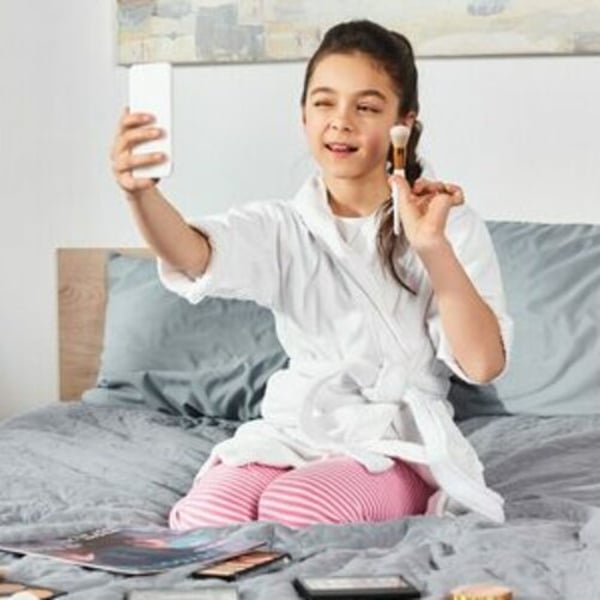
Moisturising masks with panda, unicorn or Barbie designs on the packaging: cosmetics brands are targeting a generation of children raised on social‑media beauty routines, exposing them to unnecessary and potentially harmful products, dermatologists warn.

Shutterstock

Like many celebrities, Canadian actress Shay Mitchell announced in early November that she was launching her cosmetics brand, Rini. Unusually, the range is aimed at children from the age of three.

On its website, the brand offers moisturising, after‑sun or everyday masks featuring a unicorn, a panda or a puppy, at around €5 each.

She is far from alone. Many brands are eyeing what they see as a lucrative market. Founded in 2018, Evereden, another fast‑growing U.S. brand with sales of over $100 million, sells “mists”, toners and moisturisers aimed at pre‑teens.

But “children don’t need cosmetics, apart from hygiene products, of course — toothpaste and shower gel — and sun protection products, when there’s exposure,” Laurence Coiffard, a professor of pharmacy at the Faculty of Nantes specialising in cosmetology, told AFP.

Endocrine disruptors

If social media are any guide, young people in Generation Alpha are trying out skincare and beauty routines at an increasingly early age. Dubbed the “Sephora Kids”, some imitate their favourite influencers from as young as seven, showing off their purchases on YouTube or TikTok.

The Chinese social network says it has attracted a growing number of brands since the launch of TikTok Shop. In France, the number of brands present is said to have risen from 5,000 to 16,500 in the space of six months. And beauty is the leading sector represented, according to its head for France and Southern Europe, Arnaud Cabanis.

But what may look like a game to children is not without risk, professionals insist. Scientific studies have shown that using adult cosmetics packed with chemicals exposes them to endocrine disruptors and phytoestrogens, which can interfere with hormonal development and increase the risk of skin allergies, explains Laurence Coiffard.

To study this phenomenon, Molly Hales and Sarah Rigali, American researchers at Northwestern University in Chicago, spent several months posing as 13‑year‑old girls on TikTok. They then analysed 100 beauty videos posted by 82 profiles of minors — and published their findings in June in the US journal Pediatrics.

In one of the videos, a child developed a rash and burns after applying 14 different products to her face. Another recounted waking at 4.30am to do her beauty “routine” before going to school. “I was shocked by the scale of what I was seeing in these videos, particularly the sheer number of products these girls were using,” Molly Hales told AFP.

‘Distorted self-image’

On average, the videos featured six products, often anti‑ageing creams intended for adults, at a typical cost of €145. In 25 videos analysed in detail, the products contained on average 11 — and up to 21 — substances potentially irritating to children’s skin.

Among the most popular brands are Glow, Drunk Elephant and The Ordinary, which present themselves as healthy, natural alternatives to their chemical‑laden competitors.

“Children are naturally curious,” says Rini co‑founder Shay Mitchell on Instagram, “so we might as well offer gentle, safe products that parents can trust.”

Beyond their potentially harmful effects, these products “perpetuate a certain beauty norm” by normalising the use of a “very expensive and time‑consuming” array of beauty treatments, notes Molly Hales.

On a psychological level, “the risk is to give the child a distorted, even eroticised, self‑image,” warned Pierre Vabres, a member of the French Dermatology Society, at a press conference in Paris in November. “Just as a child is not a miniature adult,” he insisted, “a cosmetic is not a toy.”

(with AFP)

This article is an automatic translation.
Click here to read the original article.

Copyright © 2025 FashionNetwork.com All rights reserved.


Source link

Continue Reading

Fashion

Another original Hermes Birkin bag sells for $2.86 million

Published

on


By

AFP

Published


December 5, 2025

An Hermes handbag that once belonged to Jane Birkin was sold for $2.86 million (2.45 million euros) at auction in Abu Dhabi on Friday, just months after the record-breaking sale of her first bag from the French brand, Sotheby’s said.

Jane Birkin with one of her signature Hermes bags – Sotheby’s

Hermes first created the design for the British singer and actress in 1984 and it has gone on to become a modern and highly prized classic, sought by fashionistas the world over. The first prototype was sold for 8.58 million euros ($10 million) at a Sotheby’s auction in Paris in July, smashing previous price records for a handbag.

The one sold on Friday was a ‘Birkin Voyageur,’ which was gifted to the former wife of French singing legend Serge Gainsbourg in 2003. The final sale price was around six times times higher than the estimated price range of $230,000-$430,000 given before the sale.

“Jane Birkin’s handbag legacy continues to captivate collectors,” Sotheby’s said in a statement sent to AFP, adding that bidding took place over 11 minutes between six collectors. The new owner was a phone buyer and has not been identified.

The handbag was one of four owned by the late celebrity, who used to sell them to raise money for charitable causes. It has a handwritten inscription in French inside from Birkin that reads: “My Birkin bag, my globetrotting companion.”

A third Hermes bag owned by Birkin is set to go under the hammer on December 15 at the Hotel Drouot auction house in Paris. It was entrusted by the late star to her friend and biographer Gabrielle Crawford, who is selling it to help fund the future Jane Birkin Foundation, Drouot said in a statement.

Produced in very limited numbers, the modern Birkin bag manufactured by Hermes has maintained an aura of exclusivity and is beloved by celebrities such as the Kardashians, Jennifer Lopez, and Victoria Beckham. The most expensive fashion item ever sold at auction was a pair of ruby red slippers worn by actor Judy Garland from The Wizard of Oz in 1939, which sold for $32.5 million in 2024 in Dallas, Texas, according to Sotheby’s.

Copyright © 2025 AFP. All rights reserved. All information displayed in this section (dispatches, photographs, logos) are protected by intellectual property rights owned by Agence France-Presse. As a consequence you may not copy, reproduce, modify, transmit, publish, display or in any way commercially exploit any of the contents of this section without the prior written consent of Agence France-Presses.


Source link

Continue Reading

Fashion

Mention Me launches AI tool to help brands reach consumers through generative AI search 

Published

on


Published


December 5, 2025

Artificial intelligence (AI) continues its march to transform businesses’/consumers’ lives with customer advocacy platform Mention Me launching ‘AI Discovery IQ’, a free-to-use tool that “helps brands reach target consumers in the new age of generative AI search”.   

Kirill KUDRYAVTSEV / AFP/Archives

It claims to allow brands to “instantly audit how discoverable they are within popular AI systems” such as ChatGPT, Claude, Gemini and Perplexity.  

According to Mention Me, 62% of UK consumers now turn to generative AI tools for product recommendations, brand discovery and comparisons, “bypassing traditional search engines entirely [so] businesses are under pressure to respond to this behaviour change,” said  the platform’s CEO Wojtek Kokoszka whose platform works with firms including Charlotte Tilbury, Huel and Puma, “helping marketing teams to boost consumer awareness and sales”.   

With AI, it says the modern customer journey, powered by natural language prompts instead of outdated keyword strings, means consumers are 4.4 times more likely to convert if they find a brand through a large language model (LLM). 

“The rise of ‘agent-mode’ assistants and AI-driven voice search has pushed brands into a new world of digital visibility. Despite this, most brands have little to no insight into how they appear in AI-generated answers”, said Kokoszka.  

AI Discoverability IQ claims to give brands an overall LLM discoverability score, specific details on areas such as technical website elements, content and structured data, and actionable recommendations to improve their AI discoverability.

Its tool generates “measurable, trackable outputs” like AI Visibility Score, brands’ prompt-based results, and a side-by-side comparisons with their competitive set. This means brands “can react quickly to improve their discoverability scores” with Mention Me’s wider suite of products and unique first-party data.  

It’s also “innovating and evolving” its platform to include more capabilities, such as the ability to benchmark against competitors, to drive further improvements for marketing leaders in the age of AI. 

Mention Me CMO Neha Mantri said: “AI Discoverability is not yet a named practice within most marketing teams; the same way SEO wasn’t in the early 2000s. But when up to 31% of consumers say they’re more likely to trust responses from generative AI than traditional search results, this needs to change. Mention Me is naming the problem and providing a solution at just the right time.”  

Copyright © 2025 FashionNetwork.com All rights reserved.


Source link

Continue Reading

Fashion

Crisis pop-up charity store returns to Savile Row with big celeb, brands support

Published

on


Published


December 5, 2025

​A host of celebrities and high-end brands have donating goods to ensure Savile Row’s latest annual ‘Pop-Up Crisis’ store will continue to support the Crisis charity event that has so far raised over £650,000 since 2018.

Image: Crisis charity

Across 8-13 December, the pop-up store at 18-19 Savile Row in London’s Mayfair will sell a curated selection of designer clothing, past stock and samples from luxury brands.

Celebs donating goods include Rosie Huntington-Whiteley, Naomie Harris, David Gandy, Jarvis Cocker, Louis Partridge, Jamie Redknapp and Emma Corrin, among others, for a week-long event and raffle with all proceeds going to help end homelessness across Britain.

Hosted by landlord The Pollen Estate, the temporary shop is also selling designer goods donated by Savile Row tailors including Mr Porter, Wales Bonner, Crockett & Jones and many other luxury brands from Barbour, Tod’s to Manolo Blahnik and Watches of Switzerland Group.

This year, celebrity model and fashion entrepreneur David Gandy will also be curating an exclusive online edit on shopfromcrisis.com, including donations from his own wardrobe as well as items from friends including Redknapp’s brand Sandbanks, Hackett and Aspinal of London.

Gandy said: “Having supported Crisis for a number of years, I’m delighted to have had the opportunity to curate my own online edit this year with the help of some of my close friends. It means a lot to know that donations from my own wardrobe are going towards such an important cause. Whether you’re looking for the perfect Christmas gift or to treat yourself, your purchase can help make a real difference to people facing homelessness this Christmas.” 

Liz Choonara, executive director of Commerce and Enterprise at Crisis, added: “Pop-Up Crisis is such an iconic event in the Crisis calendar and one that we look forward to every year. We’re thrilled to be partnering with the team once again for another week celebrating the iconic craftsmanship and style of Savile Row – with all proceeds going towards our crucial work to end homelessness.” 

Copyright © 2025 FashionNetwork.com All rights reserved.


Source link

Continue Reading

Trending

Copyright © Miami Select.