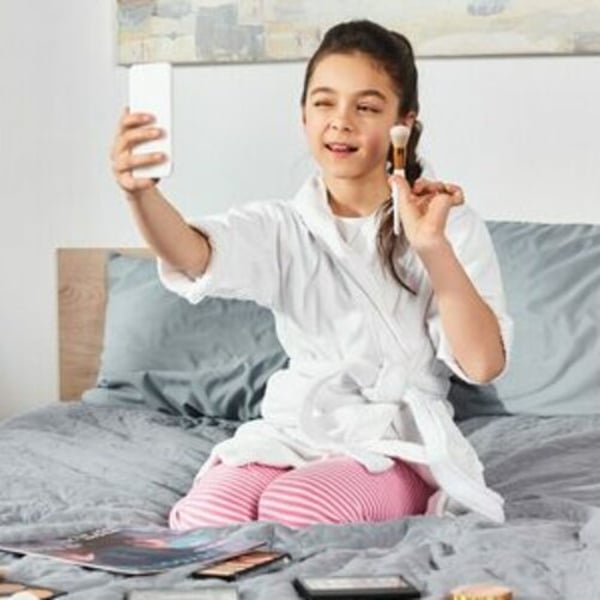
Moisturising masks with panda, unicorn or Barbie designs on the packaging: cosmetics brands are targeting a generation of children raised on social‑media beauty routines, exposing them to unnecessary and potentially harmful products, dermatologists warn.
Shutterstock
Like many celebrities, Canadian actress Shay Mitchell announced in early November that she was launching her cosmetics brand, Rini. Unusually, the range is aimed at children from the age of three.
On its website, the brand offers moisturising, after‑sun or everyday masks featuring a unicorn, a panda or a puppy, at around €5 each.
She is far from alone. Many brands are eyeing what they see as a lucrative market. Founded in 2018, Evereden, another fast‑growing U.S. brand with sales of over $100 million, sells “mists”, toners and moisturisers aimed at pre‑teens.
But “children don’t need cosmetics, apart from hygiene products, of course — toothpaste and shower gel — and sun protection products, when there’s exposure,” Laurence Coiffard, a professor of pharmacy at the Faculty of Nantes specialising in cosmetology, told AFP.
Endocrine disruptors
If social media are any guide, young people in Generation Alpha are trying out skincare and beauty routines at an increasingly early age. Dubbed the “Sephora Kids”, some imitate their favourite influencers from as young as seven, showing off their purchases on YouTube or TikTok.
The Chinese social network says it has attracted a growing number of brands since the launch of TikTok Shop. In France, the number of brands present is said to have risen from 5,000 to 16,500 in the space of six months. And beauty is the leading sector represented, according to its head for France and Southern Europe, Arnaud Cabanis.
But what may look like a game to children is not without risk, professionals insist. Scientific studies have shown that using adult cosmetics packed with chemicals exposes them to endocrine disruptors and phytoestrogens, which can interfere with hormonal development and increase the risk of skin allergies, explains Laurence Coiffard.
To study this phenomenon, Molly Hales and Sarah Rigali, American researchers at Northwestern University in Chicago, spent several months posing as 13‑year‑old girls on TikTok. They then analysed 100 beauty videos posted by 82 profiles of minors — and published their findings in June in the US journal Pediatrics.
In one of the videos, a child developed a rash and burns after applying 14 different products to her face. Another recounted waking at 4.30am to do her beauty “routine” before going to school. “I was shocked by the scale of what I was seeing in these videos, particularly the sheer number of products these girls were using,” Molly Hales told AFP.
‘Distorted self-image’
On average, the videos featured six products, often anti‑ageing creams intended for adults, at a typical cost of €145. In 25 videos analysed in detail, the products contained on average 11 — and up to 21 — substances potentially irritating to children’s skin.
Among the most popular brands are Glow, Drunk Elephant and The Ordinary, which present themselves as healthy, natural alternatives to their chemical‑laden competitors.
“Children are naturally curious,” says Rini co‑founder Shay Mitchell on Instagram, “so we might as well offer gentle, safe products that parents can trust.”
Beyond their potentially harmful effects, these products “perpetuate a certain beauty norm” by normalising the use of a “very expensive and time‑consuming” array of beauty treatments, notes Molly Hales.
On a psychological level, “the risk is to give the child a distorted, even eroticised, self‑image,” warned Pierre Vabres, a member of the French Dermatology Society, at a press conference in Paris in November. “Just as a child is not a miniature adult,” he insisted, “a cosmetic is not a toy.”
(with AFP)
This article is an automatic translation. Click here to read the original article.