Connect with us

Fashion

Beauty brands target TikTok-generation children

Published

on


Published


December 1, 2025

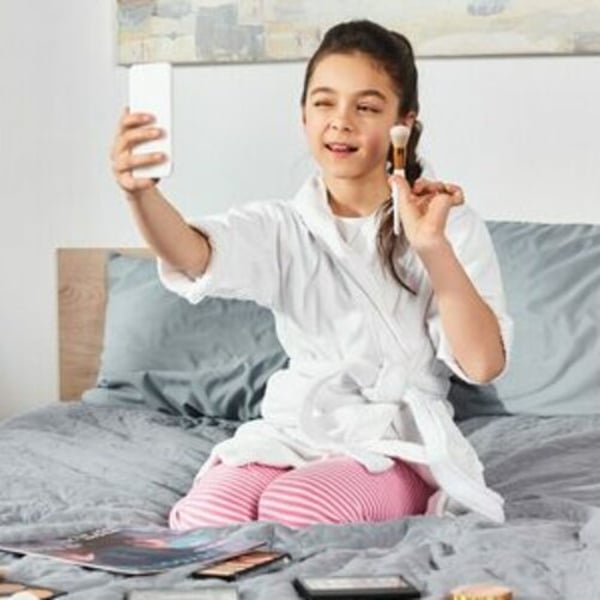
Moisturising masks with panda, unicorn or Barbie designs on the packaging: cosmetics brands are targeting a generation of children raised on social‑media beauty routines, exposing them to unnecessary and potentially harmful products, dermatologists warn.

Shutterstock

Like many celebrities, Canadian actress Shay Mitchell announced in early November that she was launching her cosmetics brand, Rini. Unusually, the range is aimed at children from the age of three.

On its website, the brand offers moisturising, after‑sun or everyday masks featuring a unicorn, a panda or a puppy, at around €5 each.

She is far from alone. Many brands are eyeing what they see as a lucrative market. Founded in 2018, Evereden, another fast‑growing U.S. brand with sales of over $100 million, sells “mists”, toners and moisturisers aimed at pre‑teens.

But “children don’t need cosmetics, apart from hygiene products, of course — toothpaste and shower gel — and sun protection products, when there’s exposure,” Laurence Coiffard, a professor of pharmacy at the Faculty of Nantes specialising in cosmetology, told AFP.

Endocrine disruptors

If social media are any guide, young people in Generation Alpha are trying out skincare and beauty routines at an increasingly early age. Dubbed the “Sephora Kids”, some imitate their favourite influencers from as young as seven, showing off their purchases on YouTube or TikTok.

The Chinese social network says it has attracted a growing number of brands since the launch of TikTok Shop. In France, the number of brands present is said to have risen from 5,000 to 16,500 in the space of six months. And beauty is the leading sector represented, according to its head for France and Southern Europe, Arnaud Cabanis.

But what may look like a game to children is not without risk, professionals insist. Scientific studies have shown that using adult cosmetics packed with chemicals exposes them to endocrine disruptors and phytoestrogens, which can interfere with hormonal development and increase the risk of skin allergies, explains Laurence Coiffard.

To study this phenomenon, Molly Hales and Sarah Rigali, American researchers at Northwestern University in Chicago, spent several months posing as 13‑year‑old girls on TikTok. They then analysed 100 beauty videos posted by 82 profiles of minors — and published their findings in June in the US journal Pediatrics.

In one of the videos, a child developed a rash and burns after applying 14 different products to her face. Another recounted waking at 4.30am to do her beauty “routine” before going to school. “I was shocked by the scale of what I was seeing in these videos, particularly the sheer number of products these girls were using,” Molly Hales told AFP.

‘Distorted self-image’

On average, the videos featured six products, often anti‑ageing creams intended for adults, at a typical cost of €145. In 25 videos analysed in detail, the products contained on average 11 — and up to 21 — substances potentially irritating to children’s skin.

Among the most popular brands are Glow, Drunk Elephant and The Ordinary, which present themselves as healthy, natural alternatives to their chemical‑laden competitors.

“Children are naturally curious,” says Rini co‑founder Shay Mitchell on Instagram, “so we might as well offer gentle, safe products that parents can trust.”

Beyond their potentially harmful effects, these products “perpetuate a certain beauty norm” by normalising the use of a “very expensive and time‑consuming” array of beauty treatments, notes Molly Hales.

On a psychological level, “the risk is to give the child a distorted, even eroticised, self‑image,” warned Pierre Vabres, a member of the French Dermatology Society, at a press conference in Paris in November. “Just as a child is not a miniature adult,” he insisted, “a cosmetic is not a toy.”

(with AFP)

This article is an automatic translation.
Click here to read the original article.

Copyright © 2025 FashionNetwork.com All rights reserved.


Source link

Continue Reading

Fashion

Kappa goes local for football campaign that traces a ‘lifelong love of the game’

Published

on


Published


December 5, 2025

BasicNet’s Kappa turns back the sporting clock for its new AW25 collection, which celebrates “local heroes in football” with a community-focused campaign “honouring the places and people that inspire a lifelong love of the game”.

Image: Kappa

The campaign shines a light on local talent Tyrone Marsh in his hometown of Bedford, revisiting the streets, pitches and community spots “that shaped his football journey”.

Local photographer Simon Gill, who had pictured Marsh during many home and away games, not only “captures the Bedford Town player in the spaces that helped define his skill”, but also highlights the brand’s “rich football heritage with contemporary streetwear energy, creating visuals that pay tribute to community, culture and grassroots football”.

The journey includes Hartwell Drive, the early days of his after-school kickabouts, Hillgrounds Road, synonymous with Bedford football culture, and then onto Faraday Square, locally identified by the concrete pitches and community spirit.

To reflect that journey, the AW25 collection “offers a sense of nostalgia” with Kappa’s long-standing history in fashion and sports “seen through the Omini logo placements and 222 Banda strip”.

The campaign sees Marsh wearing Kappa styles including the Lyman and Uriah Track Tops paired with the Ulrich Track Pants in classic colourways including navy and light blue.

The wider collection includes track tops, track pants, shorts, polos, sweatshirts and T-shirts, available at select retailers across the UK including 80s Casual Classics, Terraces Menswear and RD1 Clothing.

Copyright © 2025 FashionNetwork.com All rights reserved.


Source link

Continue Reading

Fashion

UK footfall suffers the November blues ahead of Christmas rush

Published

on


Published


December 5, 2025

UK footfall down in November? Blame the Budget and bad weather. Those two important factors damaged shoppers’ desire to venture out, resulting in an albeit slender 0.8% year-on-year dip in footfall last month, with all types of destinations suffering. It was also the seventh consecutive footfall decline, noted the latest British Retail Consortium (BRC)/Sensormatic report

Image: Nigel Taylor

That meant visits to high streets were down 1.2% in November and down from a 0.6% rise in October; shopping centre footfall dipped 1.3% last month, down from a 0.9% dip in October; and retail park visits were down 0.4% in November, but were better than a 0.5% dip in October.

The BRC also noted that November’s Storm Claudia prompted many consumers to search online for Black Friday deals throughout November, leading some to not visit physical stores on Black Friday.

But there was good news, with some northern UK cities – including Manchester and Sheffield – continuing to buck the trend, “recording positive footfall for the eighth consecutive month”.

So with many shoppers holding off on store visits until this month, Helen Dickinson, chief executive of the British Retail Consortium, said: “With the Golden Quarter in full swing, retailers are continuing to invest what they can to entice customers into stores over Christmas.

“However, as we approach the New Year, given the downward trend in footfall across recent years, we need a comprehensive strategy to revitalise our high streets and shopping centres, from better transport, affordable parking, to a reformed planning system to enable faster, better development.”

Andy Sumpter, Retail Consultant EMEA for Sensormatic, added: “November may have been dominated by caution, but there are glimmers of hope. The Golden Quarter isn’t over yet, and with four of our predicted Top Five shopping days still to come, the festive season could deliver the lift retailers need. A last-minute rush may top off the year, turning caution into celebration. With the right balance of value, convenience, and experience, there’s still time to make December count.”

Copyright © 2025 FashionNetwork.com All rights reserved.


Source link

Continue Reading

Fashion

Zara owner Inditex set for best week since 2020 on luxury push

Published

on


By

Bloomberg

Published


December 5, 2025

The world’s largest fashion retailer staged a stock-market comeback this week as Inditex SA’s push to differentiate itself from fierce ultra-low-price competition shows signs of bearing fruit.

Inside a Zara store – Zara

The owner of Zara, Bershka, and Massimo Dutti has seen its shares jump 14%, putting them on track for their best week in five years. Strong third-quarter results, coupled with accelerating November sales, were seen as evidence of the company’s resilience against weaker consumer sentiment.

This week’s surge put the stock on course for an annual gain, after what had previously looked like a lacklustre 2025. Inditex- whose second-largest market is the US- had been punished for its exposure to tariffs and a weaker greenback, amid concerns about softening consumer demand and intensifying competition from Chinese fast-fashion firms.

While its 10% rise this year trails the 50% jump for UK retailer Next Plc and the 19% gain at Sweden’s Hennes & Mauritz AB, Inditex is now outperforming the broader European retail sector. Analysts have welcomed the firm’s push to steer its Zara and Massimo Dutti brands further into the premium segment as it seeks to outmuscle competitors such as Shein and Temu. “The strategy is not to chase ultra-low prices, but to deliver premium-looking products at a good-value price point,” Alphavalue analyst Jie Zhang wrote in a note.

After this week’s rally, Inditex is trading at a substantially higher valuation than peers at 26 times forward earnings- on par with luxury behemoth LVMH. The firm’s strong third-quarter earnings reinforce “the quality of the business and will make investors question whether the right peer group for this company is luxury rather than retail in our view,” said Deutsche Bank AG analyst Adam Cochrane.

Inditex’s latest trading update spurred upward earnings revisions and price target upgrades, with more bullishness among brokers likely to follow, as the current consensus 12-month forward price target doesn’t leave any room for further upside. “These growth levels should provide reassurance of the continued opportunity for outperformance, including into 2026,” said JPMorgan & Chase Co. analyst Georgina Johanan.


Source link

Continue Reading

Trending

Copyright © Miami Select.