
Business
Anthropic’s annual revenue run rate reportedly hits $65 billion
➡️ Did someone forward you this email? If you would like to receive this information directly, every morning before the markets open in New York, sign up here.
ONE BIG THING
Anthropic books $65 billion in revenues
Anthropic’s annual revenue run rate has hit $65 billion ahead of its IPO, which is expected later this year. That’s seven times the size of its sales at the end of 2025, Bloomberg reported, when its revenues were only $9 billion. If Anthropic’s IPO plans stay on track it will go public in the fall before either OpenAI or DeepSeek, which are also expected to offer stock on the public markets.
LAW & ORDER
Meta faces a potential $1.4 trillion in damages in kids’ addiction trial that opens today
Opening arguments begin today in a California federal court over whether Meta designed Facebook and Instagram in a way that deliberately kept children addicted to its products in ways that damaged their mental health. The plaintiffs in the case are 29 state attorneys general. Meta (which denies the claims) says its potential damages could mount as high as $1.4 trillion—equivalent to its entire market cap. The states say a more realistic figure for damages would be around $200 billion.
“Meta designed a dangerous product for young users, knew it to be dangerous, and then lied to children, families, and the community about how dangerous it was,” California Attorney General Rob Bonta said. “We are ready to hold Meta accountable for its role in fueling the mental health crisis of American children.”
MORE FROM FORTUNE
The global ‘freedom of the seas’ is dying in the Strait of Hormuz—and everyone, everywhere, could pay the tolls – Jordan Blum
U.S. strategic reserves are getting so low the drawdown threatens to damage the 60 underground salt caverns storing American oil – Sasha Rogelberg
California’s billionaires just poured $40 million into blocking a wealth tax that threatens to force them to pay 5% of their net worth – Marco Quiroz-Gutierrez
Alibaba’s $2 billion gaming exit signals where Beijing wants its money – Mia Osmonbekov
AWS’s Asia chief is relocating to Japan as the country scrambles to modernize its legacy IT systems – Angelica Ang
Ousted L3Harris CEO Chris Kubasik forfeits $45 million—but he’ll still walk away with $80 million in stock and options – Amanda Gerut
The ‘Jamie premium’ nears $1 trillion as J.P. Morgan flirts with historic market valuation – Mia Osmonbekov
A dropout living in a trailer, he got $1 million from Peter Thiel at 19—now he’s a billionaire who says the American Dream isn’t dead – Orianna Rosa Royle
THE MARKETS
Oil spikes and stocks sell off as traders price in Iran’s control of the Strait of Hormuz
The price of Brent crude oil was back above $90 per barrel this morning after President Trump yesterday threatened to start bombing Oman if he can’t get a deal to reopen the Strait of Hormuz.
The speaker of the Iranian parliament, Mohammad Bagher Ghalibaf, made a new set of demands for the U.S. to leave the region this morning. “Let me state clearly: Until the commitments made by the United States in the memorandum of understanding, including the lifting of the blockade, the release of frozen assets, the lifting of oil sanctions, the end of threats and military operations on all fronts, and other conditions to which America agreed in the memorandum, are implemented, the strait will not be opened,” he said, according to Al Jazeera.
Stocks sold off globally, following the U.S. market, which declined 0.52% yesterday. U.S. futures offered little hope as dawn broke in New York—they were down 0.5% ahead of the opening bell.
“With both sides still far apart, investors grew pessimistic that the Strait of Hormuz would properly reopen any time soon.” Henry Allen at Deutsche Bank advised clients this morning.
Some investors seem to be pricing in a semi-permanent victory for Iran. “From an investor perspective, none of this changes the current situation—Iran keeps the Strait of Hormuz effectively closed—but markets’ optimism bias is undermined by the near-term outlook,” Paul Donovan at UBS told clients.
- S&P 500 futures were down 0.52% this morning. The index closed down 0.52% yesterday.
- In Europe, the Stoxx 600 was down 0.55% in early trading and the U.K.’s FTSE 100 was down 0.09% before lunch.
- Asia: South Korea’s KOSPI was down 1.55%. Japan’s Nikkei 225 was down 2.54%. India’s Nifty 50 was down 0.33%. China’s CSI 300 was down 0.32%.
- Brent crude was $91 per barrel this morning.
- Bitcoin was $64K.
In the S&P 500, the future is so bright we gotta wear shades
Wall Street is picking through Q2 earnings results to find out why they were so good. Stocks are up year-to-date and volatility is low—which suggests traders have largely lost their fear of the oil shock or an AI bubble.
“The AI-capex boom is supercharging S&P 500 earnings growth,” Lisa Shallett and her team at Morgan Stanley told clients on Monday. “In the second quarter, 1.5% real GDP growth produced nearly 30% year-over-year S&P 500 earnings growth—an extraordinary 20-times multiple. These forces have been more powerful than the oil shock, higher rates, sticky inflation and monetary-policy uncertainty combined, and such resilience should have some staying power.”
At Goldman Sachs, Ronnie Walker has a chart showing that the market isn’t just being driven by tech stocks. Revenue gains were broad-based. Overall, revenues increased over 6% for all S&P 500 companies. The median company increased 4.2% and the non-tech companies by 3%:
And gains in stocks are geographically widespread too, including emerging markets and developed foreign markets like Europe, according to Ritholtz Wealth Management’s Ben Carlson.
CHART OF THE DAY
The crystal ball of interest rate hikes
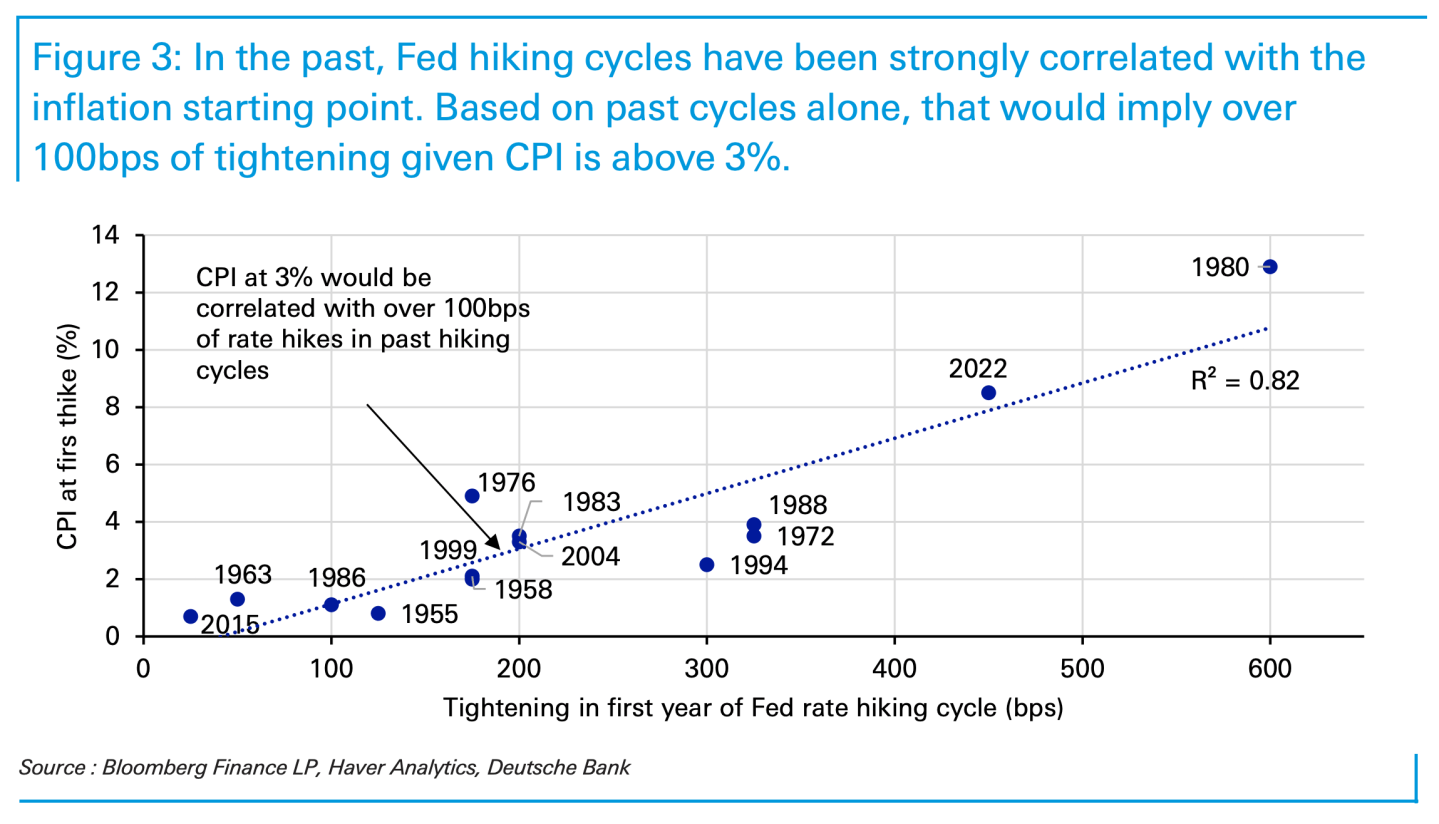
Unemployment is low, the economy is growing, and inflation remains above the Fed’s target—and that strongly implies that interest rate hikes will be coming soon. This chart from Henry Allen at Deutsche Bank plots the rate of inflation at the beginning of each historical period when the Fed began raising rates, against the number of basis points in that rate-raising cycle. Turns out there is a rough correlation between the two, which implies right now that the Fed will have to add a full percentage point to rates in order to squash inflation.
NUMBER OF THE DAY: Recession?
15%
The chance of a recession happening in the next year, according to Chief of Investment Strategy & Research Jason Pride and Vice President of Investment Strategy Michael Reynolds at Glenmede. That suggests the current economic expansion is on a solid footing, they say.
THE FRONT PAGES TODAY
AI hasn’t gone rogue. It’s worse than that – FT
The 30-year Treasury yield just hit a 19-year high. Three things could drive it even higher – CNBC
Kushner urges Netanyahu to test Hamas disarmament in Gaza – Axios
Iran-Backed Houthis Threaten Coast Along Red Sea Chokepoint – WSJ
Global Bond Slump Sends Long-Term Borrowing Costs to Highest in Decades – Bloomberg
Sick of A.I. Slop? So Are Tech Giants. – NYT
ONE MORE THING
Ray Dalio is responsible for the Chicken McNugget
Before Ray Dalio built Bridgewater Associates into one of the world’s largest hedge funds, he was advising clients on a more basic business problem: the cost of feeding chickens. That expertise helped McDonald’s to solve an early obstacle to introducing Chicken McNuggets, now one of its most popular products, Fortune’s Sarah Glodek reports.
Back in the early 1980s, amid a volatile chicken market, McDonald’s needed help pricing its nuggets and limiting the risk of menu price fluctuations. Sudden changes in chicken feed costs made it difficult to price the nuggets long-term. To address this dilemma, McDonald’s hired a young consultant to hedge the cost: Dalio.
He had previously worked at Shearson Hayden Stone advising cattle ranchers and crop producers on how to adapt to various risks in the agricultural commodities markets.
Dalio discovered that chicken feed is the most costly ingredient in the snack’s production process. Soymeal and corn costs were turbulent. Dalio’s suggestion was to combine these two ingredients into a synthetic future. “The cost of a chicken has nothing to do with the price of the chick,” Dalio explained on Bloomberg’s “Masters in Business” podcast in 2022. “It has to do with the price of the grain that you feed the chick.”