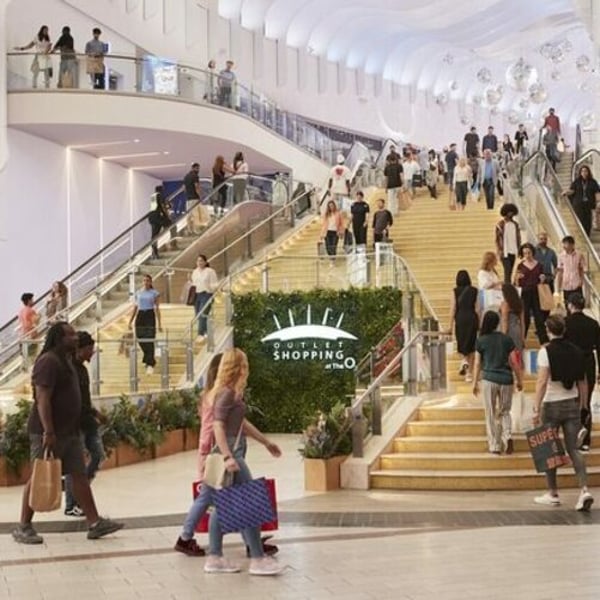
And the good news, at least for London outlet malls, keeps coming. The O2 in Greenwich is also celebrating another record-breaking year, “having achieved a consecutive year of growth for footfall and sales across retail, leisure, and F&B”.
Outlet Shopping at the O2
Following a day on from Wembley peer London Designer Outlet reporting impressive Boxing Day, Black Friday and summer-wide sales, The O2 was announcing that its own success has been underpinned by “a wave of new leasing activity and continued reinvestment from existing tenants”.
And now for the O2’s figures. It welcomed over 11 million visitors in 2025, the destination’s most successful year yet, with a 9.4% uplift on 2024 and a 23% uplift on 2023 Meanwhile, overall sales increased 12% year-on-year while Outlet Shopping sales alone achieved double-digit growth, up 15% compared to 2024.
Several retail categories also delivered double-digit growth, with beauty, accessories and footwear up 17%, 18%, and 24%, respectively, vs 2024, it noted.
Like its West London peer, Boxing Day was also a standout success for retail, experiencing its highest sales day of the year with a 7% uplift vs 2024, while Black Friday Weekend also saw sales 12% up on a year ago.
And those important new arrivals added up to 16,679 sq ft of new lettings in 2025, including beauty brand Rituals, and London outlet debuts for Kate Spade New York, Jack & Jones, New Era, Lovisa, and TM Lewin. This was in addition to nine renewals and seven sample sales, with brands including Scamp & Dude and Hackett.
Operator AEG International, also noted its leisure-based attractions saw category sales growing 18% year-on-year.
Alistair Wood, executive VP for Real Estate and Development at AEG, said: “2025 has been another landmark year for The O2. Our success comes from offering more of what people want in one place, and continually integrating and evolving our offer to stay relevant and appealing.”
He added: “Destinations that combine variety and adapt to changing consumer needs perform best, and The O2 reflects this. Our wide range of experiences drives social spending among friends and family, creating memorable moments and building strong customer loyalty that drives our continued outperformance.
“With a busy events programme and several new additions planned, we are confident this momentum will continue into 2026.”
The house of Dior has appointed Olivier Teboul to be its new president of Parfums Christian Dior North America. The nomination is effective this Friday, January 9.
Olivier Teboul – Parfums Christian Dior
Teboul moves to the United States after almost a decade in Asia, where he has been president and representative director of Dior in Japan since 2016.
“Teboul’s leadership has been a driving force behind the success of Parfums Christian Dior Japan over the last 10 years. He played a pivotal role in strengthening Parfums Christian Dior’s brand elevation to allow an undisputable brand leadership in the market,” Dior said in a release.
The Paris-based luxury marque also praised Teboull for having “successfully implemented innovative strategies, fostered strong relationships with key partners, and built a high-performing team. This move to the USA market recognizes his invaluable contributions and the outstanding work he has done in transforming our business model in Japan.”
Teboul graduated from the international business school HEC Paris in 1996 before beginning his career with international marketing positions in the luxury division at L’Oréal. He then moved on to international general management positions, including in Asia.
He joined Parfums Christian Dior in 2015 for an assignment at PCD North America in New York, before being appointed president and representative director in Japan in 2016, a position he held until December 2025.
Ambitious outdoor lifestyle brand Finisterre as appointed a new head of retail, with Joe Ward joining on 14 January from Superdry.
Finisterre
Ward brings nearly 18 years’ experience at the global fashion retailer where he was head of international retail and global retail support for two years until his departure.
Other roles there included store manager, area manager, VM operations manager before taking on those wider senior global leadership roles that took in overseeing operational strategy across the brand’s global retail estate.
Announcing the move to Finisterre on LinkedIn, Ward said: “Super excited about joining this incredible, purpose-led brand.”
Will Sheane, CEO of Finisterre, is also quoted as saying: “With his deep international retail experience and track record of building great teams, he’s perfectly placed to help us keep elevating how our community experiences Finisterre as we grow. Lots in store for 2026!”
And that teasing outlook for 2026 follows a “landmark year” for the Cornish born brand reflecting the brand’s “commitment to bringing functional and sustainable apparel to key outdoor and coastal communities across the UK”, that included Finisterre’s London flagship and openings in Brighton Holt, Norfolk, locations are in Cambridge, Cardiff and Poole and its first venture north to Leeds.
Italian luxury brand Brunello Cucinelli, known for its $3,000 cashmere sweaters, bet big on department stores, a strategy now in the spotlight as iconic US High Street retailer Saks struggles to pay back debts.
A look by Brunello Cucinelli – Brunello Cucinelli
Saks Global, created after Saks Fifth Avenue parent Hudson’s Bay Company bought rival Neiman Marcus, saw its CEO depart this month, amid reports it was preparing for bankruptcy after missing an over $100 million interest payment. That’s put a harsh spotlight on the strategy of firms like Cucinelli that have bet heavily on high-end department stores, whose future is more uncertain in a weak global luxury market where many brands have shifted towards their own outlets.
The firm, however, is doubling down. Brunello Cucinelli, founder and chairman of his namesake firm, told Reuters that the company was sticking with its strategy, which gives a strong emphasis to the wholesale channel.
He said that so far it had only faced a one-month delay in payments from Saks Global, and at the operational level had not had any issues with the retailer. “We don’t foresee any economic risks, except for extremely limited ones,” Cucinelli told Reuters by phone. “And bear in mind, they would be the first (losses) in 45 years of business. Every year, we lose 0.1% from our multi-brands, which is practically nothing.”
Cucinelli is, however, more exposed than most. Co-CEO Luca Lisandroni in December lauded the cashmere king’s ties with Saks and heralded some of its “best results ever” in its stores around the US, “demonstrating the great centrality of this client in the global luxury landscape.” The Italian firm makes some 36% of its revenues from the wholesale channel and around 64% from its own retail outlets, relying more heavily on multi-brand distribution than some key luxury peers, according to data compiled by Reuters.
Over the past decade, luxury groups have shifted toward their own retail networks, giving them more control over pricing, inventory, and margins. Retail now accounts for some 90% of sales by Prada, 81% at Moncler, 87% at Zegna, and 75% at Gucci-owner Kering.
Cucinelli, which targets some of the highest-end wealthy customers, has proved to be among the most resilient brands in the industry hit by lower demand. Sales in both the wholesale and retail channel grew in the first nine months of 2025 and the brand raised its full-year revenue growth forecast to 11–12% in December.
Morningstar analyst Svetlana Menshchikova said that a possible Saks bankruptcy or restructuring could lead to “delayed payments, limited bad-debt exposure and maybe some lost sales if the department stores would fail to replenish their stock.”
“The company has consistently highlighted the US wholesalers as key clients and an integral part of its brand image and business model,” she said. “Although we do not expect a severe impact on the company given Cucinelli’s global footprint and strong balance sheet.”
Saks Global’s financial troubles reflect wider challenges in the $417 billion global luxury market, which is battling to emerge from years of stalling sales. The US luxury retailer, which operates Saks Fifth Avenue, Neiman Marcus, and Bergdorf Goodman, missed an interest payment due at the end of December and it is preparing to file for bankruptcy, the Wall Street Journal reported last month. Founder Cucinelli credited department stores in part for that and said he had faith in Saks and the 400 multi-brand stores he said the brand worked with worldwide.
“We do 40% of our business with multi-brands and I’m absolutely delighted,” he said, calling department stores the “true custodians of the brand.”
“To make it even clearer how much we believe in multi-brand (stores), hypothetically speaking, I would buy Saks Global tomorrow if I were an interested investor.”